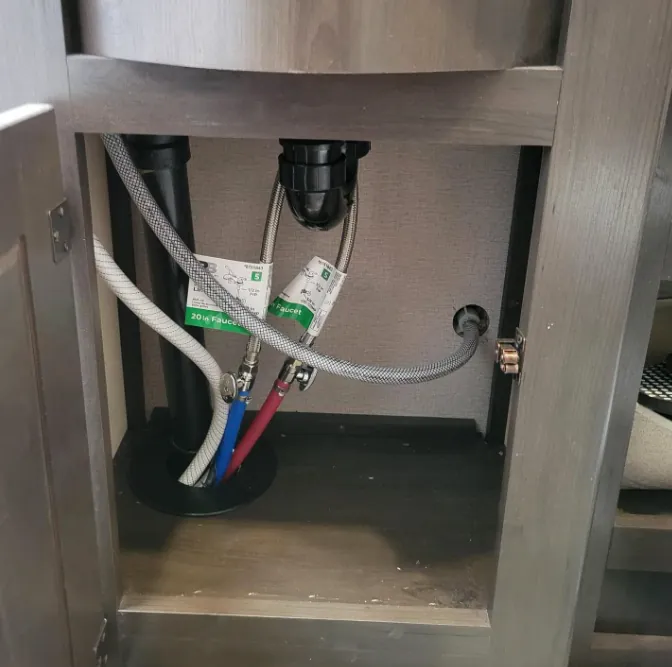
RV PEX Water Line and Fitting Repair: Crimp, Clamp, Chafe
Wet floor and no visible leak? Mobile RV PEX line and fitting repair - crimp ring, cinch clamp and push-fit joints found on site. Call 888-759-1438.
Water on an RV floor rarely appears above the joint that failed. PEX runs through chassis members and behind sealed panels, so a pinhole chafed into the tube tracks along the outside of the line and then along the floor seam before it shows. Finding it means isolating branches and watching a pressure gauge, not opening the nearest cabinet. The repair is usually a crimp ring or a cinch clamp. The labor is the access.
Why the Wet Floor Is Almost Never Above the Leak
Owners describe a damp carpet edge, a dark seam at the base of a wall, or a floor that squelches near the bathroom door. Almost none of that sits directly under the failed joint. PEX in a coach is a continuous run held to the underside of the deck and threaded through chassis members, so water leaving a pinhole follows the outside of the tube to the first low point, drops onto the subfloor, and then travels the seam where the deck meets the sidewall. Three feet between the leak and the puddle is ordinary, and six is not unusual on a long run. That is why the first move is a pressure decay test rather than demolition. Isolating branches and watching a gauge narrows the search to one circuit before a single panel comes off, which is the difference between an hour of diagnosis and a day of guessing at trim screws.
RV PEX Is Not House PEX, and the Standard Says So
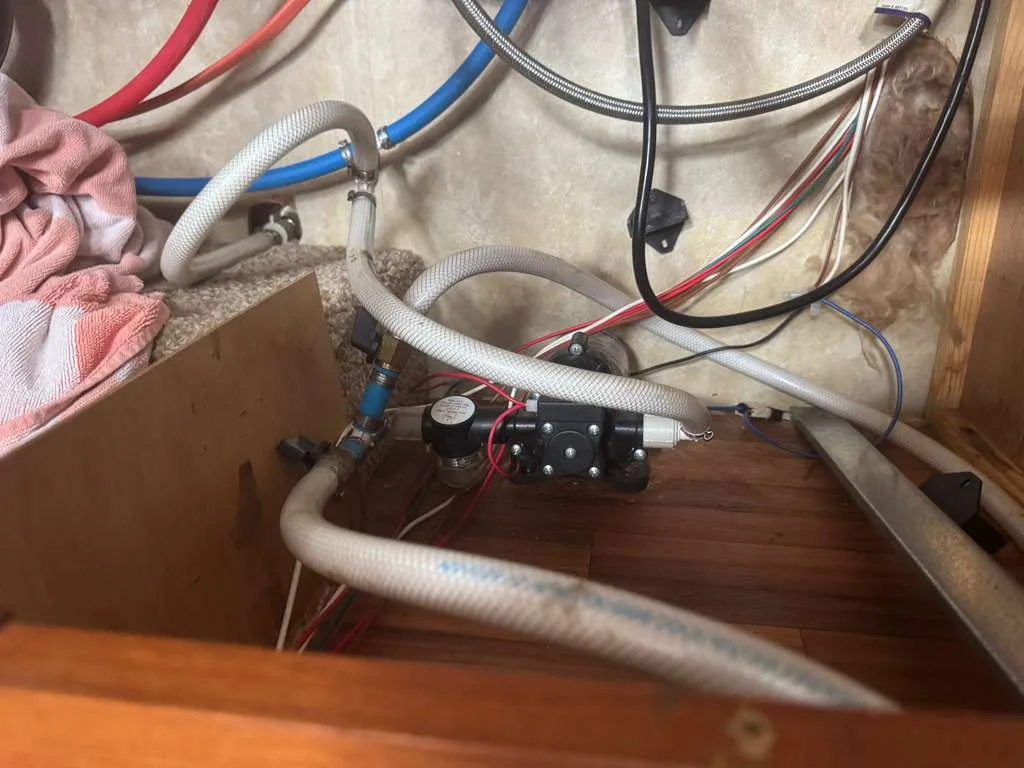
The tubing is the same material, half inch CTS PEX-b in most coaches with three eighths branches feeding single fixtures, but the installation rules are not. NFPA 1192, the construction standard recreational vehicles are built to, requires water distribution lines to be secured and supported at intervals of no more than four feet. Zurn's installation guide for that same tubing in a house calls for support every thirty two inches. A coach therefore leaves the factory with spans roughly half as well supported as a building, and then drives down the interstate at highway speed. The standard also sets a minimum bend radius wherever the tubing maker gives none: two inches for quarter inch and five sixteenths inch lines, three inches for three eighths, and four inches for half inch and three quarter inch. A line pulled tighter than that around a crossmember is already stressed before the first mile.
Crimp Ring, Cinch Clamp or Push-Fit: Where Each Belongs
Three joining methods turn up in RV fresh water systems and they are not interchangeable in practice. A copper crimp ring over a metal insert fitting falls under ASTM F1807. A stainless steel cinch clamp over the same style of barbed fitting falls under ASTM F2098, and it works by deforming around the outside of the tube to force the wall into the annular spaces between the fitting ribs. Both standards rate the finished joint identically, at 100 psi in hot and cold water up to 180 degrees Fahrenheit, so strength is not what separates them. Access is. A crimp tool needs its jaws square to the ring with clearance the whole way around it, which you rarely have behind a wet bay wall. A cinch tool closes on one ear from one side and will make a joint in a gap a crimp head cannot enter at all.
The Go and No-Go Gauge Decides Whether a Crimp Is Good
A crimp that looks right is not evidence of anything. The finished ring has a target outside diameter and the gauge is how you prove it: on half inch tubing the crimped ring must measure between 0.700 and 0.715 of an inch, on three eighths between 0.580 and 0.595, with out of round variation no greater than 0.006. The Go slot has to slide freely across the ring anywhere on its diameter, and the No-Go slot must not pass at all. Fail either and the joint is cut out and replaced rather than recrimped, because a second squeeze work hardens the ring without correcting the geometry. Crimp jaws wear open with use, so a test crimp before the first joint is what catches a tool that has drifted oversize. The gauge itself is machined to two thousandths of an inch, which is the entire point of carrying one.
Chafe, Vibration and Heat, in the Order They Do Damage
Three mechanisms account for most PEX failures in a coach and none of them is a defective fitting. The first is chafe at a pass through, where an unsleeved line rests on a cut edge in a crossmember or a wall stud and road vibration files a flat into the wall of the tube. The second is tube on tube wear. Zurn's guide is explicit that friction from one line moving against another can wear a notch, and that the notched section has to be cut out rather than wrapped. The third is heat. PEX is good for 160 psi at 73 degrees but only 100 psi at 180 and 80 psi at 200, so a line resting against a water heater flue or an engine bay shield is working at a fraction of its cold rating. Zurn requires six inches of clearance from a gas appliance vent and twelve from tankless exhaust piping, which reaches 460 degrees.
How the Leak Gets Found Without Gutting the Coach
Diagnosis is a pressure test run in the right order, and NFPA 1192 sets the numbers the coach was built to. The factory test pressurizes the piping with air at 80 to 100 psi for ten minutes with the water heater tank and the pressurized storage tank taken out of the system. Reconnect those tanks and the standard drops the ceiling to 30 to 35 psi. That distinction matters in a driveway, because air testing a whole coach at 80 psi with the heater still in circuit puts the tank at risk instead of proving the tubing. Our technicians shut the pump off, disconnect city water, isolate the heater at its bypass valves, and bring the cold side up on a regulated gauge. A circuit that holds for ten minutes is cleared. A circuit that bleeds down names itself, and only then does a panel come off.
What the Repair Costs and What Waiting Turns It Into
The fitting costs a few dollars. The bill is access, which is the honest answer to why the same failure on two identical coaches can differ by hours. A joint at an exposed manifold in the wet bay is a short job. The same joint where the line crosses behind a slide floor or above a ceiling panel means pulling trim, an underbelly section or insulation before a tool can physically reach it. Our service call covers the trip out and the first hour on site at the rate in the pricing table on this page; anything past that first hour is quoted and approved before we carry on. Left alone, a weeping joint stops being a plumbing job. Water sitting in the subfloor laminations delaminates the plywood, feeds mold behind a wall panel, and turns a two dollar fitting into a structural repair.
Sources
Every figure on this page comes from a manufacturer document or a standards body, not from another repair site. Here is where each one comes from.
- Zurn - Zurn PEX Plumbing Installation GuideCrimped copper ring diameters of 0.700 to 0.715 inch for 1/2 inch and 0.580 to 0.595 inch for 3/8 inch, the 0.006 inch out-of-round limit, the Go/No-Go gauge procedure and its 0.002 inch machining tolerance, the rule that a failed crimp is cut out rather than recrimped, the instruction not to substitute hose clamps, horizontal support every 32 inches in residential work, the warning that friction between tubes can wear a notch that must be cut out, the 6 inch clearance from a gas appliance vent and 12 inch clearance from tankless exhaust piping reaching 460 degrees F, and the 160/100/80 psi ratings at 73/180/200 degrees F.
- ASTM International - F1807-26a, Metal Insert Fittings Utilizing a Copper Crimp Ring for SDR9 PEX TubingThe standard that governs copper crimp ring joints on metal insert fittings, and its rating of 100 psi for cold and hot water distribution at temperatures up to and including 180 degrees F.
- ASTM International - F2098-26, Stainless Steel Clamps for Securing SDR9 PEX and PE-RT TubingThe standard that governs stainless cinch clamp joints, its identical 100 psi at 180 degrees F rating, and the mechanism description: the clamp deforms and locks around the outer circumference of the tubing, forcing tubing material into the annular spaces formed by the ribs on the fitting.
- NFPA - NFPA 1192, Standard on Recreational Vehicles, Chapter 7 text published with the committee public input responsesWater distribution lines secured and supported at intervals of not more than 4 ft; minimum bend radius of 2 in. for 0.25 and 0.31 in. ID, 3 in. for 0.38 in. ID and 4 in. for 0.50 and 0.75 in. ID lines where the maker gives no instruction; and the plumbing system test of 80 to 100 psi air or water for 10 minutes with the water heater and pressurized storage tanks removed, versus 30 to 35 psi with those tanks connected.
Related repairs
Other systems we service
Where we work
Service category
What this usually costs
| Item | Price | What it covers |
|---|---|---|
| Service call | $299 | Includes the trip out to your RV and the first hour on site |
| Work past the first hour | Quoted after diagnosis | We tell you what it will take before we carry on |
| Parts | Quoted per job | Special-order parts may need a deposit before we order them |
| Written estimate | No charge | You approve the estimate before any work starts |
The service call covers the trip out to your RV and the first hour on site. Anything beyond that depends on what we find, and we quote it and get your approval before carrying on.
The price ranges on this page come from our own recent jobs across Florida, not from an industry average. What you pay depends on the rig, the parts it needs and what we find on site, so we give you a written estimate before any work begins and you approve it first.
Frequently asked questions
Do you have a fitting for my hot water tank?
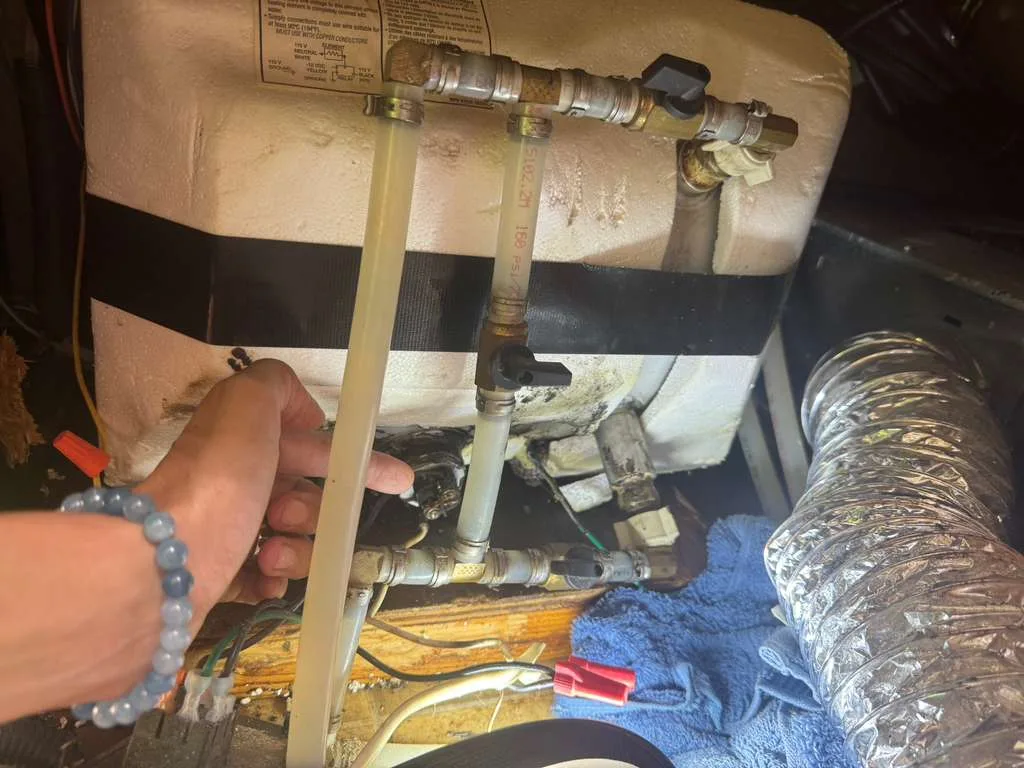
Usually, yes. The connections at an RV water heater are normally half inch PEX onto a threaded brass adapter, and those adapters, the copper crimp rings and the stainless cinch clamps are standard stock on the van. What nobody should do is guess over the phone, because the same tank turns up with a swivel adapter, a straight male adapter or a bypass kit depending on who built the coach. A photo of both connections settles it before the visit.
Can a PEX line be repaired, or does the whole run have to be replaced?
A damaged section gets cut out and a coupling goes in. There is no need to replace a run end to end. The judgment is where the cut lands. Splicing mid span behind a sealed panel puts a joint somewhere nobody can ever inspect again, so when the damage sits close to an accessible end it is often better to replace back to that point and leave the new joint where a future technician can reach it.
Why does the leak only show up when I am driving?
Because the load changes. A joint that seals at rest can open under the flex and vibration of a moving chassis, and an unsupported span swinging inside a wall pulls sideways on whatever fitting it hangs from. That is also why a shop can pressure test a parked coach, find nothing, and be telling you the truth. Recreating the fault means testing at pressure with the suspect span loaded, not static on a level site.
Is a push-fit connector good enough for a permanent repair?
Push-fit connectors are a permanent joining method rather than a patch, and they earn their place where no crimp or cinch tool will physically fit. The conditions are the same as for any joint. The tube has to be cut square and undamaged where the connector grips it, and the line either side has to be secured so the fitting is not carrying the weight or the movement of the run. A push-fit hanging on an unsupported span will weep eventually.
Can I use a hose clamp until someone can look at it?
No. A worm drive hose clamp cannot apply even pressure around a barbed fitting, and the tubing manufacturers say plainly not to substitute one for a crimp ring. It holds long enough to be trusted and then lets go, usually while the coach is parked unattended and pressurized on city water. If you have to keep using the rig, isolate that branch or shut the supply off at the inlet until it is repaired properly.
How long does a PEX line and fitting repair take?
The joint itself takes minutes. Everything around it decides the appointment. An accessible connection in the wet bay is often diagnosed and repaired in one visit. A line running above a ceiling panel or through a slide floor can need a second visit once the extent of the wet area is known. That is why the diagnostic gets priced first and the repair gets quoted after somebody has actually looked at the access.