RV Transfer Switch Repair: Generator Runs, Coach Has No Power
Generator running and nothing works inside? Mobile automatic transfer switch diagnosis and repair anywhere in Florida. Call 888-759-1438 to book a technician.
The generator starts, runs smooth, and nothing inside the coach comes on. That is almost never the generator. It is the automatic transfer switch, the sealed box that decides whether the rig runs on shore power or genset, and it sits downstream of everything the owner just tested. Transfer switch repair means proving power arrives at that box, then proving it leaves.
Generator runs, coach stays dark: what the transfer switch actually does
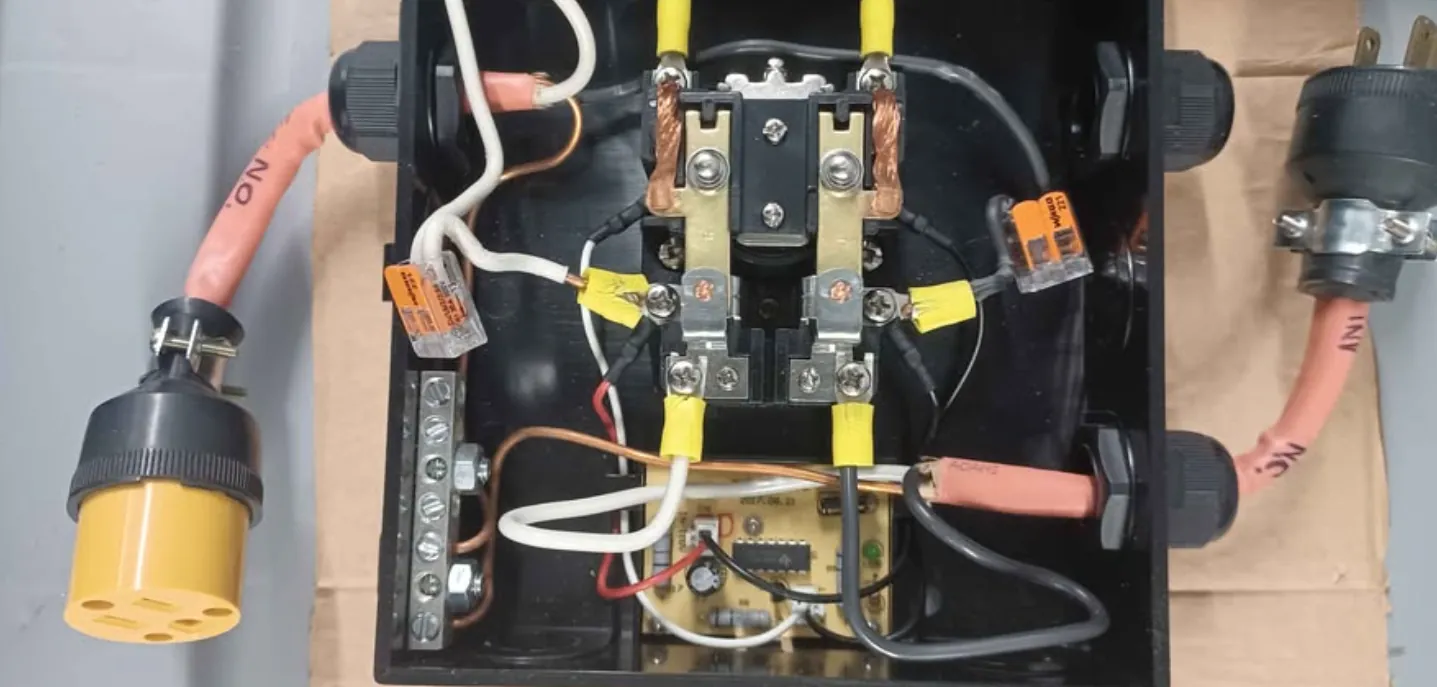
An automatic transfer switch, or ATS, is a sealed box with two AC inputs and one output. Shore power lands on one side, the onboard generator on the other, and the switch decides which source feeds the main distribution panel. Nothing in the coach is wired to both sources at once, and that exclusivity is the entire point of the design. That architecture is exactly why the classic symptom misleads people. A genset carries its own hour meter, its own indicator lights and its own load, so a unit that starts and holds speed looks healthy from the driver seat. If the ATS never closes toward the generator leg, the coach stays dark while the machine everyone is watching runs perfectly. A reading at the generator output proves the generator. A reading at the ATS output proves the fault. Those are two different measurements taken a few feet apart, and only the second one answers the question being asked.
The transfer delay is deliberate, and its length tells you which way the switch failed

Every automatic transfer switch pauses before it moves. Southwire publishes 30 seconds before a Surge Guard unit transfers to generator power, and roughly 3 seconds after the genset shuts down before shore power is restored. The long pause exists so the engine can reach stable voltage and frequency unloaded, rather than being asked to pick up two roof air conditioners the second it fires. Those two delays are different lengths, and that asymmetry is free diagnostic information. If the coach returns to shore power almost immediately but never picks up the generator, the shore side is closing and the generator side is not. If both directions hang, the timing and control circuit is the suspect rather than either set of contacts. Owners routinely read the pause itself as the failure. Timing it, instead of guessing at it, narrows the job before a cover ever comes off.
Why the terminals burn, and why a failing switch is maddeningly intermittent
Heat damage at the terminal lugs is the common way these boxes die. A lug that was never torqued properly, or that has worked loose through years of road vibration, carries full current through less contact area. Resistance makes heat, heat oxidizes the joint, oxidation raises resistance again, and the connection runs away from itself until the insulation browns and the lug scorches. Florida load worsens that process rather than starting it. A coach pulling two roof airs through an afternoon that never drops below 90F holds near continuous current through the same contacts for hours, inside a closed basement compartment with almost no airflow. Intermittency follows straight from the mechanism. A pitted contact can still conduct cold, then separate as it expands with heat, so the rig loses power an hour into a run and behaves the next morning. That pattern is what sends people back to the generator for months.
Relay interlock or contactor interlock, and why the box rating is not the contact rating

Not every transfer switch is built the same way. In the Surge Guard line, the 30 amp model 41300 uses a proprietary electrical interlock, while the 50 amp model 40100 uses mechanical interlocking contactors in a dual contactor arrangement. Both carry a UL 1008 transfer switch rating, but they fail differently and they are not substitutes for one another. The interlock is a safety device before it is a convenience. It makes closing both sources at the same instant physically impossible, which is what prevents shore power being pushed back into a running generator. Onan states the requirement plainly in its own installation manual: a vehicle with shore power provisions must have an approved device keeping genset and utility from being interconnected. Contact ratings sit above the nameplate. Southwire lists 65A FLA contactors inside its 50 amp full protection units and 95A FLA inside the 90 amp model.
How our technicians work a transfer switch fault, in order, and what it costs
Order matters, because each step eliminates a whole branch. First, confirm voltage arriving at the ATS input lugs on both legs with a meter, which separates a supply problem from a switch problem. Second, run whichever source is failing and read the output lugs as the transfer delay expires, which shows whether the contacts ever closed. Third, open the cover and look. Browned lugs, a melted terminal block or a burnt contact face is a visible answer, and an infrared thermometer on a closed joint under load finds the ones that have not discolored yet. A clamp meter on each leg confirms the switch is carrying balanced current afterward. A scorching lug left alone does not stabilize. It arcs eventually, and it takes the feed wiring with it. Do not run the generator and shore power alternately hoping the fault clears. A switch that is arcing is getting worse each time it transfers.
Sources
Every figure on this page comes from a manufacturer document or a standards body, not from another repair site. Here is where each one comes from.
- Southwire Surge Guard 50A Automatic Transfer Switch, Model 40350-RVCThe 30 second delay before transferring to generator power, generator dominance when both sources are present, the 3 second delay returning to shore power, and the low and high voltage thresholds.
- Southwire Electronics Solutions Catalog, Surge Guard automatic transfer switch rangeThat the 30A model 41300 uses a proprietary electrical interlock while the 50A model 40100 uses mechanical interlocking contactors in a dual contactor arrangement, the UL 1008 transfer switch rating, and contactor ratings of 30A, 65A and 95A FLA against 30A, 50A and 90A nameplates.
- Cummins Onan RV Generator Set HGJAA HGJAB HGJAC Installation Manual 983-0600The backfeed safety requirement: a vehicle with provisions for connecting shore power must have an approved device to keep the genset and utility from being interconnected.
Related repairs
- our Lithium Battery Conversion service
- Rv Converter Charger Repair in Florida
- how we handle victron inverter install
Other systems we service
Where we work
Service category
What this usually costs
| Item | Price | What it covers |
|---|---|---|
| Service call | $299 | Includes the trip out to your RV and the first hour on site |
| Work past the first hour | Quoted after diagnosis | We tell you what it will take before we carry on |
| Parts | Quoted per job | Special-order parts may need a deposit before we order them |
| Written estimate | No charge | You approve the estimate before any work starts |
The service call covers the trip out to your RV and the first hour on site. Anything beyond that depends on what we find, and we quote it and get your approval before carrying on.
The price ranges on this page come from our own recent jobs across Florida, not from an industry average. What you pay depends on the rig, the parts it needs and what we find on site, so we give you a written estimate before any work begins and you approve it first.
Frequently asked questions
My generator runs fine but nothing in the coach works. Is the generator bad?
Usually not. If the genset starts, holds speed and shows normal voltage at its own output terminals, it has done its job. The fault is nearly always downstream at the automatic transfer switch, which has to close a set of contacts before that power ever reaches the distribution panel. The fastest check is measuring at the transfer switch output while the generator runs and the transfer delay expires.
Why is there a pause before the generator powers the coach?
It is designed in. Southwire specifies a 30 second delay before a Surge Guard unit transfers to generator power, and about 3 seconds to return to shore power once the genset shuts down. That long pause lets the engine reach stable voltage and frequency with no load on it, instead of being hit with two air conditioners the instant it starts. A pause is normal. A pause that never ends is not.
Can an RV transfer switch fail intermittently?
Yes, and that is the most common version of the failure. A pitted or heat damaged contact conducts when cold and separates once it warms and expands, so the coach runs for an hour and then goes dark. Because everything works again the next morning, the switch gets ruled out and the generator takes the blame. Note the heat, the load and the elapsed time whenever it drops.
How much does RV transfer switch repair cost?
Our service call covers the trip out and the first hour on site at the rate in the pricing table on this page; anything past that first hour is quoted and approved before we carry on. Parts depend entirely on what the box turns out to be, since a 30 amp electrically interlocked unit and a 50 amp contactor unit are different hardware. No fixed price gets quoted on a switch nobody has opened yet.
Can I skip the transfer switch and plug the coach cord straight into the generator?
Not as a permanent arrangement. The transfer switch is what makes it impossible for shore power and generator output to be live together, and the Onan installation manual requires an approved device to keep the two from being interconnected. Backfeeding a running generator, or energizing a shore cord end that somebody else is handling, is exactly the outcome that interlock exists to prevent.
Does a burnt transfer switch get repaired or replaced?
If the damage stops at a loose lug and the wire end, cleaning the joint, fitting a fresh terminal and torquing it correctly can put the box back in service. Once a contact face is pitted or welded, or the terminal block itself has melted, the unit gets replaced. A degraded contact never recovers, and it will cook whatever is bolted to it next.