Level-Up Control Board Diagnosis and Replacement in Florida
Level-Up touchpad throwing errors or auto level refusing to run? Mobile controller, pump and voltage diagnosis across Florida. Call 888-759-1438.
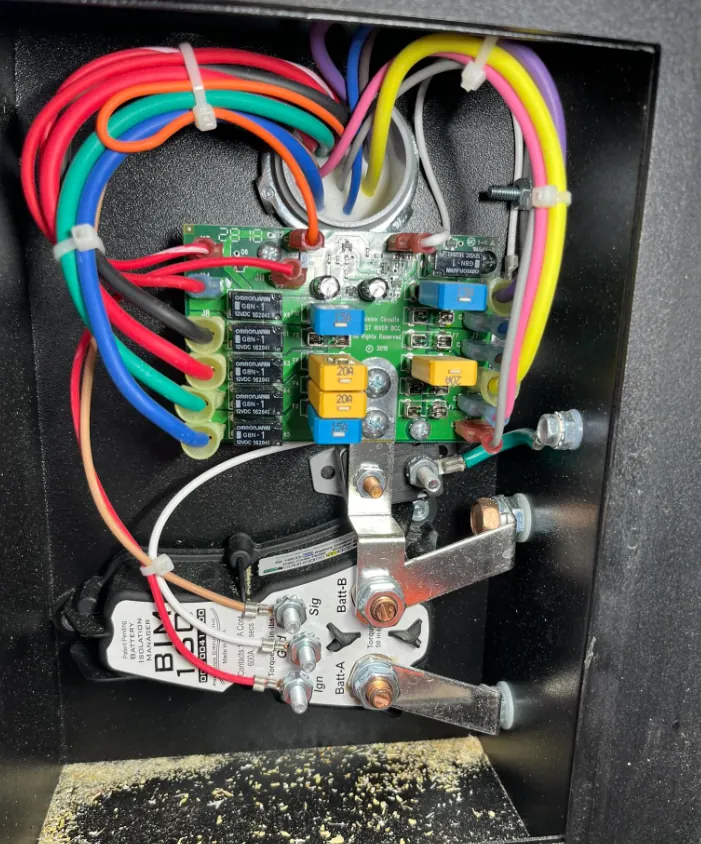
A Lippert Level-Up control board is the box that runs the pump motor, switches the solenoid valves and reads the level sensor, then reports faults through the touchpad. Most of the boards our technicians are asked to replace are not actually dead. A house battery below 12 volts or a corroded frame ground throws the same touchpad errors, so voltage at the control box gets measured before any part is ordered.
I Pressed Auto Level and It Just Beeps At Me
The two calls we take on this system are almost word for word the same every time. One is "I press auto level and it just beeps at me", and the other is "the jacks went down at the campsite and now they will not come back up". Both sound like a dead control board, and most of the time they are not. Four things have to agree before a single jack moves on a Lippert Level-Up coach. The touchpad has to send the command, the control box has to accept it, the pump motor solenoid has to close, and the right cartridge solenoid on the hydraulic manifold has to open. The controller is the only component that talks to all four, so it takes the blame for every one of their failures. That is why our technicians start with a digital multimeter on the control box terminals rather than with a parts order.
What Each Level-Up Fault Message Is Really Telling You
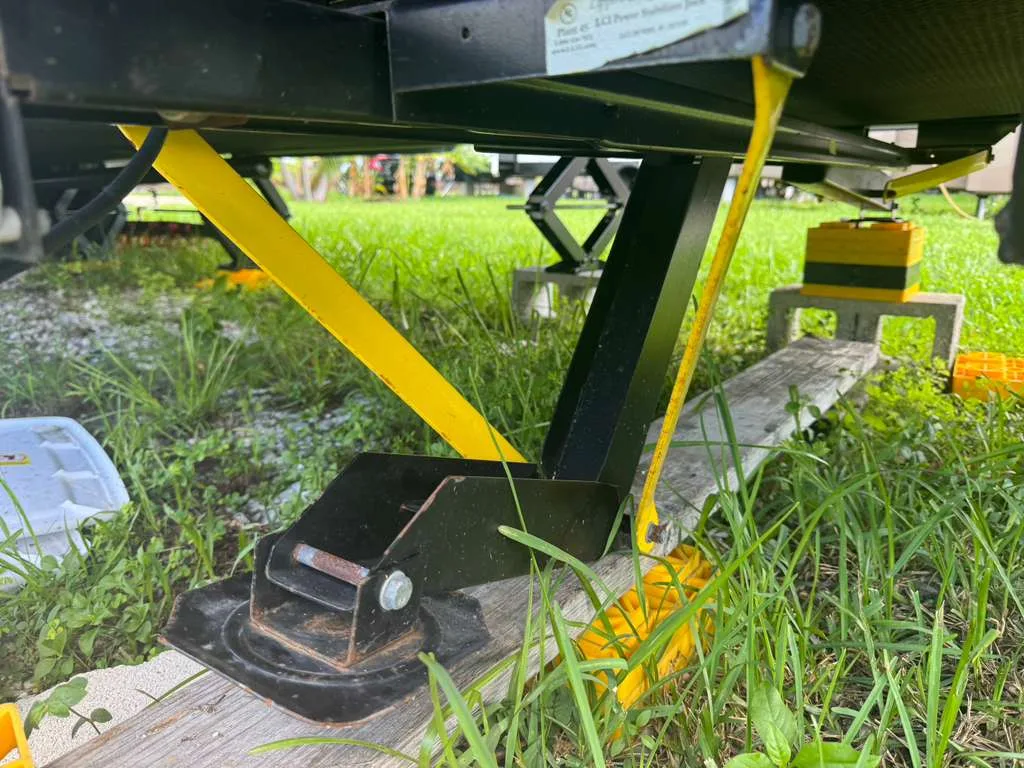
The exact wording changes between touchpad generations, but Level-Up and Ground Control faults sort into four families. Excessive slope means the sensor sees the coach tilted further than the jacks can correct, which on a Florida site usually means a rear axle settled into soft ground or a crushed shell pad rather than a broken system. Low voltage means the control box saw its supply collapse during the cycle. Jack timeout, sometimes shown as excessive extension, means a jack was commanded to move and the controller never saw the coach attitude change within its allowed run time. Communication error means the touchpad and the control box stopped talking, which is a harness or connector fault far more often than a board fault. None of these four say the board is bad. They describe what the board observed, and treating an observation as a diagnosis is how a good controller ends up in the bin.
Controller Fault or Low Voltage: Telling Them Apart Before You Buy a Board
This distinction decides the whole job. A hydraulic pump motor pulls heavy inrush at startup, and a tired house battery that reads a comfortable 12.6 volts at rest can collapse well under 11 the instant the motor loads. The control box reads that collapse and stops, and the touchpad reports an error that looks exactly like hardware failure. Lippert puts real numbers on that band: 12.75 volts DC minimum before an auto sequence will run, manual operation rated only between 9.5 and 12.75 volts DC, and the controller stopping and posting low voltage below 9.5 volts DC. So our technicians take two readings: resting voltage at the battery bank, then voltage at the control box power and ground studs while the pump is actually running. If the battery holds but the control box sags, the loss is in the cable, the connection or the ground, not the board. More than about three tenths of a volt dropped across a single ground path is a failed connection, whatever it looks like.
The Auto-Level Sequence and the Zero Point It Levels To

Auto level is not one motion, it is a stored routine. The controller drops all jacks until they load, corrects front to rear, then corrects side to side, then re-reads the sensor and repeats the passes until the coach sits inside its tolerance window. What it levels to is not true level. It is the zero point stored in memory, taught once with the coach manually leveled on flat ground, and every auto level afterwards chases that stored attitude. A coach that ends up nose high or leaning consistently, with no fault message at all, has a zero point problem rather than a board problem. That matters here because a genuinely replaced control box arrives with no stored zero point, so the coach must be manually leveled with a long bubble level or a digital angle gauge and the zero point re-taught from the touchpad before the job is finished. Full sensor calibration is covered on our sensor and zero point page.
Stuck With the Jacks Down and a Dead Controller
An owner who cannot retract is not in a maintenance situation, they are stuck, so the honest answer matters more than the tidy one. On the hydraulic Level-Up power unit there is a manual release on the valve manifold, and opening it lets fluid return to the reservoir so the jacks can bleed down as the coach settles onto its suspension. On electric Ground Control jacks the path is different: each jack motor carries a hex override stub, and a socket on a cordless drill winds that jack up by hand, one leg at a time and a little at a time so the coach never racks. Retract in small passes across all four corners rather than running one leg to the top. Never crawl under a coach standing on extended jacks, and close the manual release before traveling. A jack left on a released manifold can creep down on the road.
How Our Technicians Diagnose It On Site, In Order, and What It Costs
The order is fixed because each step decides whether the next one is worth doing. Battery resting voltage and state of charge first, then voltage at the control box under load, then the frame ground lug and the pump ground, then the pump motor solenoid, then the individual cartridge solenoid coils, and only then the control box itself. Our service call covers the trip out and the first hour on site at the rate in the pricing table on this page; anything past that first hour is quoted and approved before we carry on. A corroded ground lug cleaned, sealed with dielectric grease and re-torqued costs the visit and nothing more, while a genuine control box replacement adds the part. Left alone, the cheap fault gets expensive. A ground that drops voltage makes the pump motor run hot and hard on every cycle, and the same corrosion path eventually reaches the solenoid coil connectors.
Sources
Every figure on this page comes from a manufacturer document or a standards body, not from another repair site. Here is where each one comes from.
- Lippert Level Up with OneControl Touch Panel - Owner's Manual (CCD-0001539)Lippert's own published supply minimum for this system: 'Level Up requires a minimum of 12.75V DC from the battery for proper operation', stated as a pre-operation requirement alongside charging the battery or connecting shore power. It backs the section that measures supply voltage at the control box before a board is condemned, and it is the number the page now quotes in place of a 12.5 volt figure Lippert does not publish. The same manual's error-code chart lists LOW VOLTAGE against a discharged or bad battery and bad connections or wiring, which is the observation-not-diagnosis point made in the fault-message section.
- Lippert FAQ - How do I know if I have low voltageThat low voltage is reported by the controller as its own fault code, supporting 'What Each Level-Up Fault Message Is Really Telling You' where a low voltage message describes what the board observed rather than a failed board.
- Lippert FAQ - How do I manually override my Level Up systemThe manual release and hex override procedures described in 'Stuck With the Jacks Down and a Dead Controller'.
- Lippert FAQ - What to do if the hydraulic pump unit does not run when the leveling control is activatedThat Lippert's own path for a non-running pump goes through supply and solenoid checks, supporting the fixed diagnostic order that puts the pump motor solenoid and ground lug ahead of the control box.
- Lippert Hydraulic Leveling with LCD Touchpad (4 Point/3 Valve) - OEM Installation Manual (CCD-0002372)The three voltage figures quoted in 'Controller Fault or Low Voltage'. Lippert's Low Voltage Signal section states that the vehicle requires 12.75V DC to operate in AUTO mode and will display 'Low Voltage' if supply is too low, that the system ceases operating if voltage drops below 9.5V DC during AUTO or MANUAL operation, and notes that the coach will operate in manual mode between 9.5V DC and 12.75V DC. Its error-code chart repeats the 9.5V DC figure and directs the technician to run the engine and test battery voltage under load. The document contains no 12.5 volt threshold.
Related repairs
- Hwh Hydraulic Leveling Service
- our Bal Electric Leveling Repair service
- Leveling Jack Cylinder Reseal in Florida
Other systems we service
Where we work
Service category
What this usually costs
| Item | Price | What it covers |
|---|---|---|
| Service call | $299 | Includes the trip out to your RV and the first hour on site |
| Work past the first hour | Quoted after diagnosis | We tell you what it will take before we carry on |
| Parts | Quoted per job | Special-order parts may need a deposit before we order them |
| Written estimate | No charge | You approve the estimate before any work starts |
The service call covers the trip out to your RV and the first hour on site. Anything beyond that depends on what we find, and we quote it and get your approval before carrying on.
The price ranges on this page come from our own recent jobs across Florida, not from an industry average. What you pay depends on the rig, the parts it needs and what we find on site, so we give you a written estimate before any work begins and you approve it first.
Frequently asked questions
Can you repair an RV leveling leg, or does the whole thing get replaced?
Often it is repaired rather than replaced. A hydraulic jack that leaks at the rod is a seal job on our cylinder reseal page, and an electric leg with a dead motor usually takes a motor rather than a whole leg. What is not repairable is a scored or bent cylinder rod, or a leg that has been bent by driving off with it partly down.
How do I know if my Level-Up control board is actually bad?
By elimination, not by the error message. If the bank is at Lippert's 12.75 volts DC before the sequence starts and the control box never sags toward the 9.5 volts DC at which the system stops and posts low voltage, the grounds are clean, the pump motor solenoid clicks and the solenoid coils each read a sensible resistance, then the board is the remaining suspect. If any of those fail first, fix that and retest before buying a controller.
Why does my auto level work at home but throw errors at the campground?
Usually charge, sometimes slope. At home the coach sits on shore power with a full bank, while at a site after a few days of dry camping the same bank cannot hold voltage through a pump start. If the message is excessive slope instead, the site itself is beyond what the jacks can correct and the coach needs blocks under the low corners first.
Does rain in the leveling bay really cause board faults?
Yes, and it is common here. Afternoon storms and road spray drive water into a lower bay, and it collects at the frame ground lug and inside the solenoid coil connectors rather than on the board itself. The corrosion adds resistance, the voltage at the control box sags under pump load, and the touchpad reports a fault that reads like failed hardware.
Do I have to recalibrate after a control board is replaced?
Yes. A new control box has no stored zero point, so it will level the coach to whatever it considers flat, which is rarely what the owner wants. The coach gets manually leveled with a long bubble level or a digital angle gauge, then the zero point is taught from the touchpad, and auto level is run once to confirm it settles where it should.
What does Level-Up diagnosis usually cost?
We will not quote a fixed price for a board we have not tested, because a large share of these calls end at a battery or a ground rather than at a controller.