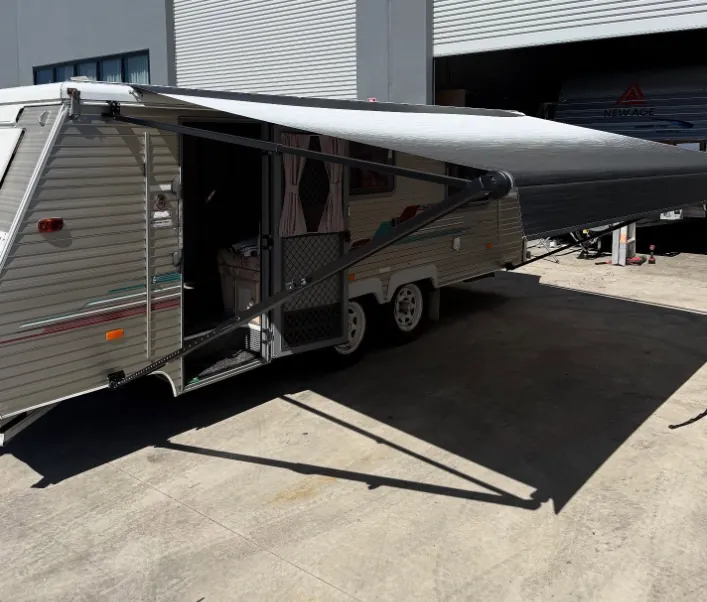
Carefree Awning Repair: Arms, Springs and Motors Florida
Carefree awning not retracting? Mobile repair of torsion assemblies, lead rails, arm castings and 12-volt motors across Florida. Call 888-759-1438.
"Why is my awning not coming in?" is the question behind most Carefree of Colorado awning calls. On Eclipse, Altitude and Freedom power units the usual causes are a failed 12-volt motor, a stripped gearbox, or an arm binding on a corroded casting. On manual Fiesta and Campout awnings it is lost spring tension in the torsion assembly, a bent lead rail, or a seized pivot.
Why Your Carefree Awning Will Not Come In
Owners rarely call with a part name. They call to say the awning is stuck halfway, that it hums but nothing moves, or that one arm is hanging lower than the other after a storm. A Carefree awning retracts because stored energy in the torsion assembly, or a 12-volt motor inside the roller tube on powered models, winds the fabric back while the arms fold along a fixed path. Anything that interrupts that chain stops the retraction. A motor that hums without turning, a stripped gearbox, a bowed lead rail, a seized arm casting, or fabric that has stretched and is dragging on the coach will all produce the same complaint from the owner. Our technicians separate the electrical fault from the mechanical one before quoting anything, because the two branches cost very different money. A motor drawing no current at all is a switch, fuse or wiring problem. A motor drawing hard and stalling is being asked to move something that is physically bound.
Carefree Arms and Dometic Solera Arms Are Not Interchangeable
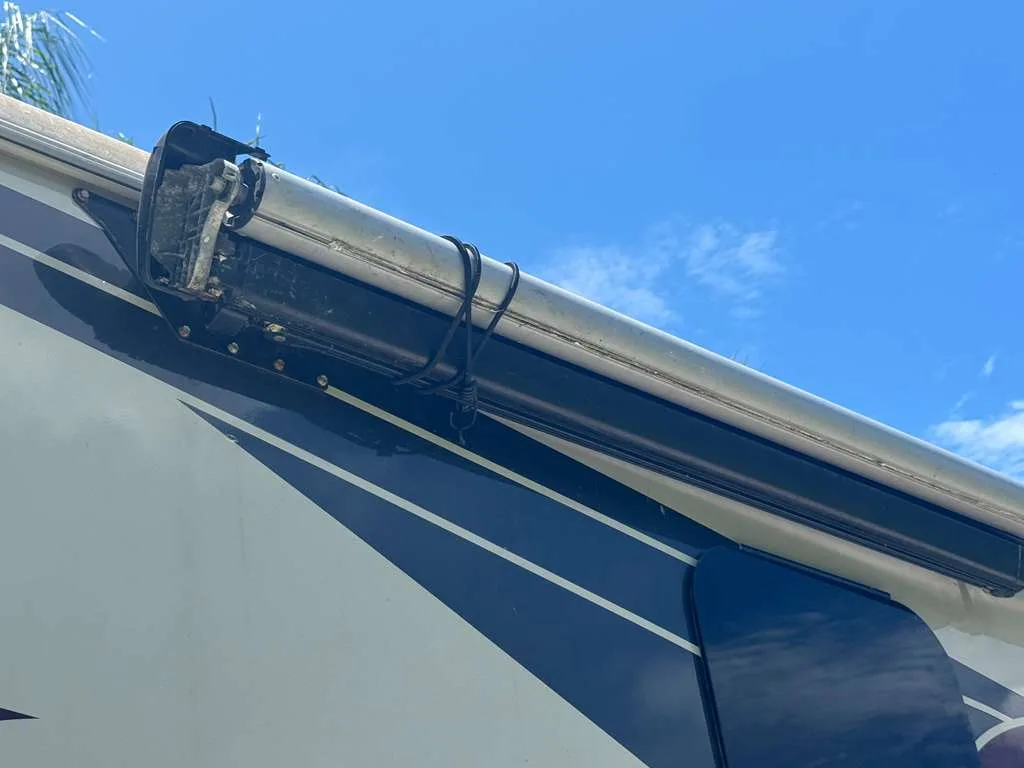
From twenty feet away a Carefree of Colorado awning and a Dometic Solera look like the same product on the side of a coach. They are not, and the difference is not cosmetic. The arm geometry differs, so the pivot path an arm sweeps as it folds is different, and the wall bracket footprints and fastener patterns rarely line up between the two brands. The motors differ as well. Carefree's powered box awnings, including the Eclipse and Altitude families, carry the drive inside the roller tube, and the motor, gearbox, lead rail, arm castings and end caps are all Carefree-specific parts. That matters on a service call for one practical reason: ordering the wrong brand's component costs a week rather than an hour. Our technicians confirm the brand and family from the roller end cap and the arm casting before a single part is ordered. Solera work is covered on its own page.
What Our Technicians Check, and In What Order
The sequence matters more than any single test. Our technicians start at the switch with a multimeter, confirming 12 volts actually reaches the motor and that the inline fuse is intact, because a dead awning is a wiring fault about as often as it is a failed motor. A clamp meter goes on the motor feed next, usually a Fluke 323. A healthy Carefree power awning motor runs in the five to ten amp range with a brief spike as it breaks away, while a motor pulling twenty amps or more and stalling is being asked to move something that is jammed. Only then do we go mechanical, in this order: arm castings and their rivets, the pivot points, the lead rail for straightness, the torsion assembly for lost tension, and the pitch adjustment and travel stop last. Checking pitch first is the tempting shortcut, and it hides a bound arm well enough to earn you a second service call.
Eclipse, Campout, Fiesta, Freedom or Altitude: Which One Do You Have?
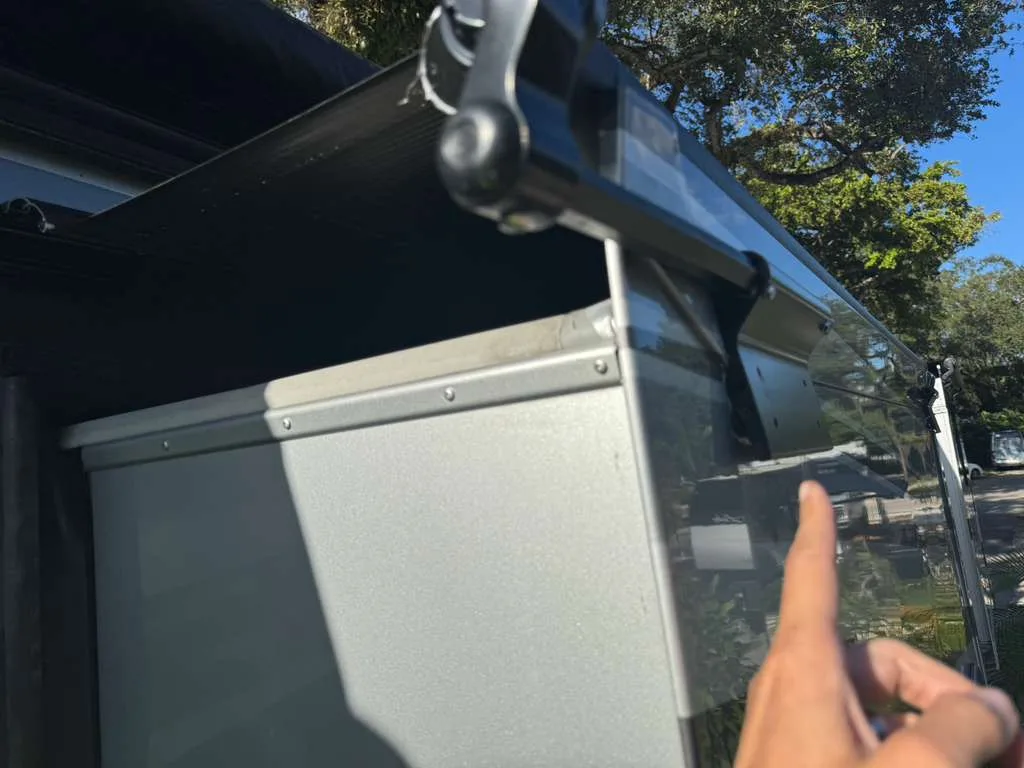
Carefree of Colorado does not sell one awning, it sells families, and parts follow the family rather than the brand name. Getting the family right is the difference between a one-visit repair and a parts return. The Eclipse and the Altitude are powered box awnings, with the motor inside the roller tube and the whole assembly closing into a case. The Freedom is the shorter powered box awning common on smaller travel trailers and van conversions. The Fiesta is the spring-assisted manual roll-out with rafter arms, and the Campout is the lighter bag-style manual awning found on pop-ups and compact trailers. Which one is bolted to your coach decides everything downstream: whether there is a motor and gearbox at all, whether the arms carry a torsion assembly, and which lead rail profile and arm casting the parts desk should send. Our technicians photograph the end cap and the casting on arrival for exactly that reason.
The Torsion Spring Is the Real Reason This Is Not a DIY Job
A Carefree torsion assembly stores genuine mechanical energy, and that is the honest answer to owners asking whether they can pull an arm apart themselves. The spring stays wound even when the awning is fully rolled up and the coach is sitting still in the driveway. Taking that arm apart without releasing the tension first lets the assembly unwind against whatever is holding it, and in practice what is holding it is a hand, a wrist or a face. Our technicians de-tension deliberately, capturing the assembly with a lock pin or winding bar and walking the tension off in controlled turns before any fastener comes out, then re-winding to the specified turn count on reassembly. The ladder is the other half of the safety picture. An awning arm that releases while someone is reaching overhead on an extension ladder turns a parts failure into a fall, which is a far more expensive afternoon than a service call.
Repair or Replace: The Honest Fork, and What It Costs
Repair is the right call more often than the forums suggest, and it is not always the right call. A failed motor, a stripped gearbox, a tired torsion assembly or one cracked arm casting are all replaceable in place, and a mobile visit usually clears them in a single trip. What pushes a Carefree unit toward full replacement is accumulated corrosion. On coastal Florida rigs, salt air attacks the aluminum castings around their steel rivets, and once several castings are chalked, pitted and loose, no torque value will hold them. UV does the parallel damage above, hardening fabric and end caps until they split at the first real wind load. Fabric-only failures and full storm rebuilds are covered separately.
Ask which of the two you are being quoted, and why. The answer should reference the arm, the spring and the rail, not just the fabric you can see.
Sources
Every figure on this page comes from a manufacturer document or a standards body, not from another repair site. Here is where each one comes from.
- Dometic - official product support, manuals and spare partsThat Dometic Solera awnings are a separate product line from Carefree of Colorado, with their own arm geometry, brackets and motor parts, so components are not interchangeable between the two brands.
- RV Industry Association (RVIA)The industry body whose member manufacturers build and supply RV awning systems, and the source for the RV construction and safety standards behind the repair or replace decision.
- Fluke 323 True-RMS clamp meter - manufacturer product pageThe clamp meter our technicians put on the awning motor feed, and the instrument named in the diagnostic sequence for separating a failed motor from a bound arm.
Related repairs
- Dometic Solera Awning Repair
- our Awning Fabric Replacement service
- Manual Electric Awning Conversion in Florida
Other systems we service
Where we work
Service category
What this usually costs
| Item | Price | What it covers |
|---|---|---|
| Service call | $299 | Includes the trip out to your RV and the first hour on site |
| Work past the first hour | Quoted after diagnosis | We tell you what it will take before we carry on |
| Parts | Quoted per job | Special-order parts may need a deposit before we order them |
| Written estimate | No charge | You approve the estimate before any work starts |
The service call covers the trip out to your RV and the first hour on site. Anything beyond that depends on what we find, and we quote it and get your approval before carrying on.
The price ranges on this page come from our own recent jobs across Florida, not from an industry average. What you pay depends on the rig, the parts it needs and what we find on site, so we give you a written estimate before any work begins and you approve it first.
Frequently asked questions
How do I manually retract a Carefree awning that has stopped working?
Most Carefree power awnings can be brought in without power, but the method depends on the family. Pull the awning fuse first so the motor cannot fire while your hands are on it, then drive the motor through its manual override and fold and latch the arms. On a manual Fiesta or Campout, release the arm latches and walk it in with the pull strap. Strap the roller before driving, because a partly retracted awning will unroll itself at highway speed.
Is it the awning brushes or the motor?
It is a fair question and usually the wrong fork. Carefree power awning motors are sealed assemblies, so brushes are not a field-serviceable item on them. The useful split is between no current, which points at the switch, fuse or wiring, and heavy current with no movement, which points at a stalled motor, a bound gearbox or a seized arm. A clamp meter on the feed settles it in about a minute, which is why our technicians start there.
Can somebody come out for a detached awning?
Yes, and a detached or partly hanging awning is the one awning call our technicians treat as urgent. A loose arm can tear the awning rail or the sidewall skin off the coach, which turns a component repair into bodywork. If the unit is not safe to leave, we secure or remove it on the first visit, then quote the rebuild once we can see whether the lead rail, the castings and the wall brackets survived intact.
What does a Carefree awning repair usually cost?
Our service call covers the trip out and the first hour on site at the rate in the pricing table on this page; anything past that first hour is quoted and approved before we carry on. We do not quote a fixed price for an awning we have not seen. A motor swap and a full arm rebuild with new castings are different jobs, and only the diagnosis tells us which one is in front of us.
Can you get and install a Carefree part, or fit a motorized arm?
Yes. Our technicians identify the family and the exact component from the roller end cap and the arm casting, then order through the Carefree of Colorado parts channel. Lead rails, arm castings, torsion assemblies, end caps and motors are all available separately rather than only as a complete awning. We also fit powered arms and complete power awnings. Converting a manual awning to electric is a separate job with its own bracket and wiring work.