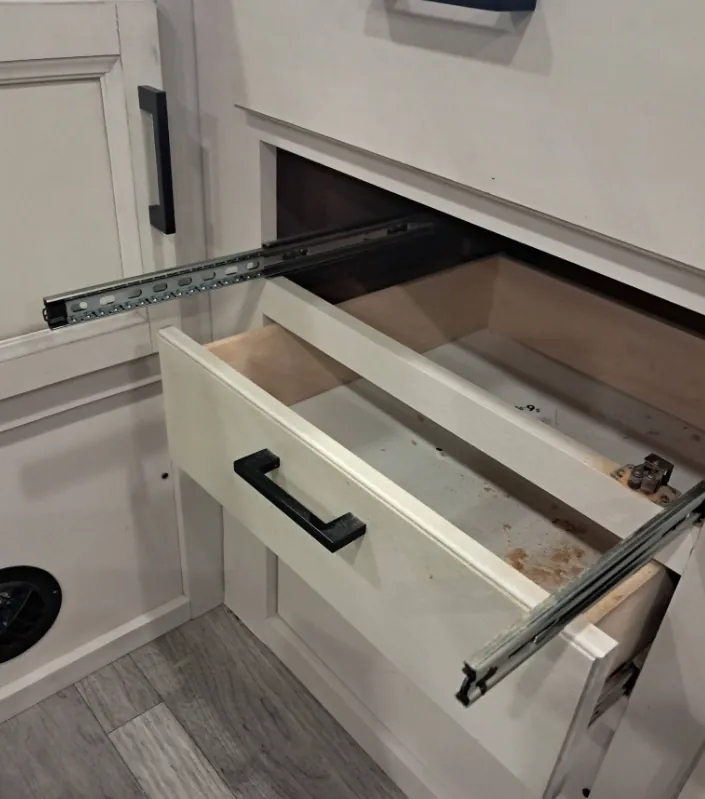
RV Cabinet Door, Hinge and Latch Repair for Road Vibration
Cabinet door sagging or popping open on the road? We rebuild stripped hinge holes with dowels, inserts and cup hinges. Mobile RV service. Call 888-759-1438.
An RV cabinet hinge carries a door on two or three short screws driven into particleboard or a thin lauan panel, and it does that while the coach flexes over every expansion joint. That screw joint, not the hinge itself, is what fails first. Repair means rebuilding the substrate the screws bite into using dowels, epoxy, threaded inserts or a backing plate, then rehanging the door and restoring a positive catch that holds at speed.
Carcase, Face Frame, Hinge and Catch: What Holds an RV Cabinet Door
An RV cabinet is four parts working together, and only one of them is the hinge. The carcase is the box itself, usually eighth to quarter inch lauan plywood skins or thin particleboard over a light stick frame. The face frame is the visible perimeter the door closes against, and in most coaches it is the only member with real thickness. The door hangs off that face frame on hardware. Most RVs ship with a wrap-around or semi-wrap steel hinge whose leaf takes short coarse-thread screws into the frame edge, rather than the European cup hinge used in better residential cabinetry. The catch is separate hardware again: a magnetic catch, roller catch, bullet catch or a positive-lock push-button latch. Overhead lockers add a gas strut or lid stay, which loads its own bracket screws every time the door swings up. Each of those parts fails in its own way, and the repair depends entirely on which one let go.
Road Vibration, Not Door Weight, Is What Strips the Screw Hole

A kitchen cabinet screw sees one static load: the weight of a door hanging still. A coach cabinet screw sees that same weight plus a continuous stream of small reversing loads as the body works over expansion joints, railroad crossings and driveway aprons. Particleboard and thin lauan hold a screw by compressing chips and fibers around the thread, not by biting into long grain the way solid wood does. Reversing load walks that compressed ring loose, the hole grows a few thousandths at a time, and one day the screw turns without feeling tight. Nothing snapped, so there is nothing visible until the door starts to drop. This is why the obvious fix makes things worse. A longer or fatter screw cuts fresh threads in material already crushed, and in a thin skin it blows out the back or pushes a dimple through the show face. Once one screw lets go, the survivor becomes a lever and the second hole tears out.
A Sagging Door or a Cabinet That Pops Open: What We Check, In Order
Owners describe two symptoms. The door hangs crooked and rubs the one beside it, or the cabinet swings itself open somewhere on the interstate. Our technicians work the same sequence for both. First we watch the hinge instead of the door while it swings, because a failed mounting shows up as movement between the leaf and the wood. Then the reveal gets measured with a steel rule at the top and the bottom of the hinge edge. More than roughly a sixteenth of an inch of taper across a two foot door is a mounting failure, not a warped door. Next one screw comes out and the thread impression gets read. Clean threads mean a sound joint, powder and fuzz mean the hole is gone. An awl goes in after that, and if it turns with no resistance the substrate is finished. Last the box gets checked against its wall cleat, and on a pop-open complaint the strike alignment gets checked before anyone condemns the latch.
What Each Finding Costs, and What It Becomes If You Leave It
Those are ranges rather than quotes, because no fixed price belongs on a cabinet nobody has stood in front of. Loose screws in sound material are a tightening and relocation job that lands inside that first hour. Stripped holes add rebuild time per door, since a glued dowel or a filled epoxy repair has to cure before hardware goes back on. A sprung or broken hinge adds parts, and matching a builder-specific hinge that went obsolete years ago is what pushes many coaches toward a cup hinge conversion instead. Leaving it does not hold still. The surviving screw levers its own hole open, the door drops onto the one below it, the face frame splits along the grain, and an overhead locker full of dishes ends up hanging on one fastener. Empty an overhead locker the moment its door starts to sag, before the frame does.
Rebuilding the Substrate: Dowels, Epoxy, Threaded Inserts and Cup Hinges
The repair is chosen by how much material is left, not by preference. A hardwood dowel glued into a drilled-out hole and re-piloted works where the panel is plywood or solid stock. A two-part epoxy with filler rebuilds a crumbled particleboard edge that a dowel would only split further. Where the panel has thickness, a threaded insert puts a machine screw thread into the wood and ends the cycle rather than resetting it. Where the panel is a quarter inch lauan skin, none of that applies and the answer is a backing plate: hardwood or aluminum bonded behind the skin so the fastener lands in something with depth. Screws go back with a clutched driver on its lowest usable setting, using a self-centering bit, and never an impact driver. Rehanging is worth it while the door and face frame are intact. Replacement wins once a stile is split through, a bottom edge has swollen and delaminated, or the same holes have been rebuilt twice.
Florida Storage: Swollen Particleboard and What Moves In
Two things happen to cabinetry in a coach that sits closed through a humid Florida storage season. Particleboard and MDF take up moisture and swell, which relaxes the bond around every screw hole, and the crushed chips never recover their grip once the panel dries out. A cabinet that was tight in April can be loose in October with nobody having opened it. The second is what an unlatched door invites in. Cabinet floors and backs carry oversize cutouts for plumbing and wiring that are almost never sealed, and those cutouts open into the wall cavity. American cockroaches, the palmetto bug most owners mean, travel that route along with rodents, and food residue in a galley cabinet that no longer closes is what keeps them there. So a storage-season repair opens with an inspection for droppings, egg cases and nesting material, and the penetrations get sealed while the box is apart. Rebuilding a screw hole in a cabinet something is living in is wasted work.
Sources
Every figure on this page comes from a manufacturer document or a standards body, not from another repair site. Here is where each one comes from.
- Blum - COMPACT concealed hinges for face frame cabinetsBlum's own product page states COMPACT hinges are concealed hinges for face frame cabinets adjustable in side, height and depth, and that the 38N is a partial overlay hinge with a 105 degree opening angle and a 7/16 inch cup depth. That cup depth is the figure this page uses to explain which RV doors can accept a 35 mm cup and which are too thin to bore.
- Blum - CLIP top BLUMOTION hinge programBlum documents that the BLUMOTION soft-close feature is built into the hinge cup and can be deactivated, that doors snap on and off with CLIP technology, and that the hinge takes three dimensional and cam adjustments. This supports the point that a cup hinge is realigned in the field without redrilling wood, and that Blum offers EXPANDO T for fronts too thin to bore.
- E-Z LOK - threaded inserts for woodE-Z LOK manufactures the wood threaded inserts named in the substrate repair section, confirming that setting a metal machine screw thread into wood is an engineered off-the-shelf product class rather than an improvised fix, which is why it sits a step above a dowel or epoxy repair where the panel has thickness.
- RV Industry Association - Association and ANSI Adopted StandardsThe RV Industry Association's adopted standards list covers NFPA 1192 for fuel, fire and life safety, plumbing and vehicular requirements, ANSI A119.5 for park model construction, and the ANSI/RVIA DC standard for low voltage systems. Cabinet door hardware and its attachment appear nowhere on that list, which is why interior cabinet build quality varies by builder instead of being fixed by an adopted standard.
Related repairs
- our Dinette Bed Conversion service
- Theater Seat Recliner Repair in Florida
- how we handle rv countertop replacement
Other systems we service
Where we work
Service category
What this usually costs
| Item | Price | What it covers |
|---|---|---|
| Service call | $299 | Includes the trip out to your RV and the first hour on site |
| Work past the first hour | Quoted after diagnosis | We tell you what it will take before we carry on |
| Parts | Quoted per job | Special-order parts may need a deposit before we order them |
| Written estimate | No charge | You approve the estimate before any work starts |
The service call covers the trip out to your RV and the first hour on site. Anything beyond that depends on what we find, and we quote it and get your approval before carrying on.
The price ranges on this page come from our own recent jobs across Florida, not from an industry average. What you pay depends on the rig, the parts it needs and what we find on site, so we give you a written estimate before any work begins and you approve it first.
Frequently asked questions
Why do my RV cabinet hinge screws keep backing out?
Because the screw is not fighting the door's weight, it is fighting road vibration. Every expansion joint and driveway apron sends a small reversing load through a fastener held only by compressed particleboard or lauan chips. That compressed ring works loose a few thousandths at a time until the screw spins without seating. Tightening it again crushes what little is left, which is why the hole has to be rebuilt rather than re-torqued.
Can a longer or thicker screw fix a stripped RV cabinet hinge hole?
Almost never, and it often costs you the panel as well. A bigger screw cuts new threads in material that is already crushed, so it holds for a few trips and then strips a wider hole. In a quarter inch lauan skin it can blow out the back or push a visible dimple through the show face. The durable answers are a glued hardwood dowel, a filled epoxy repair, a threaded insert or a backing plate behind the skin.
A cabinet door flew open while we were driving. Is a magnetic catch enough?
No. A magnetic catch is rated for static pull with the coach standing still, and a hard stop or a swerve loads that door with a multiple of what its contents actually weigh. RV cabinets want a positive catch instead, meaning a roller, bullet or push-button latch that needs a mechanical release to open. Check strike alignment before replacing anything, because a sagging hinge walks the door off its strike.
Can RV cabinet doors take European cup hinges?
Most solid-framed three quarter inch doors can, and thin or hollow fronts cannot. A 35 mm cup needs material left under it: Blum's COMPACT 38N face frame hinge is a partial overlay hinge with a 105 degree opening angle and a 7/16 inch cup depth. For fronts too thin to bore, Blum builds the EXPANDO T instead. The payoff is three dimensional adjustment, so the door realigns later without touching the wood again.
My coach sat in storage all summer and now three doors are loose. What changed?
Humidity, and nothing you did. Particleboard swells as it takes on moisture, which relaxes the glue bond around each screw hole, and the chips do not recompress when it dries back out. Screw-holding strength ends up permanently lower than it started. A cabinet that has been through a wet storage season is a different repair from a dry one, and those same cabinets are worth checking for droppings and nesting while they are open.
What does RV cabinet door and hinge repair cost, and how long does it take?
Our service call covers the trip out and the first hour on site at the rate in the pricing table on this page; anything past that first hour is quoted and approved before we carry on. A single door rehung on rebuilt holes is generally a twenty to forty minute job once the adhesive has cured. A coach wide pass across every door and drawer front runs a half day to a full day.