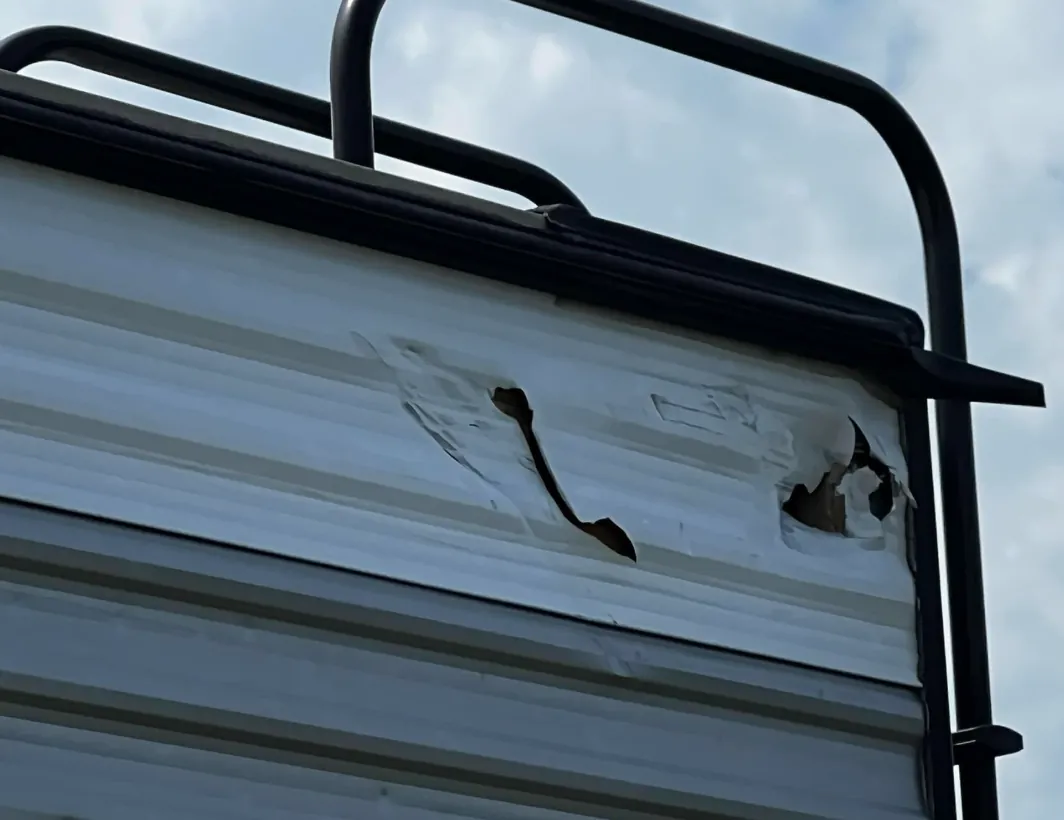
RV Insurance Damage Appraisal and Claim Documentation FL
We document RV damage and write a line-item repair estimate for your insurance claim. Coverage is your carrier's call, not ours. Call 888-759-1438.
An RV insurance damage appraisal is a documented condition report paired with a line-item repair estimate, prepared at the rig. Photographs are shot with a scale reference and context, moisture is read and logged, damaged parts are identified by manufacturer part number, and labor is priced in hours. It is not a coverage decision. The carrier's adjuster decides what the policy pays, so confirm the claim and verify coverage before any repair work begins.
What an RV Insurance Damage Appraisal Is, and What It Is Not
An RV insurance damage appraisal is a written record of condition paired with a priced repair plan. It has three parts: photographic evidence of what is damaged, measured findings such as moisture content or voltage drop, and a line-item estimate naming each part and the labor hours to fit it. What it is not is a coverage decision. Our technicians document the damage and price the repair. The carrier decides whether the policy responds, what it pays, and whether the rig is repairable or a total loss settled at actual cash value. That split matters because the two documents come from different people doing different jobs. A licensed adjuster works the claim file on behalf of the insurer. A repair estimate comes from the technicians who would carry out the work, which is why it carries part numbers and labor hours rather than a settlement figure. Nobody here can promise an insurer will pay. Anyone who does is guessing with your money.
Confirm the Claim With Your Carrier Before Anything Is Repaired
The order is not negotiable. Open the claim, get the claim number, and have the carrier confirm that the loss is covered before repair work starts. A policy nobody has verified for this specific cause of loss is not a budget, it is a hope. Ask the adjuster for a name and license number, and ask directly whether teardown counts as repair. On plenty of claims it does, and pulling a wet panel before the insurer has inspected can put the claimed amount into dispute. What is possible varies by location as much as by policy. Coverage forms, claim-handling rules and the dispute routes open to an owner differ from state to state, and a motorhome, a fifth wheel and a park model are not treated identically. Apex works alongside the adjuster and supplies the technical documentation. We do not adjust claims and we do not decide coverage.
The First 48 Hours After You Find the Damage
Report the loss promptly. Policies generally carry a duty of prompt notice and a duty to protect the property from further damage, and both are far easier to satisfy in the first two days than to argue about a month later. Protect the rig in a way that can be undone: a tarp over the opening, a temporary bead of lap sealant across a failed termination, a dehumidifier running inside. Keep every receipt, since reasonable mitigation costs are often claimable, and photograph the temporary fix so nobody later mistakes it for the original condition. Do not throw anything out. A snapped Schwintek slide motor bracket, a shattered Fan-Tastic vent dome, a section of soaked lauan cut away to stall mold growth: each one is evidence, and a bagged, labeled part beats a description of one. Write down the date, the time and the weather when the damage was found, then leave the diagnosis to the visit.
What Gets Checked First, What It Costs, and What It Becomes
Callers rarely describe a part. They describe an event and a worry: can you repair travel trailer damage, did the subflooring get damaged, could the fuse box be damaged. The visit works outward from that reported event rather than opening with a general once-over. The stated point of impact or entry is examined first, then the perimeter around it: roof terminations, the roof-to-sidewall joint, window and slide flanges, and the sealant beads on every roof penetration. Moisture is mapped inward from that point until readings fall back to a dry baseline, which is what fixes the boundary of the damage on paper. Left alone, a failed termination that would take a couple of hours to reseal becomes subfloor and wall stud replacement measured in days.
Photograph everything before anything is moved or covered, including the areas that look undamaged. An appraisal is only as good as the record it is built on, and the shots nobody took are the ones an adjuster asks for.
What a Report an Adjuster Can Actually Use Contains
Photographs are shot in a sequence rather than scattered: a wide frame showing where on the coach the damage sits, a mid frame taking in the surrounding panel or seam, and a tight frame with a tape measure or ruler in shot so the size is provable. The VIN plate and the coach data label are photographed too, because an estimate that cannot be tied to the insured unit is worth very little. Measured findings go in as numbers, not adjectives. Moisture readings are logged against named locations on a numbered grid, with the meter and mode stated, and anything at or above twenty percent moisture content in lauan is flagged as active decay rather than damp. Parts are named with manufacturer part numbers where they exist, each with its own labor hours. Cause and origin is stated where it is determinable and marked not determinable where it is not.
Comprehensive, Collision and the Causes Commonly Excluded
Collision coverage answers impact: striking an object, being struck, or a rollover. Comprehensive, written on many policies as other than collision, is the part that answers fire, wind, hail, a falling branch, theft, vandalism, flood and animal strikes. The Florida Department of Financial Services warns that the phrase full coverage means different things to different people, so read the declarations page instead of trusting the phrase. Several causes are commonly excluded, and they are the ones RV owners run into most. Wear and tear, gradual seepage through a sealant joint that has been failing for seasons, rot, and damage put down to neglected maintenance sit outside a physical damage policy on most forms, while a manufacturing defect belongs to a warranty claim instead. This is where a rig left standing for a snowbird season is exposed. A leak that began in June and was found in November reads as gradual on paper, and that is the argument the documentation has to answer.
Supplements: Why the Number Changes After Teardown
A first estimate is written from what can be seen and measured without cutting. A laminated sidewall hides its own condition, so an honest opening number covers the visible damage and the repairs that follow from it, not the ones nobody can see yet. A supplement is a revised estimate submitted mid-repair once teardown exposes more. Rotten wall studs behind sound-looking Filon, delamination running well past the wet area, a slide floor that comes apart the moment the flooring lifts: each gets documented with fresh photographs, priced as its own line, and sent for approval before work carries on. The discipline that gets supplements approved is stopping. Work pauses the moment the extra damage appears, it is photographed in place before anything else is removed, and it reaches the adjuster as an addition to the claim file rather than a surprise on the final invoice.
Sources
Every figure on this page comes from a manufacturer document or a standards body, not from another repair site. Here is where each one comes from.
- Florida Department of Financial Services - Personal Automobile Insurance OverviewThat physical damage cover on a vehicle policy is split into Collision and Other Than Collision, that it is optional rather than compulsory in Florida, and the department's own warning that the term full coverage means different things to different people and should not be relied on in place of the declarations page.
- National Association of Insurance Commissioners - Auto Insurance consumer guidanceThe regulator-level definitions used on this page: collision coverage responds to physical damage from colliding with an object, comprehensive responds to almost all other causes including fire, severe weather, vandalism, flood and theft, and an insurer may total a vehicle and pay what it was worth rather than repair it.
- Florida Statutes 627.70131 - Insurer's duty to acknowledge communications regarding claims; investigationThe claim-handling timings and disclosures cited in the information-gain section: acknowledgment of a claim communication within 7 calendar days, investigation beginning within 7 days of proof-of-loss statements, the adjuster's name and state license number being given to the policyholder, and a copy of any detailed estimate generated by the insurer's adjuster being sent to the policyholder within 7 days.
- Lippert Components - product support and parts identificationManufacturer-side identification of slide-out, entry step and frame-mounted components by model family and part number, which is how a damaged assembly gets named on an estimate line rather than described in prose.
Related repairs
- how we handle rv warranty claim documentation
- Post Hurricane Rv Assessment repairs
- Rv Pre Purchase Inspection
Other systems we service
Where we work
Service category
What this usually costs
| Item | Price | What it covers |
|---|---|---|
| Service call | $299 | Includes the trip out to your RV and the first hour on site |
| Work past the first hour | Quoted after diagnosis | We tell you what it will take before we carry on |
| Parts | Quoted per job | Special-order parts may need a deposit before we order them |
| Written estimate | No charge | You approve the estimate before any work starts |
The service call covers the trip out to your RV and the first hour on site. Anything beyond that depends on what we find, and we quote it and get your approval before carrying on.
The price ranges on this page come from our own recent jobs across Florida, not from an industry average. What you pay depends on the rig, the parts it needs and what we find on site, so we give you a written estimate before any work begins and you approve it first.
Frequently asked questions
Will my insurance cover it?
Only your carrier can answer that, and the honest answer is that it depends on the cause of loss and the coverage you bought. Sudden accidental damage from an impact, a storm, a falling branch or vandalism is the sort of thing a physical damage policy contemplates, while wear, gradual leaks and neglect are commonly excluded. Open the claim, get coverage confirmed, then have the damage documented.
Did the subflooring get damaged?
That is answerable without guessing. The floor is walked for deflection, moisture is read through the finished surface at a grid of points, and a pin probe or a borescope through a small hole confirms whatever the scan flags. Readings at or above twenty percent moisture content in lauan indicate active decay rather than damp. The findings, the locations and the meter used all go into the report.
What does a damage appraisal cost and how long does it take?
Our service call covers the trip out and the first hour on site at the rate in the pricing table on this page; anything past that first hour is quoted and approved before we carry on. A single-area loss is often covered inside that first visit, while a whole-coach water or storm loss takes longer. No fixed price is quoted on a rig nobody has seen yet.
How is your estimate different from the adjuster's appraisal?
Ours is a technical repair document: parts, part numbers, labor hours and measured findings, written by the people who would do the work. The adjuster's appraisal is the carrier's own valuation of the loss under the policy, and it decides what gets paid. Florida law requires an insurer to send the policyholder a copy of any detailed estimate its adjuster generates, so ask for it and compare it line by line.
Could the fuse box be damaged if water reached it?
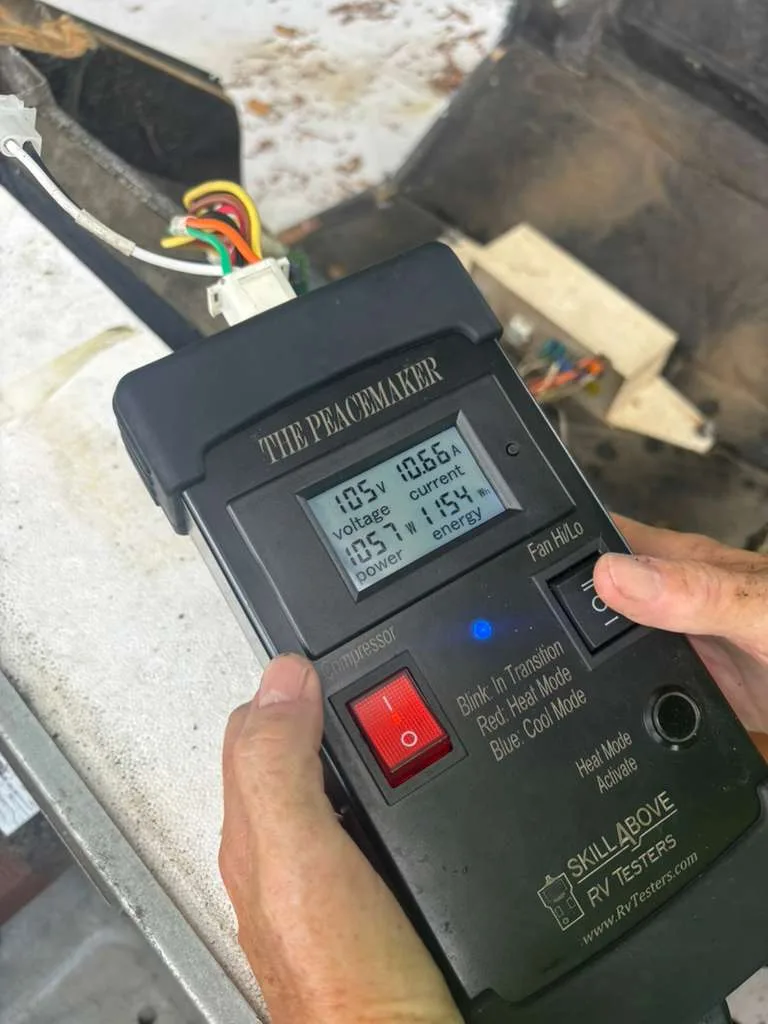
It can be, and it needs documenting rather than assuming. A 12V distribution panel that has been wet shows green corrosion on blade fuse legs and bus bars, and voltage drop across an affected connection under load is the test that separates a stained panel from a failing one. Corroded terminations keep degrading long after everything looks dry, so the reading goes into the report with a photograph.