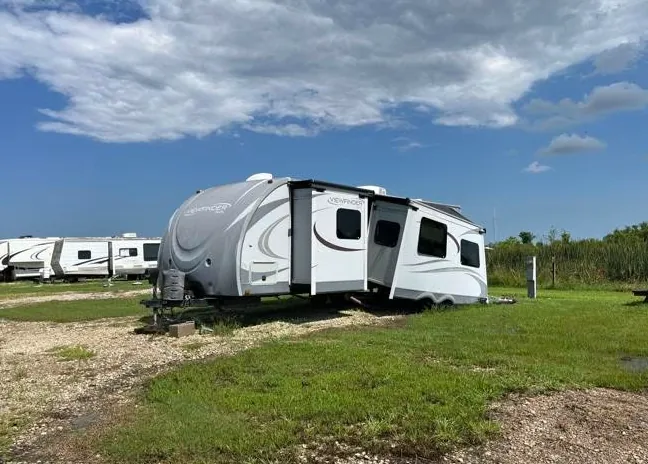
Post-Hurricane RV Damage Assessment - Mobile Florida Techs
Post-hurricane RV damage assessment across Florida. Hidden water, salt corrosion and roof strikes found and documented for your claim. Call 888-759-1438.
A post-hurricane RV assessment is not a walk-around for dents. The damage that decides whether a rig is repairable is almost always hidden: water forced past seals sideways, salt left sitting inside connectors, and a debris strike in the roof membrane that is invisible from the ground. Our technicians moisture map the roof, sidewalls and floor, then test the 12-volt system for corrosion, before anything gets cleaned up.
What a Post-Hurricane RV Assessment Actually Checks
A post-hurricane assessment is a damage survey run against a known event, and that is what separates it from the routine work owners compare it to. A moisture and leak survey hunts an ongoing leak of unknown age. A pre-purchase inspection prices a coach you do not own yet. This one begins from the fact that a specific storm applied wind load, water load and impact to your rig on a specific date, and works out what moved. That changes the order of operations. Our technicians start on the roof, because impact and water entry both begin there, then work down through sidewall seams, windows and slide seals, then into the floor, the walls and the 12-volt system. Every reading is written down with the date attached, because the report is evidentiary as much as mechanical. An adjuster wants a dated baseline, and so will you if a bubble appears in the sidewall six weeks from now.
Wind-Driven Rain Gets Past Seals That Shed Vertical Rain

Nearly every seal on a recreational vehicle is engineered for water falling downward. A window frame, a clearance light gasket, a roof vent flange, a termination bar and a slide topper all depend on gravity carrying water across a surface and out of a drain path. Hurricane rain does not fall downward. It arrives horizontally, at speed, with static pressure behind it, and it is perfectly capable of traveling uphill. The Saffir-Simpson Hurricane Wind Scale puts a Category 1 storm at 74 to 95 mph sustained, and rain driven at that speed gets up under a lap joint, past a butyl tape bed and behind a screw head. The seal is usually not defective and often is not even visibly damaged. It was simply loaded in a direction it was never designed to resist, and the water entered through a path that will look bone dry the next time it rains normally.
Why a Saltwater Flood Is Categorically Worse Than Fresh
Fresh water soaks insulation and swells a subfloor, and once the coach is dried and the ruined material is replaced, the failure stops. Salt water does not stop. Storm surge, which the National Hurricane Center identifies as the leading cause of hurricane fatalities and which can push up rivers and canals well inland, leaves sodium chloride behind in every crimp, ground strap and circuit board it reached. That residue is hygroscopic. Sodium chloride deliquesces at roughly 75 percent relative humidity, and coastal Florida sits above that on most nights, so a harness that looks completely dry quietly re-wets itself and keeps corroding. Our technicians test suspect connections under load with a Fluke 87V multimeter, because appearance proves nothing here. More than about 0.2 volts of drop across a single crimp means that connection is already resistive. Rinsing a flooded chassis is not the same thing as decontaminating it.
Roof Debris Strikes That Look Purely Cosmetic
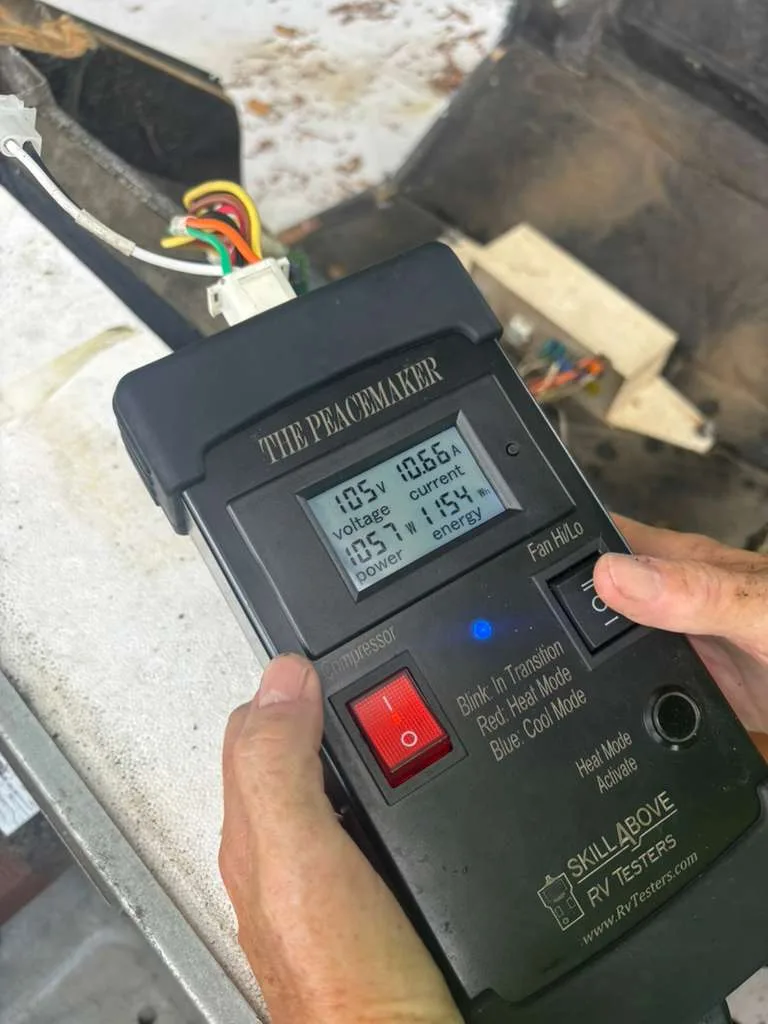
A branch, a roof tile or somebody else's awning arm landing on an EPDM or TPO membrane usually leaves a scuff, a crease or a shallow dimple rather than an obvious hole. The membrane is thin. Beneath it sits a luan and foam deck that absorbs the real impact, so what reads as a scrape can be a stretched or split membrane over crushed decking, and the split frequently hides under the edge of a Dicor 501LSW self-leveling bead where nothing shows from a ladder. Our technicians walk the roof where the construction allows the load, press by hand for soft spots around every penetration, and take readings across the deck rather than trusting the eye. A Delmhorst BD-2100 moisture meter returns a number instead of an opinion. Under about 12 percent is dry, 16 to 20 percent means water is present and moving, and above 20 percent the deck is saturated.
Document Everything Before Anyone Starts Cleaning Up
The sequence matters far more than most owners expect. FEMA's National Flood Insurance Program guidance is explicit: photograph and video the damage, record the make, model and serial number of every affected appliance and electronic, and keep physical samples of destroyed flooring and upholstery before cleanup begins. An adjuster estimates from evidence, and evidence in a dumpster is gone. Note also that NFIP policies exclude mold damage, which is a real risk in a closed-up coach in September. RV losses are typically handled under the comprehensive portion of an RV or auto policy rather than under a flood policy, so coverage has to be confirmed directly with your carrier before you assume anything. Coverage varies by policy, by carrier and by cause of loss. If a claim stalls, the Florida Department of Financial Services Division of Consumer Services operates an insurance helpline and a mediation process. Our report is written to be read by an adjuster, but it is not a coverage determination.
What Gets Checked First, What It Costs, What It Becomes
Owners rarely call about a part. The call is usually some version of we took a hit and I do not know what I am looking at, so the assessment runs in a fixed order: roof membrane and penetrations, then seams, windows and cap joints, then slide rooms and their wiper seals, then floor and wall moisture mapping, then the 12-volt and shore power systems if water reached that height. The service call covers the trip out to your RV and the first hour on site. Anything beyond that is quoted after diagnosis and approved before work continues, because a number quoted on a coach nobody has looked at is not a quote. Left alone, a hidden roof strike becomes subfloor rot within a season, salt in a connector becomes an intermittent fault that costs more to chase than to have prevented, and sidewall delamination surfaces weeks later, long after the claim feels settled.
Sources
Every figure on this page comes from a manufacturer document or a standards body, not from another repair site. Here is where each one comes from.
- NOAA National Hurricane Center - Saffir-Simpson Hurricane Wind ScaleCategory 1 hurricanes carry 74 to 95 mph sustained winds, the figure used to explain why horizontally driven rain defeats seals designed for vertical rain.
- NOAA National Hurricane Center - Storm Surge OverviewStorm surge is the leading cause of hurricane fatalities and can travel up rivers and canals well inland, so saltwater exposure is not limited to beachfront storage.
- FEMA National Flood Insurance Program - How to start a flood insurance claimThe federal claim sequence: photograph and video damage and record make, model and serial numbers before cleanup, keep samples of destroyed materials, and the NFIP mold exclusion.
- Florida Department of Financial Services - Division of Consumer ServicesFlorida's state insurance consumer helpline and its mediation and neutral evaluation process, cited as the route when a storm claim stalls.
Related repairs
- Rv Pre Purchase Inspection
- our Rv Moisture Leak Survey service
- Rv Pre Trip Safety Inspection in Florida
Other systems we service
Where we work
Service category
What this usually costs
| Item | Price | What it covers |
|---|---|---|
| Service call | $299 | Includes the trip out to your RV and the first hour on site |
| Work past the first hour | Quoted after diagnosis | We tell you what it will take before we carry on |
| Parts | Quoted per job | Special-order parts may need a deposit before we order them |
| Written estimate | No charge | You approve the estimate before any work starts |
The service call covers the trip out to your RV and the first hour on site. Anything beyond that depends on what we find, and we quote it and get your approval before carrying on.
The price ranges on this page come from our own recent jobs across Florida, not from an industry average. What you pay depends on the rig, the parts it needs and what we find on site, so we give you a written estimate before any work begins and you approve it first.
Frequently asked questions
Can you do a roof and seal assessment?
Yes, and after a storm that is exactly where the assessment starts. Our technicians inspect the membrane for punctures, creases and stretched areas, check every penetration - roof vents, the air conditioner shroud, antennas, the refrigerator vent, the plumbing vent - and probe the lap sealant beds along the front and rear caps and every screw line. Roof and seal work is the first stage of the full assessment, not a separate visit.
How soon after a hurricane should the RV be inspected?
As soon as it is safe to reach it, and before cleanup starts. Owners who winter elsewhere are the hard case: a coach that sat unattended through the storm can hold water in a wall cavity for weeks before anybody opens the door, and Florida heat turns a repairable panel into a rebuild in that time. Photographs and moisture readings taken while the evidence is intact are worth far more to a claim than anything recorded afterward.
The RV looks fine after the storm. Do I still need an assessment?
Looking fine is the normal presentation. Wind-driven rain leaves no exterior mark, a debris strike often reads as a scuff, and delamination can take weeks to appear. A dated moisture map and photo set costs about a service call and gives you a documented baseline. Without one, a bubble that shows up in November is very difficult to attribute back to a September storm, and that is the argument you do not want to be having.
Will insurance cover post-hurricane RV damage?
That depends entirely on your policy and must be confirmed with your carrier. RVs are generally covered under the comprehensive portion of an RV or auto policy rather than under a flood policy, and coverage varies by carrier, by policy form and by cause of loss. We document and measure damage; we do not determine coverage. If a claim stalls, the Florida Department of Financial Services Division of Consumer Services runs a consumer insurance helpline.
Is a saltwater-flooded RV repairable?
Sometimes, but it is a fundamentally different job from a fresh-water flood. Salt has to be removed from connectors, ground points and circuit boards rather than simply dried, because the residue pulls moisture back out of humid air and corrosion restarts on its own. Assessment concentrates on how high the water line reached, which electronics and which harness runs sat below it, and whether the subfloor absorbed salt it will never fully release.
How is this different from a moisture and leak survey?
A moisture and leak survey chases an ongoing leak of unknown origin, usually one the owner already noticed as a stain, a soft spot or a smell. A post-hurricane assessment is tied to one storm on one date and is written to be read by an adjuster. The instruments overlap almost completely. The sequence, the scope and the documentation standard do not.