Lithium Battery Conversion for RVs - LiFePO4 Done Right
Lead-acid to LiFePO4 conversion done properly across Florida: charge profile, DC-DC alternator protection, BMS and wiring. Call 888-759-1438.
"My batteries will not make it through the night and someone told me to switch to lithium." Converting an RV from flooded lead-acid to LiFePO4 gives you roughly 80 to 100 percent usable capacity instead of about 50 percent, which is why a 200Ah lithium bank outruns 400Ah of flooded batteries. It is not a drop-in swap.
What is the difference between lead acid and lithium in an RV?
LiFePO4 is lithium iron phosphate, a chemistry with a flat discharge curve and a battery management system built into the case, and it behaves nothing like the flooded or AGM bank it replaces. The number that decides everything is usable capacity. A flooded 12-volt house bank should not be taken below roughly 50 percent state of charge without shortening its life, so 400Ah of flooded batteries realistically returns about 200Ah of work. A LiFePO4 bank returns roughly 80 to 100 percent of its rating, so 200Ah of lithium does the same job at half the amp-hour label and around a quarter of the weight. Voltage sag is the second difference owners notice on night one. A flooded bank is down to roughly 12.1 volts by the time it reaches 50 percent state of charge, and every load on the circuit reads that drop. A LiFePO4 bank holds close to 13.1 volts across most of its discharge and keeps a residential refrigerator and a CPAP running without complaint.
Why a LiFePO4 drop-in is not actually a drop-in

Drop-in describes the case dimensions, not the charging. A LiFePO4 bank wants an absorption stage of 14.4 to 14.6 volts and then a 13.5 volt float, while a converter written for flooded batteries is set to hold a 13.2 to 13.6 volt float and to fire periodic equalize pulses that lithium has no use for. Leave a Progressive Dynamics Inteli-Power or a WFCO WF-8955 on its factory profile and the expensive new bank lives chronically short of full, which is the fastest way to make lithium feel like a tired battery. Every charging source has to be addressed, not only the converter. A SmartSolar MPPT controller needs its lithium preset written, and an inverter/charger such as a Victron MultiPlus or Xantrex Freedom XC needs its charge curve rebuilt or the unit replaced outright. Our technicians quote converter work and solar controller work as their own line items beside the conversion.
Alternator protection and why a DC-DC charger is not optional
A large LiFePO4 bank will accept nearly everything an alternator can produce, and that acceptance is the hazard. Lead-acid resists current as it fills, and that internal resistance is what quietly protected your alternator for years, while lithium keeps pulling near maximum until it is almost full. Wire a 200 to 400Ah lithium bank straight onto the chassis charging circuit through the factory battery isolator and a 130-amp alternator can be held near full output for an hour, which is a thermal failure path rather than a charging strategy. The correct part is a DC-DC charger between chassis and house bank: a Victron Orion-Tr Smart 12/12-30 at 30 amps, a Victron Orion XS 12/12-50 at 50 amps, or a Redarc BCDC1225D. It caps the draw and delivers a proper lithium curve at the same time. Our technicians size that unit to the alternator rating rather than the battery bank, then check alternator case temperature with an infrared thermometer at idle under load.
The BMS, low-temperature cutoff, and year-round Florida use
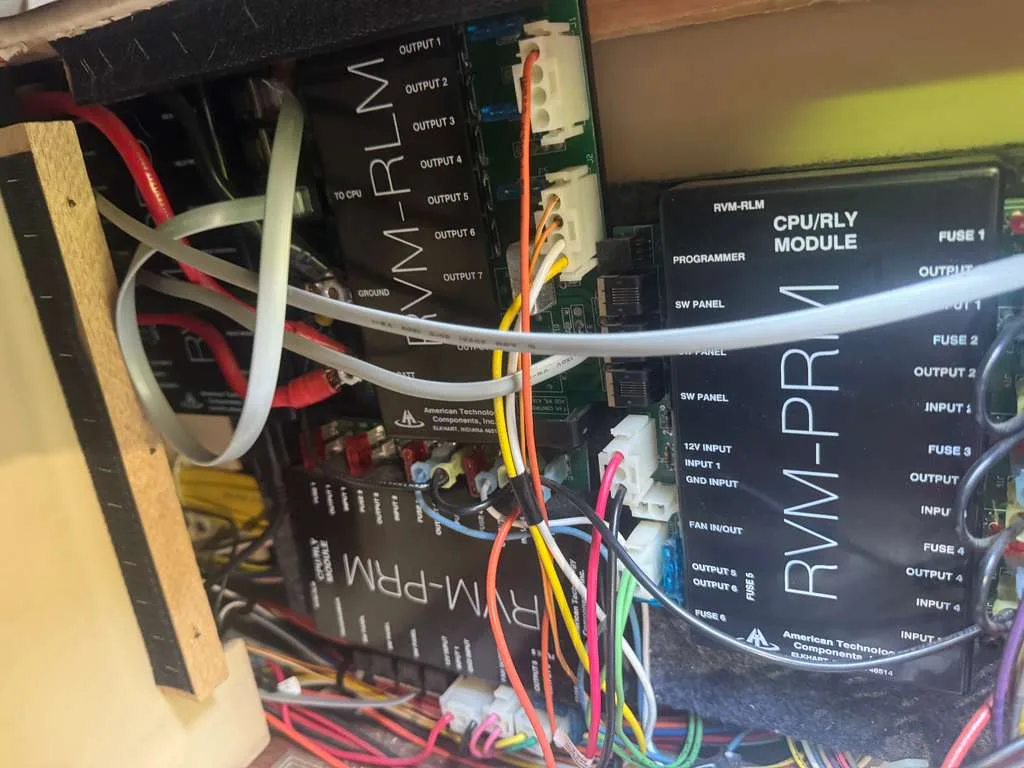
Every LiFePO4 battery carries a battery management system inside the case, and its job is to open the charge circuit rather than let the pack damage itself. The most common trigger is temperature, because LiFePO4 must not be charged below about 32F, so the BMS refuses charge current and the panel shows a bank that reads healthy and accepts nothing. Rigs here run all twelve months with no winter lay-up, so the wear on cables, lugs and hold-downs never pauses, but the cold cutoff almost never fires while the coach stays in state. It fires the week you tow north in January, park in the mountains and wake to a full-voltage bank that will not take a single amp. Heated LiFePO4 models exist for exactly that case, because the pack has to come back above its own cutoff before the BMS will pass a single amp, and no charger can force it. A BMS also disconnects on overcurrent or cell imbalance, which looks identical to a dead battery from the driver seat.
How our technicians sequence a conversion, and what it costs
The call almost always opens with "my RV battery is not staying charged," so the first visit is diagnosis rather than parts. Our technicians read resting voltage, then actual charge current at the bank with a Fluke 376 FC clamp meter, then voltage drop between converter output and battery post, because a bank that never sees more than three or four amps has a charging fault and not a battery fault. The install itself is the straightforward half: 2/0 AWG cable and hydraulically crimped lugs, a Class T fuse at the positive post, a Blue Sea busbar, and a Victron SmartShunt so the owner finally sees true state of charge. Convert the bank and skip the charging sources and you have bought a battery that will never reach full. Budget the charging sources into the conversion from the start rather than as a later phase.
Sources
Every figure on this page comes from a manufacturer document or a standards body, not from another repair site. Here is where each one comes from.
- Victron Energy Orion-Tr Smart DC-DC charger product pageThat the correct part between a chassis alternator and a house bank is a DC-DC charger rather than a plain isolator. Victron describes the Orion-Tr Smart as an adaptive three-stage charger for dual battery systems where the starter battery, and therefore the alternator, charges the service battery, and states it suits both lead-acid and lithium banks.
- Victron Energy Orion XS DC-DC battery chargersThe 50-amp DC-DC option named in the sizing discussion, and the reason the unit is sized to the alternator. Victron lists the Orion XS in 12/12-50A and 12/12-70A models, so these chargers are rated and selected by their own output current, and states that input current can be precisely limited to prevent alternator overload.
- Battle Born Batteries, understanding temperature limits of LiFePO4That a LiFePO4 battery management system blocks charge current at low temperature near freezing, so the bank reads a healthy voltage and accepts nothing. This is the mechanism behind the low-temperature cutoff section.
Related repairs
Other systems we service
Where we work
Service category
What this usually costs
| Item | Price | What it covers |
|---|---|---|
| Service call | $299 | Includes the trip out to your RV and the first hour on site |
| Work past the first hour | Quoted after diagnosis | We tell you what it will take before we carry on |
| Parts | Quoted per job | Special-order parts may need a deposit before we order them |
| Written estimate | No charge | You approve the estimate before any work starts |
The service call covers the trip out to your RV and the first hour on site. Anything beyond that depends on what we find, and we quote it and get your approval before carrying on.
The price ranges on this page come from our own recent jobs across Florida, not from an industry average. What you pay depends on the rig, the parts it needs and what we find on site, so we give you a written estimate before any work begins and you approve it first.
Frequently asked questions
How much do lithium batteries cost?
Our service call covers the trip out and the first hour on site at the rate in the pricing table on this page; anything past that first hour is quoted and approved before we carry on. Hardware price swings enormously by brand and amp-hour, so we quote the bank only after sizing it against your actual loads. Budget for the supporting parts as well, since the DC-DC charger, Class T fuse, cable and shunt are the line items owners forget.
Why is my RV battery not staying charged?
The battery is the suspect far more often than it is the culprit. A converter stuck on the wrong stage, a corroded ground at the frame, an undersized cable dropping voltage, or a BMS that has opened on overcurrent will all present as a bank that dies overnight. Our technicians measure charge current before recommending any battery, because replacing a healthy bank into an unchanged charging system reproduces the same symptom within weeks and costs the owner twice.
Is a lithium conversion ever not worth it?
Often, and we say so. If your rig lives on shore power at a seasonal site and never dry camps, lithium buys you almost nothing that a decent AGM pair does not already deliver. If the budget will not stretch to a lithium-capable converter and a DC-DC charger, stop, because a lithium bank held at the wrong voltage is a worse purchase than the lead-acid it replaced. Small 30-amp coaches with no solar and light loads are usually better served by fixing the charging system first.
Do you replace corroded battery hold-down brackets, and what retrofit brackets do you use?
Yes, and on conversions it is close to routine, since a bay that has held vented flooded batteries for years usually has acid-eaten steel underneath. LiFePO4 cases are also lighter and often a slightly different footprint, so the original J-hook and rod frequently no longer clamp anything. Our technicians fit a stainless J-hook and threaded rod set or a fabricated aluminum tray sized to the new case, since an unsecured bank chafing a positive cable in a moving coach is a fire risk.
Do you deliver and install chassis batteries too?
Yes. Chassis and house are separate systems, and we regularly bring out a chassis starting battery on the same visit as house bank work, which spares you a second service call. Note that we do not recommend converting the chassis start battery to LiFePO4 on most coaches, because the engine charging circuit has no current limit and the starter draw and BMS protections do not pair well. Lead-acid or AGM stays the right answer on the chassis side for most rigs.
What is the cheapest way to diagnose a battery or inverter issue?
One properly instrumented service call. Guessing at parts is what actually costs money, and we see owners who bought two battery banks before anyone put a clamp meter on the charging circuit. Our technicians arrive, load-test, read charge current and voltage drop, and tell you which single component is failing before anything is ordered.