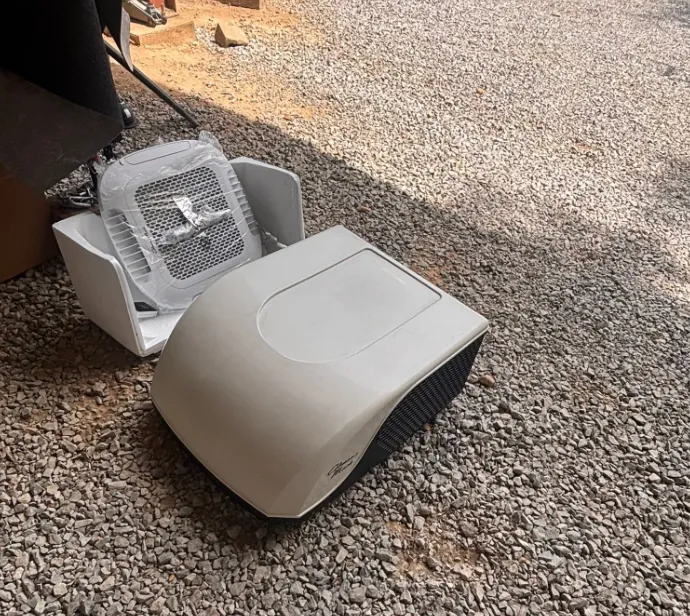
Coleman-Mach AC Repair: Mobile RV Service Across Florida
Coleman-Mach rooftop AC humming, tripping off or blowing warm? Our technicians diagnose and repair Mach units on site statewide. Call 888-759-1438.
A Coleman-Mach is a rooftop air conditioner built by Airxcel that sits over the 14 by 14 inch vent opening, with the compressor, run capacitor, coils and control box all outside on the roof under a molded plastic shroud. Only the ceiling assembly is inside the coach. So when a Mach hums and shuts itself off, the fault is almost always in that rooftop control box rather than in anything visible from a chair.
The Rooftop Unit Hums, Then Shuts Off Before The Coach Cools
Owners describe compressor lockout almost identically every time - the unit hums for a second or two, clicks, the fan keeps blowing warm air, and nothing gets cold. That is a compressor trying to start and failing, not a compressor that has already died. On a Coleman-Mach the only motor start component is the dual run capacitor in the rooftop control box, and when its capacitance drops the compressor pulls locked rotor current, heats its internal overload protector and trips itself off. The protector then holds it out until it cools, which is why the coach cools fine for ten minutes at seven in the morning and refuses all afternoon. Low incoming voltage produces the identical complaint, so our technicians meter at the unit rather than at the pedestal. Coleman rates these for 115 volt service, and the practical floor is around 103.5 volts measured while the compressor is pulling in.
The Order Our Technicians Work A Mach: Shroud Off, Control Box First
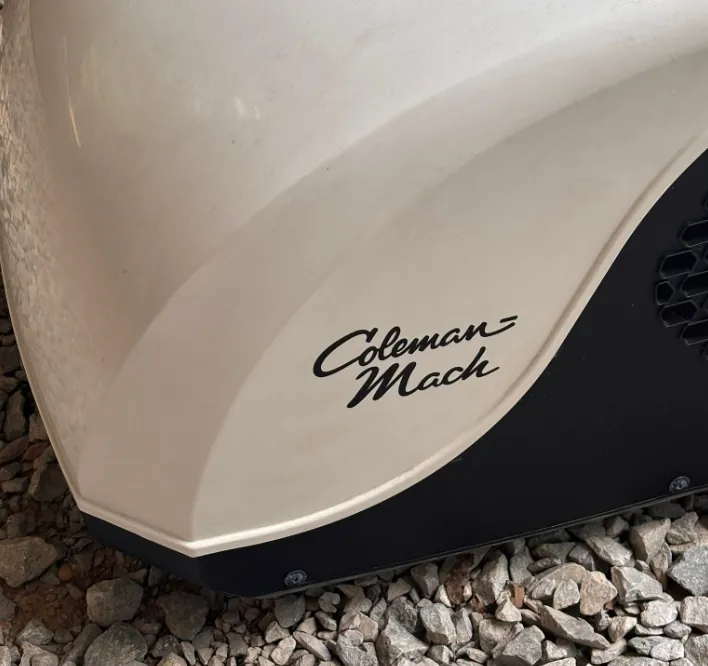
We work a Mach from the outside in, because every part that fails on one lives on the roof. The shroud comes off first, and it comes off with a nut driver rather than a screwdriver, since the screws thread into molded plastic bosses that strip once the plastic has aged. With it off we photograph the model and serial label on the base pan, then read the control box before metering anything: capacitor terminals, the compressor relay, the thermostat terminal block, and any staining that says water has been inside. Only then do the meters come out. A capacitance capable multimeter reads the run capacitor against its printed rating, a clamp-on ammeter reads compressor draw at start and at run, and a probe thermometer reads the return-to-supply split at the ceiling assembly. Coils, fan motor and mounting gasket come last, because those present differently than a lockout.
Why Coleman-Mach Shrouds Crack Here, And What Gets Wet When They Do
The shroud is a single molded plastic piece, and at Florida latitude the UV inhibitor blended into it is consumed long before the metal underneath is finished. It goes chalky first, then brittle, then splits at the corners and around the screw bosses, usually starting on the face that takes the afternoon sun. Owners read that as cosmetic damage. It is not, because the shroud is the only thing between driving rain and the control box, the capacitor terminals and the fan motor sitting in the open on the base pan. The same exposure attacks the foam mounting gasket between the unit and the roof, which takes a compression set and stops sealing the 14 by 14 inch opening. That is the mechanism behind most interior water calls we get on Mach units, and none of it shows up while the coach sits in shade.
Inside The Control Box: Run Capacitor, Compressor Relay, Three Minute Delay
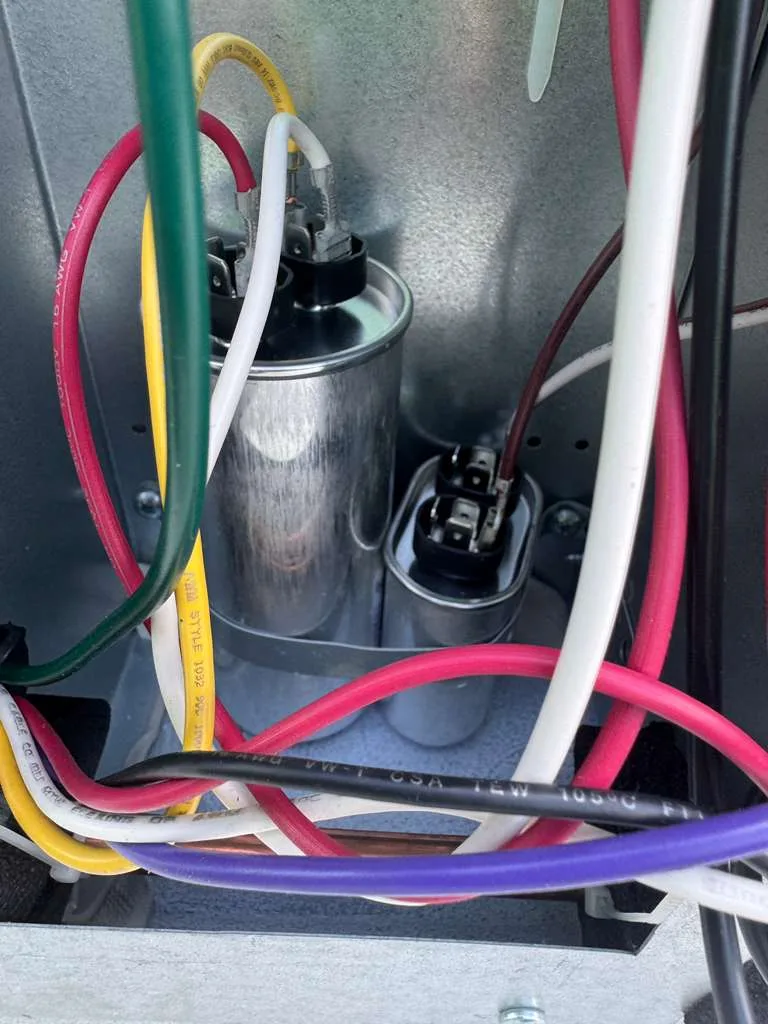
The control box is a metal enclosure on the base pan holding the dual run capacitor, the compressor relay, the fan wiring and, on ducted units, the low voltage terminal block the wall thermostat lands on. Everything electrical is in one place, which makes it the fastest thing to rule in or out. Dual run capacitors on a 13,500 BTU Mach commonly fall in the 35/5 to 45/5 microfarad range at 370 volts, and tolerance is about six percent, so a 35 microfarad section reading 32 has failed even though the meter still shows a number. Older mechanical control Mach 3 units carry no compressor time delay at all. Newer control boards hold the compressor out for roughly three minutes after a shutdown, and an owner who cycles the thermostat inside that window reports a dead air conditioner that was only counting.
Weak Airflow, Iced Coils And Water At The Ceiling Assembly
A Mach that runs continuously, moves air, and only limps toward cold is usually an airflow fault rather than a refrigerant fault. Return air enters through the ceiling assembly filters, crosses the evaporator coil and leaves through the register or the ducts. When the filters load, the coil runs colder than design, condensation freezes into a solid block across it, and airflow collapses further until the owner sees water at the ceiling assembly as that ice melts. Up on the roof the condenser coil packs with pollen, road film and coastal salt, and flattened fins on the sun side cut heat rejection until the compressor trips on head pressure. Our technicians comb and wash both coils, clear the drain slots at the base pan corners, and read the split between return and supply air, which should land in the high teens on a healthy unit.
What Each Finding Turns Into, And What You Decide
Each finding on a Mach carries its own scope. A run capacitor lives in the rooftop control box, reads in seconds on a capacitance capable multimeter and swaps in place, so it stays one visit whenever the correct 35/5 to 45/5 microfarad part at 370 volts is already on the truck. A fan motor or a whole control box means unbolting the assembly, moving wiring one lead at a time and rechecking the ceiling assembly afterward, which is longer roof time plus a part ordered against the model and serial label on the base pan. That label is the usual reason a Mach job becomes two visits, because it is only readable once the shroud is off. A seized compressor is different in kind: the circuit is sealed at the factory, there is no field repair, and the decision moves to a replacement unit weighed against the age of the coach. Waiting has its own price, because a weak capacitor forces a hard start every cycle until the morning nothing turns at all.
Sources
Every figure on this page comes from a manufacturer document or a standards body, not from another repair site. Here is where each one comes from.
- Coleman-Mach (An Airxcel Brand) - manufacturer siteThat Coleman-Mach is an Airxcel brand manufacturing RV rooftop air conditioners, heat pumps, ceiling assemblies and thermostats, as stated in the opening description of what a Coleman-Mach is.
- Coleman-Mach - RV air conditioner product seriesThat Coleman-Mach rooftop units are their own product families with their own ceiling assemblies and controls, supporting the claim that Coleman-Mach and Dometic Penguin II parts do not cross over.
- Coleman-Mach Document Library - installation and service manualsThat model specific installation and service documentation is published by the manufacturer, supporting the point that the model and serial label on the base pan under the shroud is what determines the correct part.
- Airxcel - brand familyThat Airxcel is the parent manufacturer behind Coleman-Mach, as asserted in the lede.
Related repairs
- our Furrion Chill Ac Repair service
- Rv Ac Soft Start Install in Florida
- how we handle suburban furnace repair
Other systems we service
Where we work
Service category
What this usually costs
| Item | Price | What it covers |
|---|---|---|
| Service call | $299 | Includes the trip out to your RV and the first hour on site |
| Work past the first hour | Quoted after diagnosis | We tell you what it will take before we carry on |
| Parts | Quoted per job | Special-order parts may need a deposit before we order them |
| Written estimate | No charge | You approve the estimate before any work starts |
The service call covers the trip out to your RV and the first hour on site. Anything beyond that depends on what we find, and we quote it and get your approval before carrying on.
The price ranges on this page come from our own recent jobs across Florida, not from an industry average. What you pay depends on the rig, the parts it needs and what we find on site, so we give you a written estimate before any work begins and you approve it first.
Frequently asked questions
Is it the rooftop air conditioner or the engine?
They are two separate systems with separate failures. Dash air runs off the engine and only cools while you are driving, while the Coleman-Mach on the roof runs on 120 volt shore power or the generator and cools the coach when you are parked. One useful test before we arrive: if the Mach behaves on shore power but struggles on the generator, we look at generator output and voltage under load first, not at the air conditioner.
The rooftop unit, what seems to be the issue?
That is the first thing we ask, and your answer routes the visit. Tell us whether the fan still runs, whether the compressor hums and clicks off, whether it cools for a while then quits, or whether water is showing up inside. Hums and quits points at the capacitor or supply voltage. Runs and never cools points at airflow, coils or the sealed system. Water points at drains or the mounting gasket.
Do you know the model of the rooftop AC?
Most owners do not, and you can book without it. The model and serial label sits on the base pan under the shroud, invisible from the ground and from inside the coach. It matters because Coleman-Mach and Dometic Penguin II parts do not cross over: different height and internal layout, different capacitors and fan motors, and a Coleman ceiling assembly will not talk to a Dometic thermostat. A photo of your ceiling assembly and thermostat usually settles it.
Where is rooftop air conditioner leaking?
Two very different sources, and the timing tells us which one. Water arriving while the unit is running is condensate that could not leave, caused by an iced evaporator coil or blocked drain slots at the base pan corners, and it stops once the airflow fault is corrected. Water arriving after rain with the unit switched off is the mounting gasket over the roof opening, or a split shroud letting rain into the base pan.
Is it rooftop, or does the unit have to come off the coach?
Almost everything on a Coleman-Mach is a rooftop repair done in place with the shroud off: run capacitor, compressor relay, fan motor, control box, coil cleaning and shroud replacement. The unit only comes off its mounting bolts for a gasket replacement or a full unit swap, and that is scheduled work rather than something done off the back of the truck on a first visit.
What does it cost to have someone come out and look at a Coleman-Mach that will not start?
Our service call covers the trip out and the first hour on site at the rate in the pricing table on this page; anything past that first hour is quoted and approved before we carry on. You get the finding and the number before we replace anything, and we do not put a fixed price on a rooftop unit nobody has opened yet.