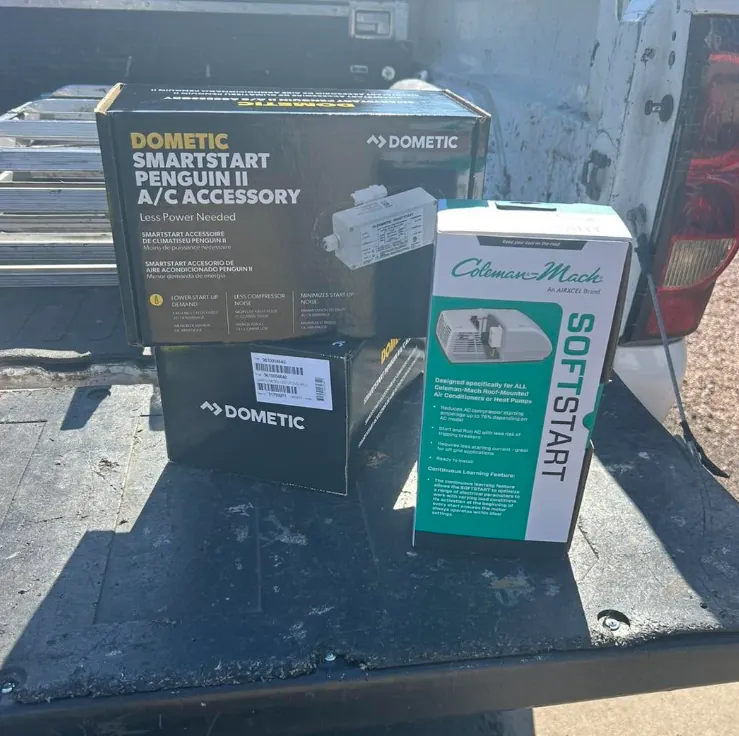
RV AC Soft Start Install: Run Your Air Conditioner on 30A
Breaker trips the second the AC starts? Our technicians fit Micro-Air EasyStart and SoftStartRV soft starts anywhere in Florida. Call 888-759-1438.
Before our technicians fit a soft start, we measure three things in order: the pedestal or generator voltage under load, the compressor's locked rotor inrush with a clamp meter set to INRUSH, and the run capacitor's actual microfarad value. A rooftop RV air conditioner pulls roughly 55 to 70 amps for a fraction of a second at startup. A soft start ramps that down to about 20 to 25 amps.
The breaker trips the second the air conditioner kicks on
The call usually arrives the same way: the pedestal breaker snaps off the instant the air conditioner tries to start, or the generator bogs down, coughs and stalls. The unit itself often sounds perfectly healthy for the half second it does run. That is the signature of a startup surge problem rather than a cooling fault, and it is a completely different job from a rooftop AC repair. An RV rooftop unit spends almost all of its working life drawing 12 to 17 amps. For roughly a third of a second at every compressor start it demands several times that. If the hookup is a 30 amp NEMA TT-30 pedestal, the power source is a 2,000 watt inverter generator, or the coach is running off a battery bank, that brief spike is the only number that matters. Everything our technicians do on this job is aimed at that fraction of a second.
Why the startup surge trips a 30 amp pedestal when the running load does not
A compressor motor sitting at rest generates no back EMF. The moment 120 volts hits the windings, the only thing limiting current is the copper's own resistance, so the motor pulls locked rotor amps until the rotor breaks away and begins generating opposing voltage. On a 13,500 BTU rooftop unit that figure is commonly 55 to 65 amps, and on a 15,000 BTU unit it is often 65 to 80. A 30 amp pedestal is 30 amps at 120 volts, or 3,600 watts for the entire coach. Breakers are thermal devices and will tolerate a brief overload, which is why the surge sometimes passes and sometimes does not. Cord length, a corroded pedestal lug and a hot afternoon all push it toward tripping. Generators and inverters are far less forgiving, because they have no thermal lag at all: an inverter asked to surge past 4,000 watts simply shuts down.
What our technicians check before fitting anything
We do not sell a soft start before measuring, because three different faults produce an identical complaint. First we read pedestal or generator voltage under load with the air conditioner calling, because anything sagging below roughly 105 volts makes the compressor draw more current rather than less, and the real fix there is the cord, the lug or the pedestal instead of a controller. Second we clamp the compressor lead with a meter set to INRUSH, a Fluke 376 FC or a Klein CL800, and capture the actual locked rotor figure instead of guessing at it. Third we pull the shroud with a 5/16 nut driver and measure the dual run capacitor out of circuit against its printed rating, typically 35/5 uF at 370 volts. Only when the supply voltage holds and the capacitor reads inside tolerance does a soft start become the correct part to sell you.
Why would a capacitor go?
That is a question owners ask us on the phone almost every week, and the honest answer is heat plus time. A run capacitor is a wound device sitting in a control box under a black plastic shroud on a roof, and through a sustained 90F Florida afternoon that box runs far hotter than the outside air, so the dielectric slowly loses capacitance. A capacitor rated 35 uF that has drifted down to 29 uF still lets the unit run, so nothing sounds wrong to the owner. What changes is the start: the phase shift to the start winding weakens, the rotor takes longer to break away, and locked rotor current climbs and holds for longer. That is why a coach that lived happily on 30 amps for four seasons suddenly starts tripping. Bolting a soft start onto a drifting capacitor hides that for a while, which is precisely why we measure the capacitor first.
Micro-Air EasyStart and SoftStartRV: where the controller wires in
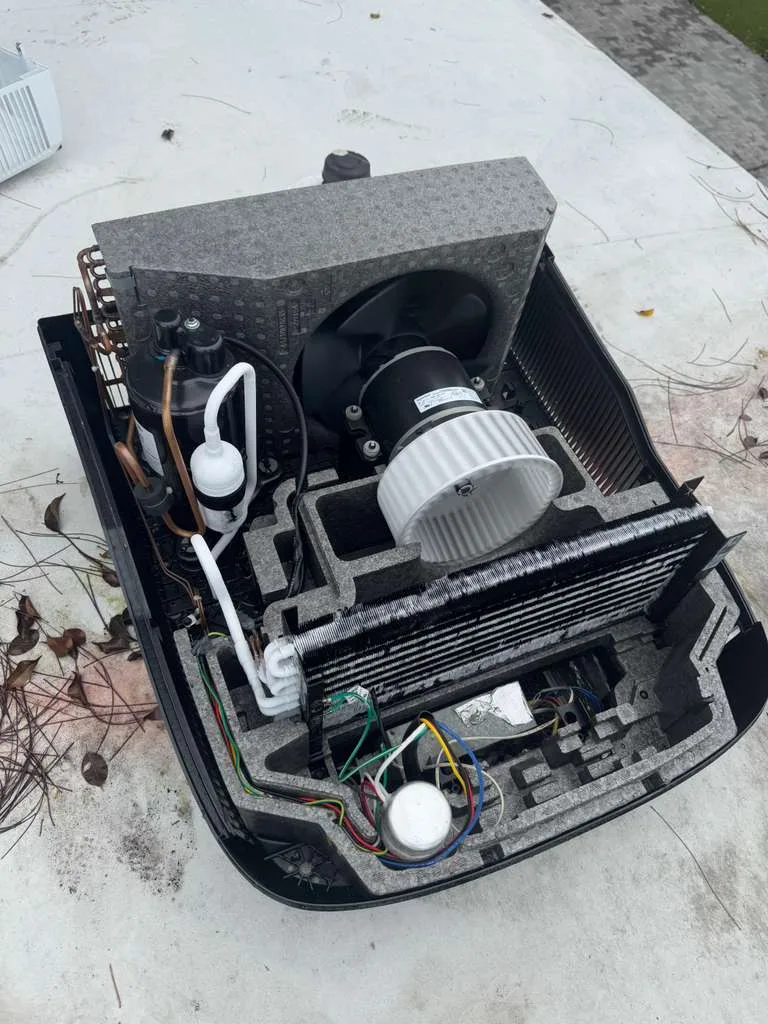
A soft start is a solid state controller that phase cuts the incoming AC waveform for the first half second of every compressor start, ramping the voltage up instead of applying all of it at once. The Micro-Air EasyStart 364 and the SoftStartRV SSRV-3T are the two units our technicians fit most often, and Hyper Engineering's SureStart turns up on some factory installations. All three bring measured inrush down to roughly 20 to 25 amps. The controller lives inside the air conditioner's own control box under the rooftop shroud, not anywhere in the coach. It is a three wire hookup: the device is inserted in series in the line feeding the compressor common terminal, with the third lead landed on the opposite leg. Any existing hard start kit, PTC relay or start capacitor has to come out, because two devices fighting over one start event is worse than neither. The run capacitor stays.
Generators, inverters and lithium: what a soft start unlocks
What a soft start actually buys you is headroom during that half second, and that headroom is what makes three setups workable. A Honda EU2200i or a 2,800 watt Onan will usually start a 13,500 BTU rooftop unit once a soft start is fitted and usually will not without one. A 2,000 watt inverter rated to 4,000 watts surge stops dropping into overload shutdown. A 30 amp pedestal will carry one air conditioner alongside a converter and a water heater instead of dropping out at every cycle. What it does not buy is running capacity. A 15,000 BTU unit still pulls its 13 to 17 amps continuously once the surge is over, so a LiFePO4 bank feeding the air conditioner through a Victron inverter still burns somewhere near 1,500 watts an hour. Soft starts change the peak and never the plateau, and that single distinction decides whether a battery plan works.
What the install involves, and what the failed starts turn into
A soft start fit is one visit when the rest of the system is healthy. The shroud comes off, the controller mounts inside or beside the rooftop control box, and its leads move to the compressor common, start and run terminals, so nothing about the coach's own wiring changes. The visit stretches for one reason: the checks that come first sometimes find something else. A run capacitor that has drifted, a pedestal sagging under load, or a compressor already damaged each change the job, and a capacitor not carried in the right rating turns it into a second trip. Leaving the tripping alone is the expensive path. Every failed start is a locked rotor event the compressor absorbs as heat in its windings, and repeated stalls do the same to a generator. A compressor hammered that way for a season does not get a soft start later, it gets a whole replacement rooftop unit, because these refrigeration circuits are sealed at the factory.
Sources
Every figure on this page comes from a manufacturer document or a standards body, not from another repair site. Here is where each one comes from.
- Micro-Air - EasyStart soft starter (manufacturer product page)The manufacturer's own figure of up to a 75 percent reduction in air conditioner starting current, and the multi-start resettable learning algorithm that is the reason our info gain says to measure inrush on the third to fifth start rather than the first.
- Micro-Air - EasyStart soft starter range, direct from the manufacturerThat the EasyStart 364 and its siblings are Micro-Air products sold and supported by the manufacturer, supporting the naming of the Micro-Air EasyStart 364 as one of the two controllers our technicians fit most often.
- Coleman-Mach - Soft Start Series RV air conditionersThe manufacturer's statement that a soft start reduces the start-up power surge that trips RV breakers, which is the mechanism this page describes and the reason a soft start is not a cooling repair.
- Dometic - Rooftop RV Air Conditioners (13,500 and 15,000 BTU line)That the 13,500 and 15,000 BTU rooftop units named in the surge and running load figures are the standard Dometic rooftop capacities a soft start is fitted to.
Related repairs
Other systems we service
Where we work
Service category
What this usually costs
| Item | Price | What it covers |
|---|---|---|
| Service call | $299 | Includes the trip out to your RV and the first hour on site |
| Work past the first hour | Quoted after diagnosis | We tell you what it will take before we carry on |
| Parts | Quoted per job | Special-order parts may need a deposit before we order them |
| Written estimate | No charge | You approve the estimate before any work starts |
The service call covers the trip out to your RV and the first hour on site. Anything beyond that depends on what we find, and we quote it and get your approval before carrying on.
The price ranges on this page come from our own recent jobs across Florida, not from an industry average. What you pay depends on the rig, the parts it needs and what we find on site, so we give you a written estimate before any work begins and you approve it first.
Frequently asked questions
Will a soft start let me run both air conditioners on a 30 amp hookup?
No, and this is the single most common misunderstanding we correct on the phone. A soft start only reduces the startup surge and does nothing at all to running current. Two 15,000 BTU units draw roughly 26 to 34 amps continuously, which is at or beyond the 3,600 watt ceiling of a 30 amp pedestal before your converter, water heater or microwave is counted. Two air conditioners need 50 amp service, not a controller.
Can a soft start run my air conditioner off a Honda EU2200i?
Usually yes for a single 13,500 BTU unit, and usually no without one. The EU2200i is rated near 1,800 watts continuous, which comfortably covers the roughly 1,400 to 1,700 watt running load, but the unmodified startup surge is well past its surge rating. With inrush cut to about 20 to 25 amps the generator carries the start cleanly. A 15,000 BTU unit is marginal and depends on ambient heat.
Does a soft start lower my running amps or my electric bill?
It does not. The controller is only active for roughly half a second at each compressor start, then passes line voltage straight through, so steady state draw is unchanged at 12 to 17 amps depending on the unit. Anyone selling it to you as an efficiency device is selling the wrong thing. What it actually buys is the ability to start at all on limited power.
Can I install a soft start myself?
The wiring is a three wire connection inside the air conditioner's control box, so it is within reach of a competent owner. The two things that go wrong are working on a live rooftop unit and leaving an old hard start kit or PTC relay in circuit, which produces intermittent no starts that look exactly like a failed controller. Our technicians also verify inrush with a clamp meter afterward, which is the only real proof the install worked.
What does a soft start install cost in Florida?
Our service call covers the trip out and the first hour on site at the rate in the pricing table on this page; anything past that first hour is quoted and approved before we carry on. The controller itself is typically $250 to $350 depending on the model. We will not quote a fixed total before seeing the unit, because a weak capacitor or a sagging pedestal changes the job.
Will a soft start fix an air conditioner that already struggles to start?
Sometimes, and that is exactly the problem. If the run capacitor has drifted or the compressor windings are degraded, a soft start can mask the symptom for a few months while the underlying fault keeps getting worse. Our technicians measure capacitance and inrush before fitting one specifically so you are not paying to hide a failing compressor. On a healthy unit a soft start is an upgrade, not a repair.