What Should You Check on an RV After a Hurricane?
The order to work through after a storm, why the damage that matters shows up days later, and the one distinction that decides whether anyone pays for it.
Check for downed power lines and standing water before you go near the coach. Then work top down: roof, seals, openings, then interior for moisture. Do not energize anything that has been under water. The damage that decides the repair bill is usually water that entered during the storm and shows itself a week later.
Apex RV Repair is mobile across Florida - we come to your RV. Call 888-759-1438.
A coach that looks untouched after a storm frequently is not, and the difference between a cheap outcome and an expensive one is almost always how quickly water was found.
This is the order we work through on a post-storm assessment, what to do before a technician arrives, and the distinction between wind and flood that decides how the whole thing is paid for.
What is safe to do before you go near the coach?
Look for two things before anything else: power lines and standing water. A downed line in a park can energize wet ground, metal fencing and the coach itself, and it is not always obvious which line is live.
Standing water is the second, and it carries its own hazards beyond the electrical one. Storm water in Florida routinely contains sewage, fuel and displaced wildlife, and none of that is visible from the surface. If the coach is sitting in water, the answer is to wait rather than to wade.
Assume the coach's own electrical system is unsafe until proven otherwise. Do not plug into shore power, do not start the generator, and do not switch the inverter on to see whether it works. If anything is going to be damaged by being energized wet, energizing it is what does the damage.
Photograph everything from a distance first. That record is worth having before anyone moves anything.
What should you check on an RV after a hurricane?
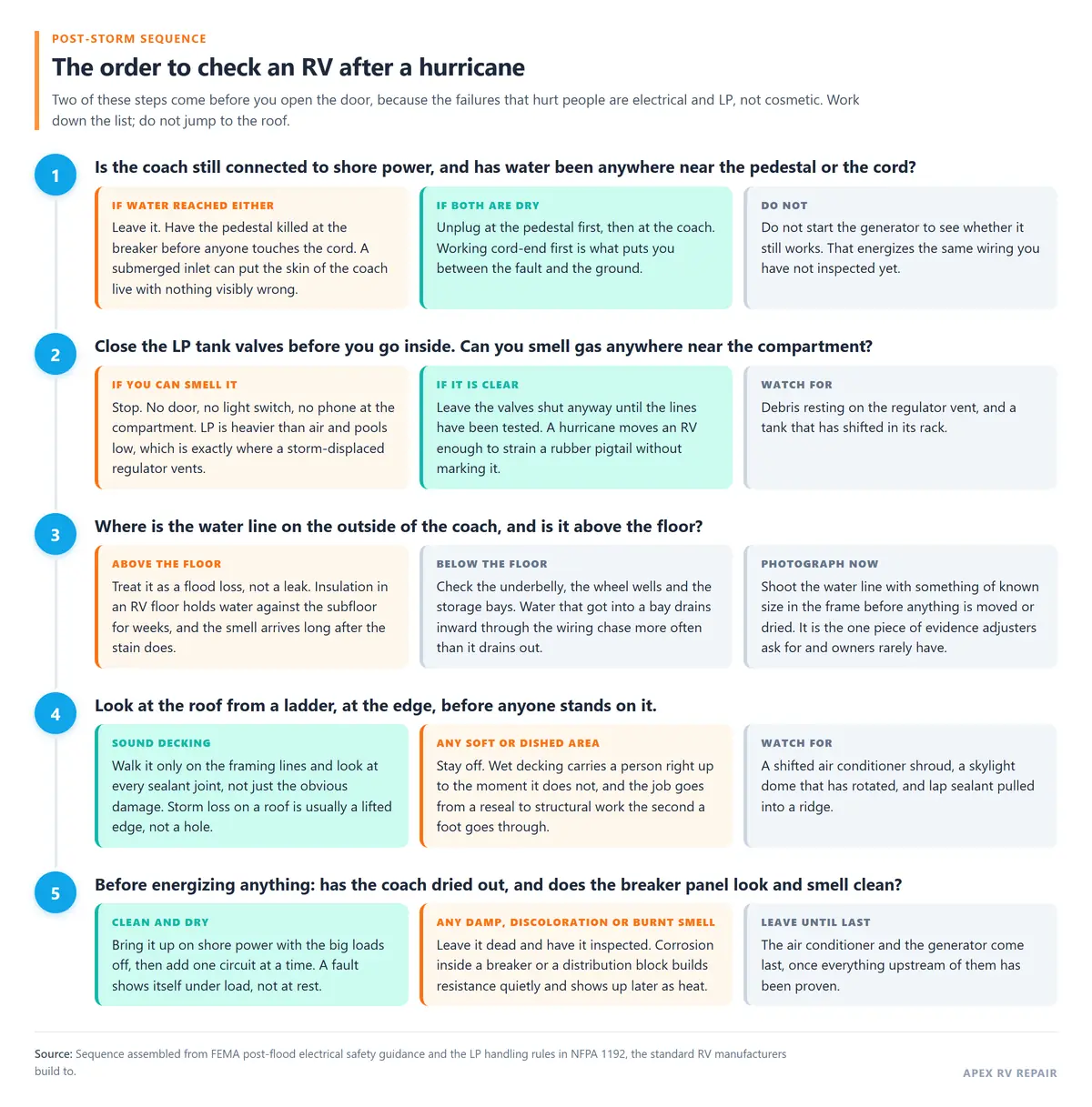
Work top down, because that is the order water travels and it stops you finding a symptom before you find its cause.
- The roof: tears, lifted membrane, missing vent covers, displaced or damaged air conditioner shrouds, and debris still sitting on it.
- Every penetration: sealant around vents, fans, skylights, antennas and the air conditioner, looking for anything lifted or split.
- The sides: awning arms and brackets, windows, doors, storage bay seals, and any impact marks.
- The underside: displaced insulation belly wrap, damaged tanks, and anything hanging that should not be.
- The interior: ceilings and upper corners first, then window surrounds, then the floor at the walls.
Photograph as you go rather than at the end. Photographs taken before anything is cleaned up or covered are the evidence any claim will rest on.
How do you check the roof without making it worse?
From a ladder at the edge rather than by walking on it, at least until you know what you are standing on. RV roofs are only load-bearing in specific places at the best of times, and a roof that has taken storm damage may have wet decking under an intact-looking membrane.
What you are looking for from the edge is anything that has changed: a tear, a lifted seam, a component sitting at a different angle, sealant that has split. Debris still on the roof matters too, because a branch left up there keeps working at the membrane every time the wind blows.
If the surface flexes at the edge where you can reach it, stop. Soft decking under a person is how a roof repair becomes a structural repair, and it is also genuinely dangerous.
A technician with a moisture meter answers in an hour what walking around guessing never will.
Why does water damage appear days after the storm?
Because water that enters at the top travels sideways through the structure before it ever reaches a surface you can see. Insulation and wood absorb it first, and only once they are saturated does anything show on a ceiling panel or at the base of a wall.
That delay is why a coach inspected the morning after can look completely fine and produce a stain the following week. Nothing changed except that the water finally arrived somewhere visible.
It also explains why the stain almost never appears above the leak. Water follows framing and wiring runs, so an entry point at a roof vent can present as a wet patch several feet away and on the opposite side.
The practical answer is to check again at three days and at a week, and to treat any new stain as a live leak rather than as residue from the storm. Our guide to water damage signs covers what to look for.
Why is flood damage treated differently from wind damage?
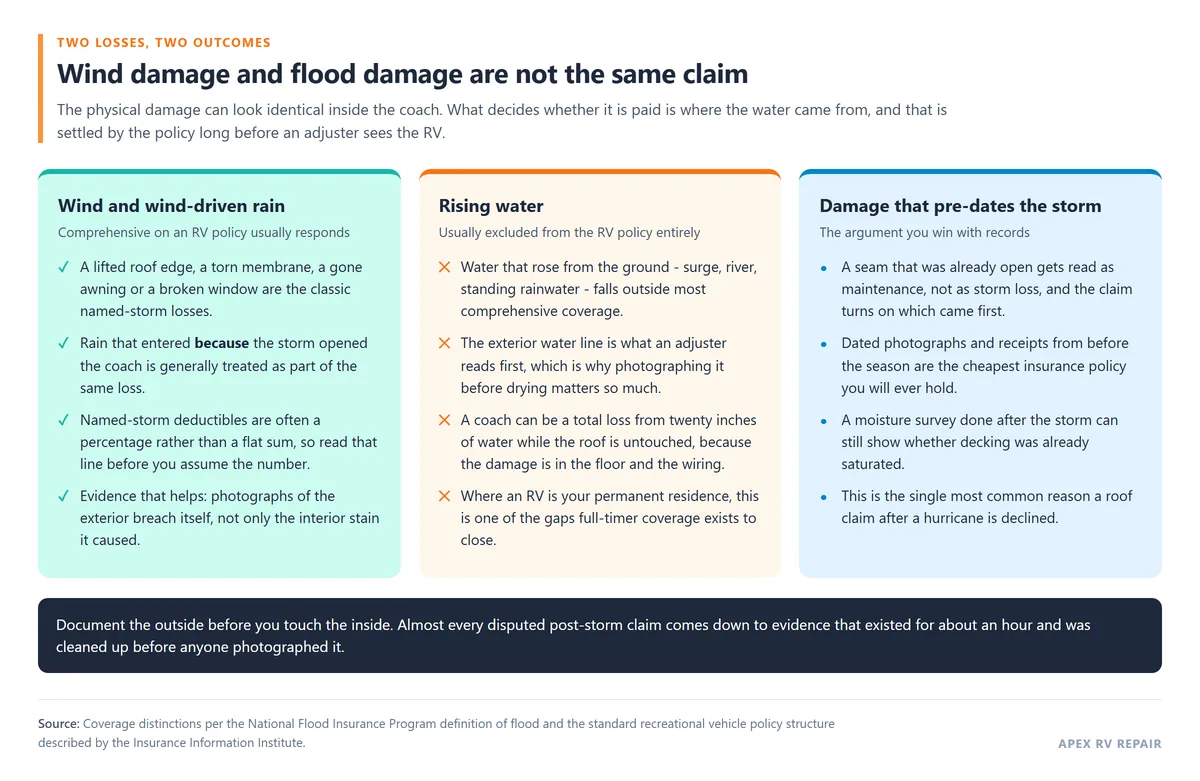
Because they are usually different products, and this is the single most consequential thing to understand after a Florida storm.
Wind damage, falling debris and impact are typically handled under comprehensive coverage on an RV policy. Rising water is generally excluded from that, and where flood is covered at all it is normally through a separate arrangement. Two coaches side by side, one hit by a branch and one that sat in two feet of water, can end up in completely different positions.
The distinction matters for what you do as well as for who pays. A coach that has been submerged has water in places wind never reaches: wiring runs, the underside of the floor, inside appliances, and inside the chassis. That is a different category of assessment.
Read your own policy on this specific point before you need to, because after the storm is the wrong time to find out.
What should you check before using the electrical system again?
Whether anything got wet, and where. This is the check most likely to prevent a second, larger loss, because energizing a wet system is how storm damage becomes fire damage.
Anything that was submerged should be treated as compromised until inspected: the converter, the inverter, the transfer switch, the shore power inlet and any outlet below the water line. Water intrusion into a 120 volt component does not always announce itself, and a device that appears to work can be tracking internally.
The same applies to the shore power cord and the pedestal it plugs into. A park pedestal that has been under water is not yours to assess, and it is worth asking the park what has been checked before plugging anything into it.
If in doubt, leave it off. Nothing in the coach is worth more than the coach.
How long should you wait before starting the generator or air conditioner?
Until each has been looked at, and the reasoning differs for the two.
A generator that has been under water must not be started. Water in the fuel system, the crankcase or the alternator windings turns a start attempt into permanent damage in seconds, and a generator that has merely been rained on is a different situation from one that has been submerged. If the water reached the generator bay, it needs draining and inspecting before it turns over.
The rooftop air conditioner is a slower risk. If the shroud was damaged or displaced, water may have reached the electrical compartment, and running it wet risks the capacitor and the control board. Give it time to dry and look inside the shroud before calling for cooling in the heat that always follows a storm.
The urge to get comfortable immediately is exactly what causes the second failure.
What does a post-storm assessment actually cover?
The point of a professional assessment is to find what you cannot see and to document it in a form an insurer will accept, which are two different jobs done in one visit.
A moisture meter reads through surfaces to find water inside the structure before it stains anything, and that is the finding that matters most, because it is both the most expensive damage and the most likely to be missed. Alongside it goes a roof and seal inspection, an electrical check on anything that got wet, and a look at the slide-out and awning mechanisms for storm loading.
What you get is a written report with photographs, moisture readings and locations. That is what turns a conversation with an adjuster into a documented claim, and it is the same report that tells you what to fix first.
Our guide to roof leak claims covers how that evidence is weighed.
What a visit costs
A service call is $299 and covers the trip out to your RV and the first hour on site. Work past that first hour is quoted to you once our technician has found the fault, before we carry on. In Orlando, Lakeland, Kissimmee, Apopka and nearby the service call is $399 and time past the first hour runs $200 per hour. Written estimates are free and you approve one before any work starts. Call 888-759-1438.
Sources and further reading
Every figure above that came from a manufacturer or a standards body is linked here so you can check it yourself.
- National Weather Service - Tallahassee - Official forecasts and post-storm information for Florida, including when conditions are safe to return.
- Florida Office of Insurance Regulation - The state regulator, including consumer guidance on storm claims and how flood is treated separately.
- Florida Highway Safety and Motor Vehicles - insurance - Florida's guidance on vehicle insurance requirements and coverage types.
- US EPA - brief guide to mold, moisture and your home - Why the days immediately after water entry decide whether a wet panel becomes a mold problem.
- OSHA - electrical hazards - The hazards behind downed lines, wet ground and energizing a system that has been under water.
Related pages on this site
- Post-hurricane RV assessment - the documented inspection an insurer will accept
- RV moisture and leak survey - finding water inside the structure before it stains anything
- Signs of RV water damage - what to watch for in the weeks after
- Will insurance cover an RV roof leak - how sudden damage is separated from gradual
- RV repair in Fort Myers - storm assessment on the southwest coast
Post-hurricane RV questions Florida owners ask
My RV looks fine after the storm. Do I still need it checked?
If it took wind, debris or standing water, yes. The damage that costs the most is water inside the structure, and that is invisible for days and sometimes weeks. A moisture survey finds it while it is still a sealing job rather than after it has become a subfloor job.
Can I run my generator after the storm to get power?
Only if the generator bay did not take water. A submerged generator must not be started, because water in the fuel system, crankcase or windings causes permanent damage the moment it turns over. Rain on the outside is a different situation from water inside the bay.
Does RV insurance cover hurricane damage?
Wind, debris and impact are commonly handled under comprehensive coverage. Rising water is generally excluded and, where flood is covered at all, it is normally arranged separately. Which one caused your damage decides the whole claim, so it is worth reading that part of the policy before a storm rather than after.
How soon after a storm should I have the RV inspected?
Within a few days, and sooner if you saw water enter. Prompt notice is a condition of most policies, and in Florida heat the window between wet material and mold is short. Both the claim and the repair get harder the longer it waits.
Should I move the RV before it is inspected?
Only if leaving it is unsafe. Moving a coach with storm damage can worsen it, particularly if the roof is compromised or a slide or jack was damaged, and it also disturbs the scene an adjuster may want to see. Photograph everything thoroughly before moving anything.
What if my RV was under water?
Treat it as a different category of assessment entirely and do not energize any system. Submersion puts water into wiring runs, appliances, the underside of the floor and the chassis, none of which wind damage reaches. It needs professional assessment before power, and the insurance position is usually different too.