What Does RV Slide-Out Repair Cost in Florida?
Cost splits by which mechanism you have, not by how big the room is. What motors, seals and toppers involve, and the finding that turns a slide job into a floor job.
There is no single price for slide-out repair because there is no single slide-out. Schwintek in-wall, cable, rack and pinion and hydraulic are four different mechanisms with different parts and different labor. Establishing which one your coach has is the first thing that turns a guess into a quote.
Apex RV Repair is mobile across Florida - we come to your RV. Call 888-759-1438.
Slide-out quotes vary more than almost any other RV job, and the reason is that owners and technicians are often not discussing the same machine.
Four mechanisms are in common use, they fail differently, and they cost different amounts to put right. This page covers what each involves, what makes a job cost more than the estimate, and the point where a slide repair stops being a slide repair.
Why does the cost depend on which slide system you have?
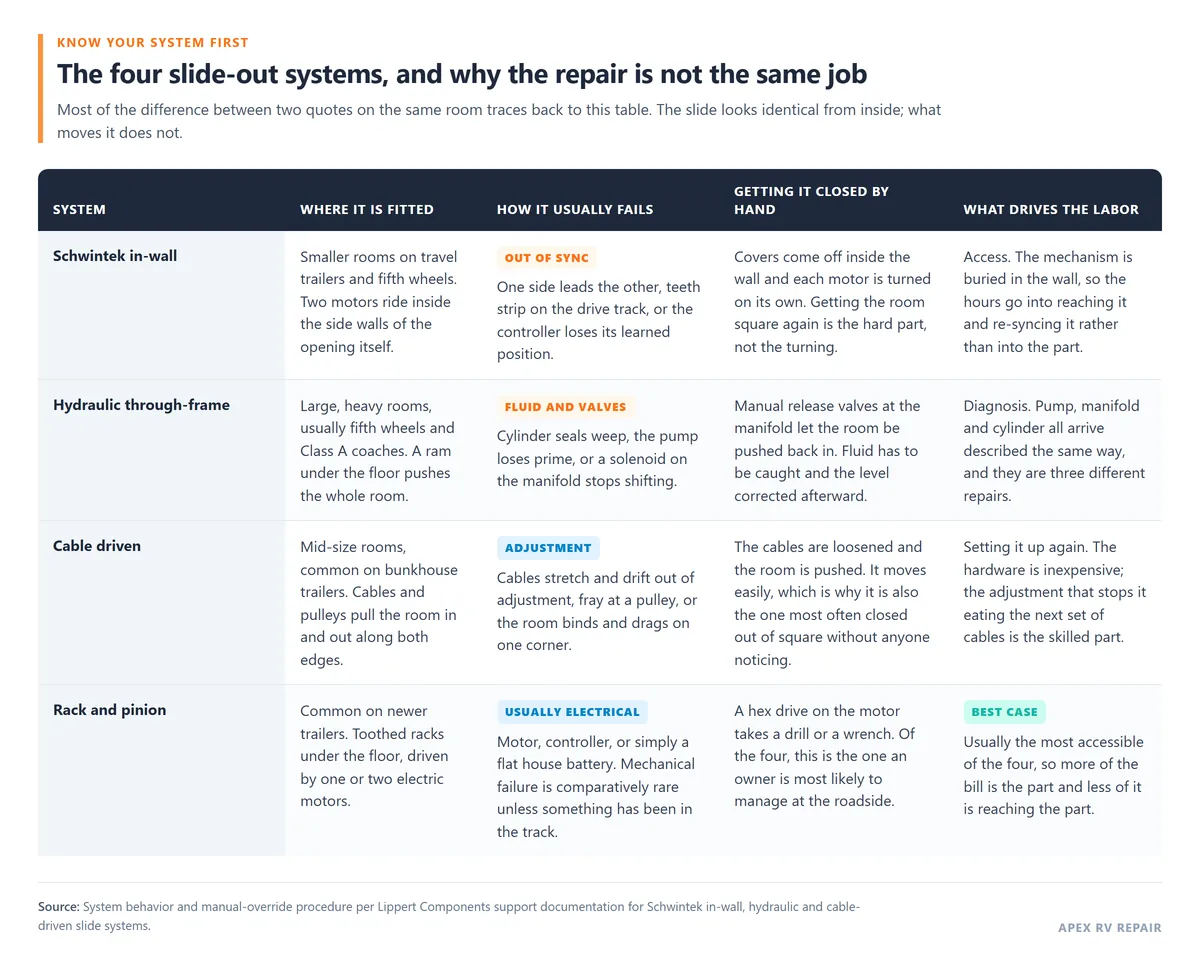
Because the four systems share almost nothing beyond the job they do. A Schwintek in-wall system drives the room from vertical toothed rails inside the wall, using two small motors that must stay synchronized. A cable system pulls the room in and out on cables through a gearbox.
A rack and pinion system runs the room on toothed rails underneath, driven by a single motor through a shaft. A hydraulic system uses a pump and rams and behaves like heavy machinery rather than like an electric mechanism.
Those differences decide everything downstream. Parts prices differ, access differs, and the labor differs enormously: a Schwintek motor is reached from the wall, and a hydraulic ram is reached from underneath the coach.
Our RV slide-out troubleshooting guide explains how to work out which one your coach has.
What does replacing a slide-out motor involve?
Less than owners expect on some systems and considerably more on others, which is why this is the line that moves a quote most.
On a rack and pinion system the motor is usually accessible from beneath the coach and the swap itself is straightforward. On a Schwintek in-wall system there are two motors, one at each side, and after replacement the system has to be re-timed so both sides move together. Skipping that step is how a room ends up crooked.
The part that catches people is that a replaced motor frequently was not the fault. Slide motors draw serious current, and a bank of batteries that cannot supply it under load produces exactly the symptoms of a failing motor: clicking, stalling, moving partway and stopping.
A technician who puts a meter on the batteries under load before quoting a motor is doing you a genuine favor, and it is fair to ask whether that was done.
What does it cost to replace slide-out seals?
Seals sit at the cheap end and they punch far above their price, because what they prevent is water entering the wall and the floor.
Cost is driven by how many seals and how long the room is, since a slide has bulb seals and wiper seals on multiple edges and they are not all replaced at once as a rule. A single torn wiper on one edge is a small job; a full set on a large living room slide is a much larger one.
What makes seals worth doing early is the alternative. A failed seal lets water into the slide floor, and slide floors are thin laminated panels that delaminate and rot quickly once wet. The seal is a fraction of the floor.
Florida accelerates this. Ultraviolet exposure hardens the rubber and daily summer storms test every edge, so seals here need conditioning and inspection more often than the general guidance suggests.
What makes a slide repair cost more than the estimate?
Four findings, and every one of them is found on the coach rather than predicted on the phone.
- A soft or delaminated slide floor, discovered once the room is out and the underside can be seen.
- Damage to the opening the room travels through, usually from a room that has been running out of alignment for a while.
- A second motor or controller found faulty alongside the first, common on synchronized systems.
- Rollers, rails or a gearbox worn enough that a new motor would simply destroy itself against them.
The floor is the one that changes the character of the job entirely. A slide floor that has been wet is structural work, not mechanical work, and no amount of new motor makes a rotted floor safe to run in and out.
Is a slide topper worth doing at the same time?
Usually yes, and the reason is access rather than the topper itself. A topper is fitted above the room, and much of the awkward work is getting to it. If a technician is already there with the room out and a ladder up, adding it costs far less than a separate visit.
What a topper does is keep debris and standing water off the roof of the slide. Without one, leaves and pine needles collect on the room and get dragged into the seals every time it retracts, which is precisely how seals tear and how water finds the floor.
In Florida there is a second argument. A room left out under trees collects organic debris that holds moisture against the slide roof continuously in the humidity, and that is a slow, quiet way to lose a slide floor.
A worn topper that no longer tensions properly is worse than none, because it holds water in a pocket instead of shedding it.
Why do two quotes for the same slide differ so much?
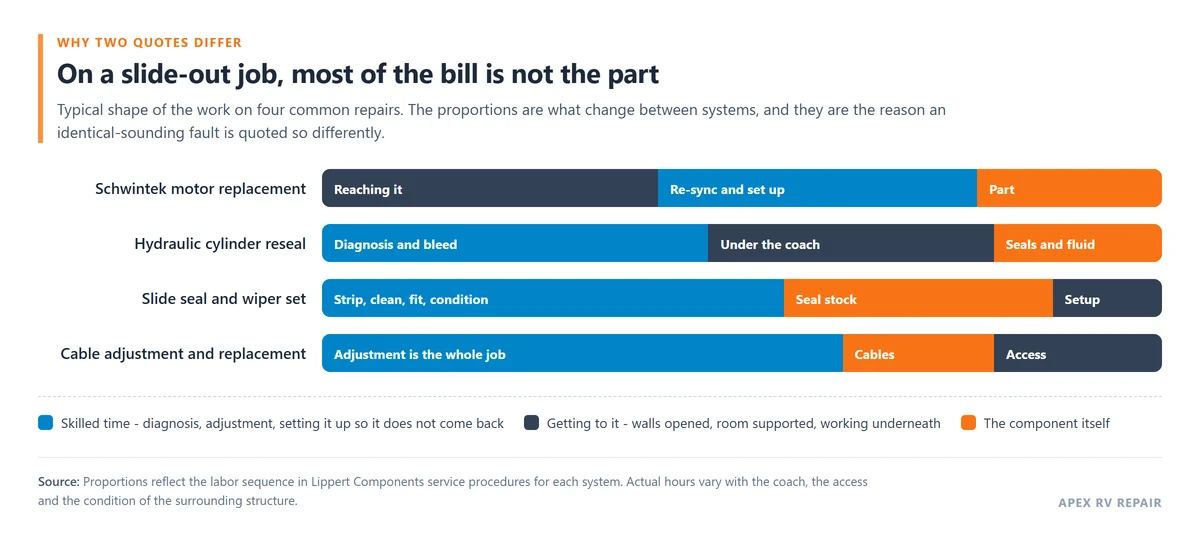
Most often because one of them tested the power supply and the other did not. A slide that clicks and will not move is the classic case: quoted as a motor by one technician and resolved with a battery and connection fix by another.
The second reason is scope. A quote to replace a motor and a quote to replace a motor, re-time the system, replace worn seals and check the floor are different quotes for the same complaint, and the cheaper one may leave you doing it again.
Third is simply identification. A quote given without establishing which mechanism is fitted is a guess, and guesses on slide-outs are wrong often enough to matter.
The question worth asking is what was measured. A quote that follows a voltage reading under load is a diagnosis; one that follows a description on the phone is an estimate.
Can you keep using a slide that is playing up?
For a short period and with care, but the risk is real and it is worth understanding rather than guessing at.
A room that binds, judders or runs out of square is putting load somewhere it was not designed to go. On a synchronized system, one side leading the other twists the room in its opening, and that is how the opening itself gets damaged, which is far dearer than the mechanism.
The practical position is that getting the room in so the coach can travel is worth doing, and continuing to cycle it daily while waiting for a part is not. Bring it in, leave it in, and use the coach with the room closed if you have to.
The one thing never worth doing is repeatedly retrying a stalled slide. Each attempt loads the mechanism and, on an electric system, heats a motor that is already struggling.
What does putting off a slide repair cost?
The escalation here is steep and it runs in a predictable order, which is what makes it worth catching early.
A torn seal is inexpensive. Water through that seal into the slide floor is a structural repair costing many times more. A room running out of alignment is an adjustment; the same room left to run damages the opening and the sidewall around it, and sidewall work is in a different category again.
There is also a travel consequence that owners underestimate. A coach whose room will not retract cannot legally or safely move, so a slide fault that would have been a scheduled repair becomes an emergency on the day you need to leave.
The cheapest slide maintenance there is costs nothing: keep the seals clean and conditioned, keep debris off the roof of the room, and stop cycling anything that has started to complain.
What a visit costs
A service call is $299 and covers the trip out to your RV and the first hour on site. Work past that first hour is quoted to you once our technician has found the fault, before we carry on. In Orlando, Lakeland, Kissimmee, Apopka and nearby the service call is $399 and time past the first hour runs $200 per hour. Written estimates are free and you approve one before any work starts. Call 888-759-1438.
Sources and further reading
Every figure above that came from a manufacturer or a standards body is linked here so you can check it yourself.
- Lippert - Master Owner's Manual, Slide-Outs - Manufacturer documentation covering the different slide mechanisms and their maintenance requirements.
- Lippert - In-Wall slide-out support - The Schwintek in-wall system, including why synchronization matters after a motor is replaced.
- Lippert - re-timing an in-wall slide-out - The procedure that has to follow a motor replacement on a synchronized system.
- Lippert - master owner's manuals index - Identify exactly which mechanism is fitted to your coach before anyone quotes parts for it.
Related pages on this site
- RV slide-out repair - what a mobile slide-out visit covers
- RV slide-out problems - identifying your system and getting the room closed
- Slide seal and wiper replacement - the cheap job that prevents the expensive one
- Slide floor rot repair - what a failed seal eventually turns into
- What mobile RV repair costs in Florida - how the service call and parts fit together
- RV repair in Ocala - mobile slide-out service in north central Florida
RV slide-out cost questions Florida owners ask
Why does my slide click but not move?
Nearly always insufficient voltage reaching the motors under load rather than a failed motor. Slide mechanisms draw heavy current, and a tired battery bank or a corroded connection produces exactly this symptom. The battery should be measured under load before anyone quotes a motor.
Can I replace a slide-out motor myself?
On some systems mechanically yes, but the re-timing afterwards is where it goes wrong. Synchronized systems need both sides brought back into alignment following the manufacturer's procedure, and a room that runs out of square damages its own opening, which costs far more than the motor did.
How often should slide seals be replaced?
They are replaced on condition rather than on a schedule, and in Florida they need looking at more often than elsewhere because ultraviolet exposure hardens the rubber. Conditioning them regularly extends their life considerably; a seal that has gone hard and cracked is already letting water past.
Is it safe to travel with a slide that will not fully retract?
No. A room that is not fully in and latched can move on the road, and the consequences range from damage to the mechanism to losing the room entirely. If it will not retract, that is what a manual override exists for, and it needs resolving before the coach moves.
Does a slide topper stop leaks?
It reduces the cause rather than sealing anything. By keeping debris and standing water off the roof of the room, it stops the material that tears seals from being dragged into them every time the room retracts. The seals still do the sealing.
Why does my slide work at home but not at the campground?
Usually the power available. A slide draws heavily, and a coach on a weak pedestal or on batteries that have been worked for a few days may not deliver enough current under load. It is the same reason a slide that has been sitting all summer often struggles on the first attempt.