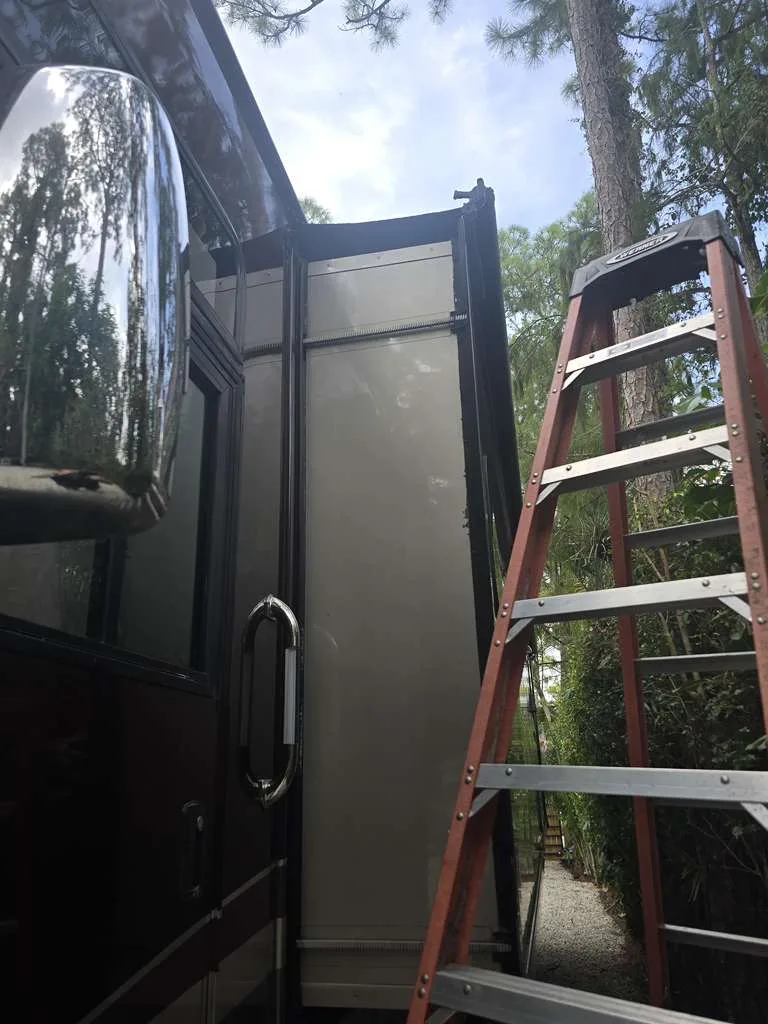
Why Your RV Slide Out Won't Move (and How to Get It Closed)
Identify which system you have, get the room closed so you can travel, and understand what a slide that binds is actually telling you.
Before you condemn a motor or a controller, put a meter on the house battery. Slide-out systems run on 12 volt DC and draw hard, so a battery that reads fine at rest but collapses under load produces exactly the symptoms owners blame on the mechanism: slow travel, stopping halfway, running crooked, clicking, or nothing at all. That one check settles a large share of slide-out calls, and it costs nothing.
Apex RV Repair is mobile across Florida - we come to your RV. Call 888-759-1438.
A slide-out that will not move is the fault most likely to end a trip, because unlike a broken air conditioner it can physically prevent you from driving away. That urgency is exactly why people start replacing parts before diagnosing.
This page is ordered the way the diagnosis should go: power first, then which system you actually have, then how to get the room closed under your own steam, then what the failure was really telling you.
Why does the house battery come first?
Slide-out mechanisms are 12 volt DC devices and they pull serious current under load. That makes them one of the most sensitive systems in the coach to battery condition, and it means a weak battery imitates almost every mechanical failure in the book.
The trap is that a tired battery often reads acceptably at rest. Voltage only collapses when the slide motors start pulling, and by then nobody is looking at the meter. What the owner sees instead is a room that travels slowly, stalls partway, moves unevenly, clicks, or does nothing while the switch feels dead.
So the first test is a loaded one. Put a meter on the battery terminals and watch it while somebody holds the slide switch. A battery that drops sharply the moment the motors engage has told you the answer, and no controller or motor will fix it.
Why does a slide that worked at home refuse to move on arrival?
- Being plugged into shore power does not guarantee this. On most coaches the slide runs off the batteries, and the converter alone may not supply the surge if the batteries themselves are failing.
- Corroded or loose battery terminals produce the same collapse under load as a dead battery. Clean and tight before you condemn anything.
- A ground fault at the chassis connection is the sneaky version. It looks like a weak battery, tests like a weak battery, and a new battery does not cure it.
If the electrical side checks out, then the mechanism genuinely is the problem, and the next question is which mechanism you own.
Days of road vibration are the variable people forget. The room left home aligned and arrives fractionally out, and the first extension after a long tow is when that shows up.
Which slide-out system does my RV have?
You cannot follow the right procedure until you know this, and the systems behave so differently that generic advice is worse than none. Look at the slide room from outside with it extended.
| System | How to spot it | How it fails |
|---|---|---|
| In-wall (Schwintek) | Vertical toothed tracks on the outside edges of the slide room itself, one on each side. No mechanism under the floor. | The two sides are driven independently, so if one side gets ahead of the other the room racks in the opening and jams. This is the most common in-wall complaint by a wide margin. |
| Rack and pinion (through-frame) | Horizontal rails and a toothed rack running under the slide room floor, driven by a motor and gearbox on a cross shaft. | Gearbox wear, a stripped rack, or a motor that has lost torque. Usually degrades over time rather than failing suddenly. |
| Hydraulic | Hydraulic cylinders under the room, hoses running back to a pump, often shared with the leveling system. | Fluid level, a failed solenoid valve, a leaking cylinder seal, or a pump that will not build pressure. Frequently connected to leveling faults. |
| Cable driven | Cables and pulleys at the corners of the room, common on lightweight trailers. | Cable stretch and tension loss, which shows up as a room that no longer seals evenly against the wall. |
If you are not sure, the model and serial sticker on the slide mechanism or inside a nearby storage bay will identify it, and Lippert publishes system-specific documentation by product line rather than one generic manual.
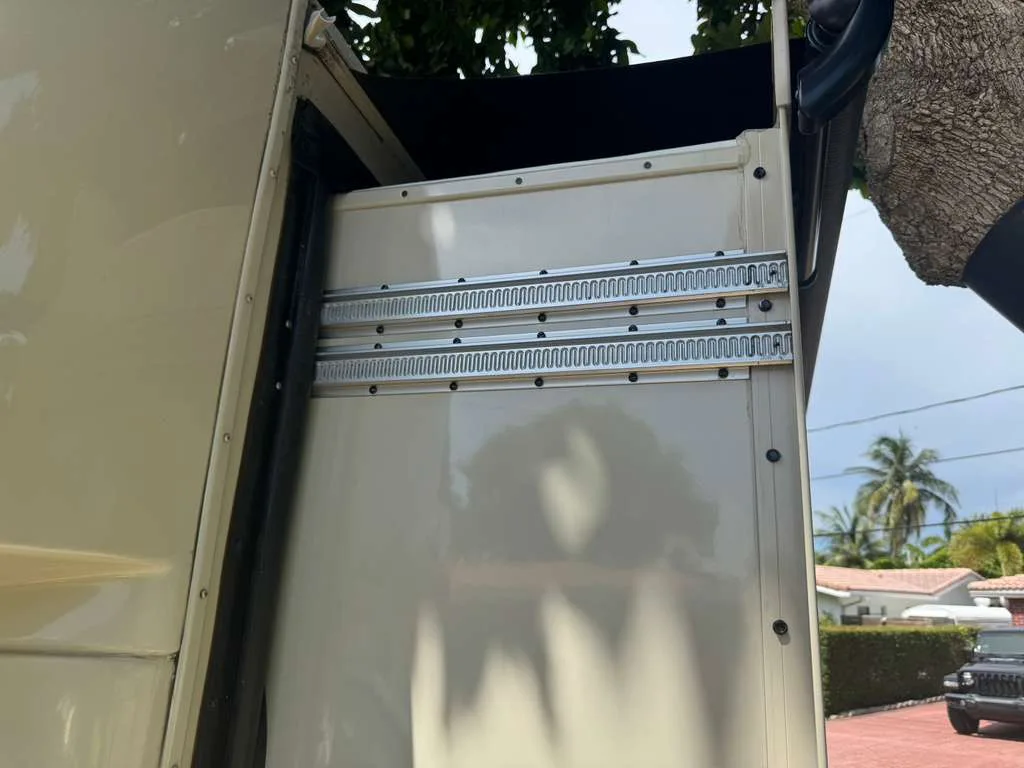
How do I get the slide closed so I can travel?
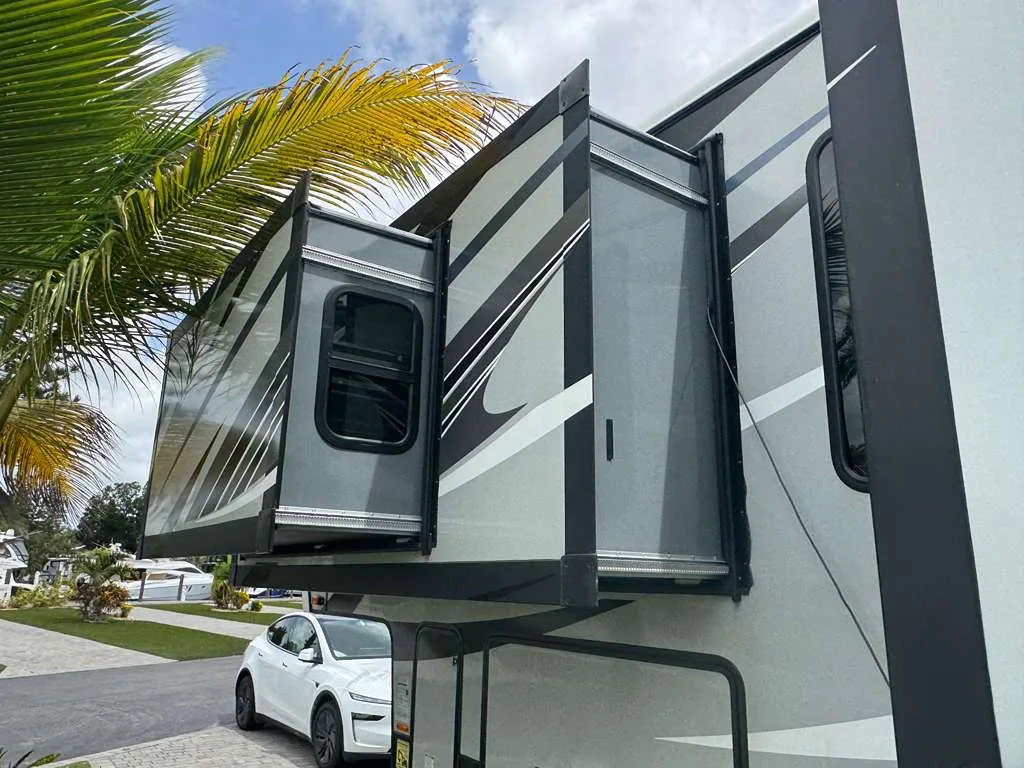
Every one of these systems has a manual override, because manufacturers know a stuck room strands people. The procedure differs completely between systems, which is why identifying yours matters before you start.
- In-wall systems are retracted by disengaging the motors from the tracks so the room can be pushed in by hand. Lippert publishes this procedure with video for its in-wall product line. It usually takes two people because the room is heavy and must go in square.
- Rack and pinion systems generally provide a shaft or socket on the motor or gearbox that accepts a drill or a hand tool, letting you wind the room in mechanically.
- Hydraulic systems use manual release valves at the pump. Opening them lets the cylinders retract, at which point the room can be pushed in - and it will move under its own weight if the coach is not level, which is worth knowing before you open anything.
- Cable systems vary most by manufacturer, so this is the one where reading your specific documentation first genuinely matters.
Two things to get right before you push
Support the room as you close it - a slide room dropping onto its rollers or seals does real damage. And close it square: an in-wall room forced in crooked can wedge harder than it was stuck, turning a roadside recovery into a workshop job.
Once the room is in and secured for travel, stop there. A manual override gets you home; it has not repaired anything, and a room that had to be forced in should not be operated again until the cause is found.
Why does my slide out go crooked or stop halfway?
On in-wall systems this is the signature failure and it is a synchronisation problem rather than a broken part. The two vertical drives are meant to move together. When one side is even slightly ahead, the room enters the opening at an angle, the seals and the opening itself begin to resist, current climbs, and the controller shuts it down to protect itself.
That distinction matters more than it sounds. One is a lubrication and alignment job that takes an hour, and the other is a drive component that has already started to fail. Listening to the room move is genuinely diagnostic here, which is unusual on an RV, because most faults do not announce themselves this clearly before they stop working altogether. Neither is improved by continuing to run the room while it complains, and a slide allowed to keep grinding usually takes its seal with it on the way out.
What is a slide that groans or judders actually telling you?
The system is designed to be re-timed, and Lippert documents the procedure. What is worth understanding is that re-timing is a reset, not a repair. If the room drifts out of time again within a few cycles, something is making one side work harder than the other - a dry or contaminated track, a damaged tooth, a failing motor on one side, or the opening itself no longer being square.
On rack and pinion and hydraulic systems, a room that stops halfway more often points to torque or pressure: a worn gearbox, low fluid, or a solenoid that is not fully opening. The behavior looks similar from inside the coach and the causes are not related, which is why the identification step above is not optional.
The noise is the cheap warning. What follows it is not.
Is a binding slide out a sign of floor rot?
Sometimes, and this is the most valuable thing on this page, because a binding slide announces the problem long before anyone feels a soft floor underfoot.
A slide room is a box, and it only travels smoothly while that box stays square. Lippert's slide-out documentation holds the room to a tight tolerance measured across the diagonals - about a quarter inch of difference, with roughly three eighths treated as a critical failure. Those are small numbers for a structure that size, and they are small deliberately: past that, the room no longer matches the hole it has to pass through.
Work through those in order rather than jumping to the motor, because the cheapest causes sit at the top of that list and the most expensive at the bottom of it. Battery voltage alone explains a surprising share of slides that will not move.
How do you tell a motor fault from a controller fault on a slide?
Now consider what water does to a slide floor. The decking softens and sags at one corner first, the box loses square by a fraction of an inch, and the room starts to bind. That happens while the floor still feels solid to walk on, because a floor that flexes measurably underfoot is far past a quarter inch of distortion.
So a slide that has recently started to bind, groan or drift out of time - particularly always at the same corner - is worth a moisture check of the slide floor and the seals above it before it is treated as a mechanical fault. Fixing the mechanism on a room whose floor is failing buys a few months at best. Our RV water damage page covers what that inspection involves.
A room that moves unevenly is a different fault from one that will not move at all.
Why is my slide out leaking, and what goes on the seals?
There are two different seals doing two different jobs, and treating them the same is how people damage both.
- The bulb seal is the fat compressible one that the room squashes against when it is closed. It is the weather seal, and it only works if the room closes with even pressure all the way round.
- The wiper seal is the thin blade that sweeps the top and sides of the room as it travels. It is not a weather seal - its job is to clear water and grit off the roof of the slide so that debris is not dragged inside when the room comes in.
That is the difference between a seal that wipes and one that merely touches, and it is visible from the ground once you know to look for it.
What happens to a slide seal that is never conditioned?
Florida is hard on both. Sustained UV and heat drive the plasticizers out of the rubber, and a seal that has gone hard stops conforming to the surface even though it looks intact. That is why leaks appear on coaches whose seals have no visible damage.
What to put on them matters. Use a rubber seal conditioner made for the purpose. Do not use a petroleum-based lubricant or a general purpose spray oil - petroleum attacks EPDM and similar rubbers and will soften and destroy the seal you were trying to protect. This is the single most common self-inflicted slide-out injury we see.
And check the drainage above the room. A slide topper or the roof edge that dumps water into the top of the slide will overwhelm any seal in a Florida downpour, and no amount of conditioner fixes a water path problem.
What maintenance actually prevents slide-out failures?
Very little of it involves parts, and most of it takes minutes.
- Operate every slide at least monthly, even in storage. Mechanisms that sit develop dry spots and seals take a set in one position.
- Before retracting, clear the roof of the slide. A pine cone or a palm frond dragged into the mechanism is a genuinely common cause of damage in Florida.
- Keep the tracks and rails clean. Grit is an abrasive, and on an in-wall system it is what makes one side start working harder than the other.
- Condition the seals on a schedule rather than when they look bad, since a hardened seal usually looks fine.
- Watch how the room seats when closed. An uneven gap top to bottom or side to side is an early squareness warning worth acting on.
- Listen. Slide mechanisms change their sound before they fail. A new click, a groan at one point in travel, or a change in speed is information.
If any of those signs show up, it is far cheaper to have it looked at while the room still moves than after it has jammed at a campground. See our slide-out service page for what a mobile visit covers.
When should you stop and call someone?
Checking the battery under load, clearing the roof of the slide, conditioning seals and looking at how the room seats are all owner jobs and worth doing before anybody is called.
Where it stops being a DIY task: any time the room has to be forced, any time it is already jammed in the opening, and any time you would be working underneath an extended slide. A slide room is heavy, it is supported by the mechanism you are about to disassemble, and there is no safe way to be under it while that is happening. Hydraulic systems add stored pressure to the same picture.
The other stopping point is diagnostic rather than physical. If the room binds at one corner, or has needed re-timing more than once, the useful question is no longer which part to replace - it is whether the structure is still square. That answer changes the whole repair, and getting it wrong means paying for the mechanism twice.
What a visit costs
A service call is $299 and covers the trip out to your RV and the first hour on site. Work past that first hour is quoted to you once our technician has found the fault, before we carry on. In Orlando, Lakeland, Kissimmee, Apopka and nearby the service call is $399 and time past the first hour runs $200 per hour. Written estimates are free and you approve one before any work starts. Call 888-759-1438.
Sources and further reading
Every figure above that came from a manufacturer or a standards body is linked here so you can check it yourself.
- Lippert - In-Wall slide-out support - The manufacturer's own documentation for the in-wall system, including manual override and re-timing procedures.
- Lippert - Master Owner's Manual, Slide-Outs - Covers the slide-out product lines including the squareness tolerances a slide room has to hold.
- Lippert - In-Wall manual override by disengaging motors - The specific procedure for getting an in-wall room closed when the drive will not run it.
- Lippert - Re-timing an in-wall slide-out that runs crooked - What to do about the racking failure described above, straight from the manufacturer.
Related pages on this site
- RV slide-out repair - what a mobile slide-out visit covers
- RV water damage - the moisture check behind a room that has started to bind
- RV leveling systems - shares a hydraulic pump with the slides on many coaches
- Book a service call - mobile across Florida
RV slide-out questions Florida owners ask
My slide out clicks but does not move. What is it?
Most often insufficient voltage reaching the motors under load, which is why the battery check under load comes first. If the battery holds up, a click with no movement points to a seized mechanism, an obstruction, or a controller that is cutting out on overcurrent. Do not keep pressing the switch - repeated stalled attempts are how a marginal fault becomes a stripped one.
Can I run my slide out while on shore power with a dead battery?
On most coaches, no, not reliably. The slide draws from the 12 volt system, and the converter is not always able to supply the surge on its own when the batteries cannot help. Some owners get away with it and some find the room stalls halfway, which is a bad place to discover it.
How often should slide-out seals be replaced?
There is no fixed interval - it depends on sun exposure and how the coach is stored. Judge on condition rather than age: a seal that has gone hard, taken a permanent set in one position, cracked, or stopped springing back when pressed is done, even if it looks intact. Florida sun brings that on faster than northern climates.
What lubricant should I use on the slide-out tracks?
Follow the manufacturer's documentation for your specific system, because in-wall, rack and pinion and hydraulic systems do not want the same treatment. What is universal is that petroleum-based sprays do not belong anywhere near the rubber seals - they will destroy them. Use a product made for RV seals on the seals and the specified product on the mechanism.
Why does my slide only leak in heavy rain?
That usually means the seal is doing its job against normal weather but the water volume is beating it, which points at the water path rather than the seal. Check where the roof edge and any slide topper are dumping water, and whether the room is seating with even pressure across the whole seal.
Is a slide topper worth fitting in Florida?
It keeps debris and standing water off the roof of the slide, which addresses two of the more common causes of slide damage here. It also becomes a maintenance item of its own - fabric degrades in UV and a sagging topper pools water. It solves a real problem and adds a smaller one.
Do you repair slide outs on site?
Yes. Slide-out diagnosis, seals, re-timing, motor and gearbox work and hydraulic faults are all mobile jobs done where the RV is parked, anywhere in Florida. Call 888-759-1438 and describe what the room is doing - the symptom usually narrows the system before we arrive.
My slide out is stuck open and I need to move the RV. What now?
Use the manual override for your system to get the room closed and secured, then have the cause diagnosed before operating it again. If you cannot identify your system or the room is jammed at an angle in the opening, call rather than force it - a room wedged harder by a well-meant push is a much bigger job than one that simply stopped.