What Does RV Air Conditioner Repair Cost in Florida?
What actually drives the bill on a rooftop unit, the point where repairing stops making sense, and why two quotes on the same air conditioner can differ by more than a thousand dollars.
Most rooftop air conditioner faults are components rather than the unit, and components are the cheap end. A start capacitor is a small part and a short visit. A failed compressor means a replacement unit, because RV rooftop air conditioners are sealed assemblies that are not rebuilt in the field. The gap between those two outcomes is the whole cost question.
Apex RV Repair is mobile across Florida - we come to your RV. Call 888-759-1438.
Air conditioning is the largest single category of work Apex does, which in Florida surprises nobody. It is also the category where the spread between the cheapest and dearest outcome is widest.
This page is about that spread. What the common faults actually cost to put right, where the line sits between repairing and replacing, and why two technicians looking at the same unit can quote numbers an order of magnitude apart.
What are the most common RV air conditioner problems?
A small number of faults account for most calls, and encouragingly the common ones are the cheap ones. Start capacitors fail more than any other single component, because they are electrolytic parts working hard in high ambient heat, which is exactly the Florida environment.
After capacitors come airflow problems: filters and returns choked with dust and pollen, and evaporator coils frozen because of them. Then fan motors, which announce themselves by noise long before they stop. Then control boards and thermostats, which produce erratic behavior rather than a clean failure.
Genuine compressor failure sits at the bottom of the list by frequency and the top by cost. It is the outcome owners fear and the least likely one, which is why the diagnostic order matters so much.
Our page on an air conditioner that runs without cooling walks that order in detail.
Can an RV air conditioner be repaired, or does it have to be replaced?
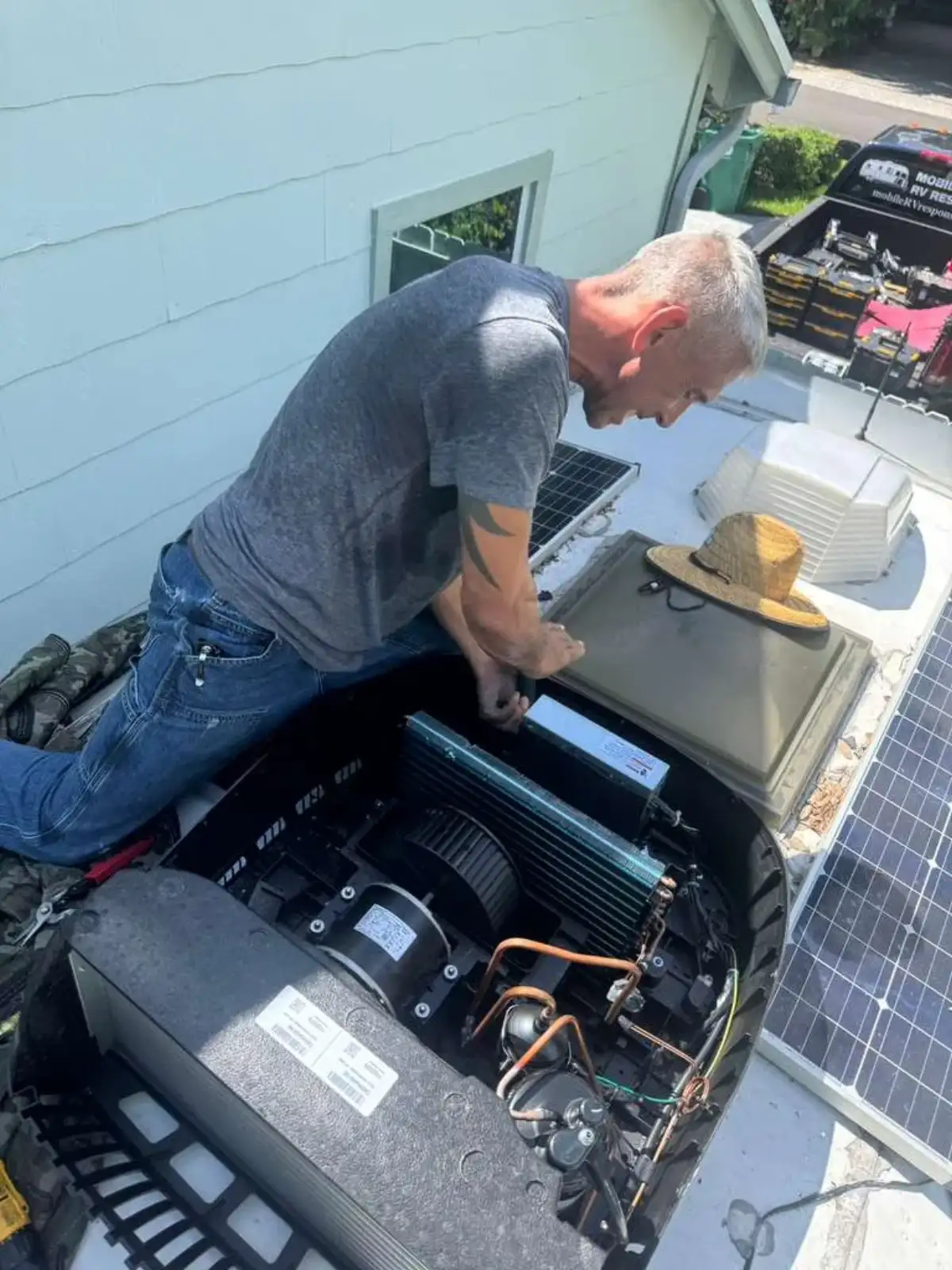
It depends entirely on which side of the unit has failed, and the dividing line is unusually clean. Everything outside the sealed refrigeration circuit is repairable: capacitors, fan motors, control boards, thermostats, wiring, shrouds and gaskets are all replaceable parts.
Everything inside the sealed circuit effectively is not. RV rooftop units are built as sealed assemblies without service ports, so there is no field procedure for recovering refrigerant, replacing a compressor and recharging. A confirmed compressor failure or a leaking sealed circuit means a new unit.
That is why the sequence matters more than the diagnosis itself. Anyone quoting a replacement air conditioner before the capacitor has been tested is skipping the cheap answer to reach the expensive one, and it is an entirely fair question to put to them directly. Ask what was measured before the unit was condemned.
What drives the price of a rooftop air conditioner replacement?
The unit itself is the largest line, and the rest is decided by what is on your roof already.
| Item | What was quoted | Notes |
|---|---|---|
| Replacement rooftop unit, compressor failed | $1,500 - $1,600 | Complete unit, the usual answer to a sealed-circuit failure |
| Replacement unit, general | About $1,500 each | Coaches with two units often replace one at a time |
| Start capacitor | Small part, stocked | Fraction of a unit; the fault most often mistaken for a compressor |
Beyond the unit itself, cost turns on whether the replacement matches the old footprint, whether the coach is ducted or non-ducted, whether the existing thermostat and control board will talk to the new unit, and how it gets onto the roof in the first place. A replacement that drops into the same opening and works with the existing controls is a straightforward visit. One that needs the roof opening altered, or the thermostat and wiring changed to suit a different control system, is a substantially longer job on the same part price.
What is the life expectancy of an RV air conditioner?
Manufacturers talk in broad terms and the honest answer is that use matters far more than age. A unit on a coach stored under cover and used a few weeks a year is barely worked. The same unit on a coach lived in through Florida summers runs most of every day for months.
What shortens life here is specific and worth knowing. Sustained high ambient temperature makes the unit work at the top of its range constantly. Salt air near the coast attacks the condenser coil. Debris and pollen restrict airflow, so the compressor runs longer for the same cooling.
The practical implication is about maintenance rather than a replacement calendar. A coil kept clean and a filter kept clear extend a unit's life more than anything else available to an owner, and both are cheap.
Age alone is rarely the reason a unit is replaced. Neglect usually is.
Is a soft start worth fitting instead of replacing the unit?
A soft start reduces the surge of current an air conditioner draws at the moment the compressor engages. That surge is what trips breakers, what a generator struggles with, and what a weak park pedestal cannot supply.
It is worth fitting when the problem is starting rather than cooling. A unit that cools well once running but trips the breaker, or will not start on a generator, is a genuine candidate. So is a coach that wants to run two air conditioners on a 30 amp service.
It is not a fix for a unit that runs and does not cool. Nothing about reducing start current addresses a failed capacitor, a frozen coil or a dead compressor, and it should never be sold as an alternative to diagnosing those.
Framed correctly it is a capability upgrade, not a repair, and the two should not be confused on a quote.
Does replacing the thermostat fix a cooling problem?
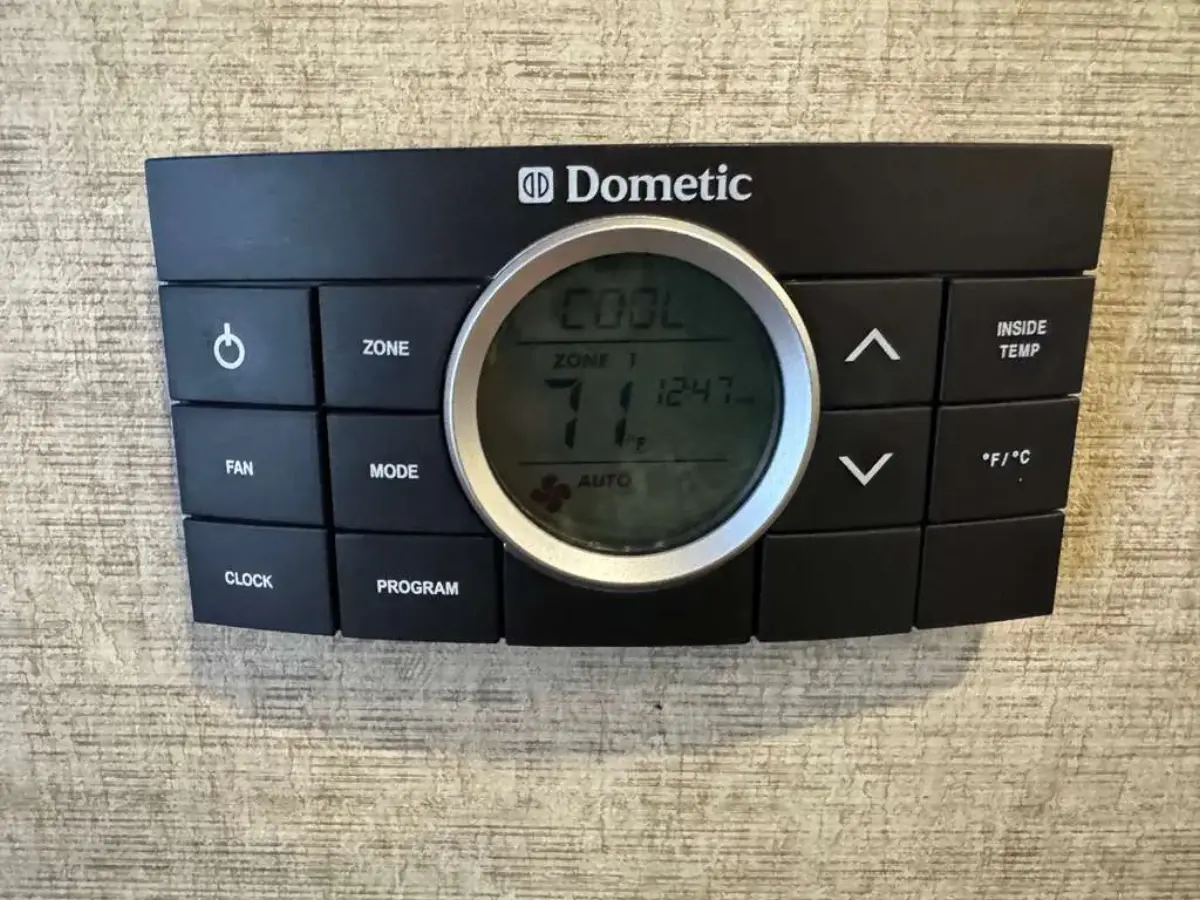
Occasionally, and it is worth checking because it is inexpensive, but it is diagnosed rather than assumed. A thermostat is a controller. It tells the unit what to do and reports what it sees; it does not cool anything itself.
A genuine thermostat fault usually shows as behavior rather than absence: a unit that runs when it should not, ignores setpoint changes, reads a temperature clearly wrong, or gives up communicating with the rooftop board entirely. Those are control symptoms.
A unit that responds correctly to commands and simply produces warm air has a working thermostat and a problem further up the chain. Replacing the thermostat in that case costs money and changes nothing, which is a common and entirely avoidable outcome. The test is whether the unit does what it is told: if it starts, stops and changes mode on command, the controller is doing its job and the fault is in what happens after the command.
Why do two quotes on the same air conditioner differ so much?
Nearly always because they are answering different questions. One has diagnosed a component and quoted that component. The other has concluded the unit is finished and quoted a replacement. Both can be given in good faith on the same coach, and only one of them was preceded by a test.
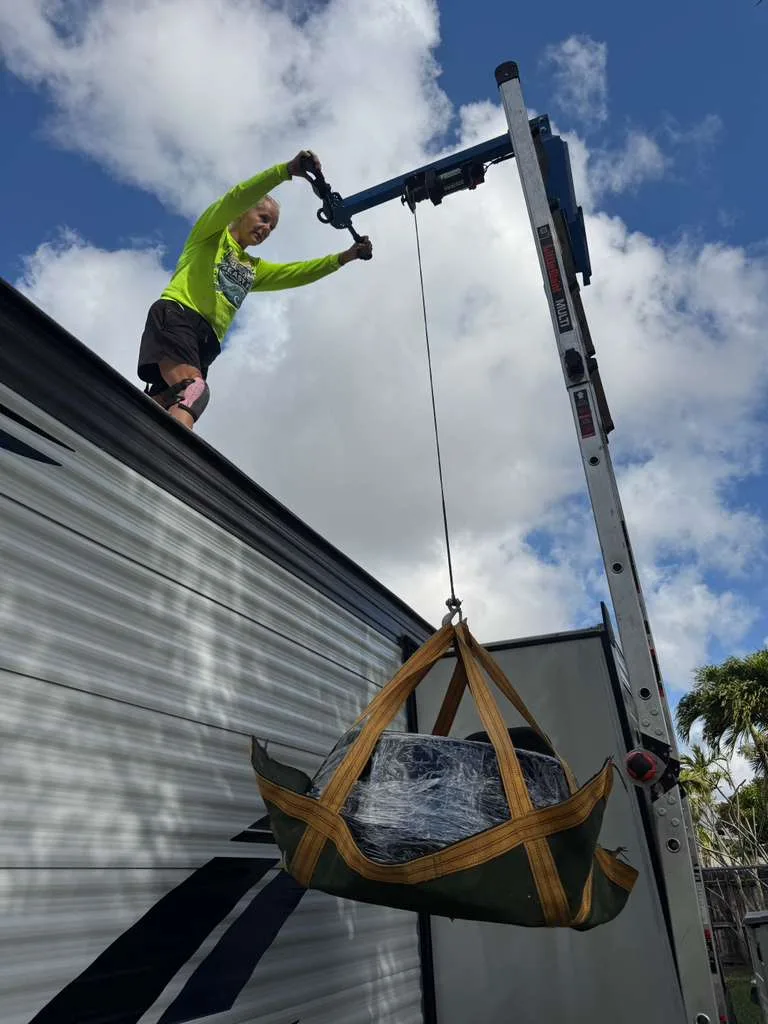
There is a second reason worth knowing. Replacing a rooftop unit is a larger operation than the part price suggests, because the unit has to reach the roof. A technician with a hoist does that safely and quickly, and a quote reflecting that equipment is not padded.
The question that separates the two is simple and entirely reasonable to ask: what was tested, and what did it read. A quote following a measurement is a diagnosis. A quote following a look is an estimate.
What can you do yourself to keep the cost down?
Three things, none of which require going on the roof, and together they prevent a meaningful share of the calls we take.
- Clean or replace the return filter regularly, and more often in spring when pollen is heaviest.
- Keep the return path clear of bedding, storage and furniture so the coil gets the air it needs.
- Park with the coach shaded where you can, particularly the side carrying the refrigerator and the roof unit.
The fourth thing is to call while the symptom is still small. A unit short of airflow runs hot and works its compressor harder, so an airflow problem left for a season is how a filter becomes a compressor.
Where to stop is the roof itself. Rooftop work means walking a surface that is only load-bearing in specific places and opening a shroud that exposes live 120 volt terminals and a capacitor holding a charge. That combination is worth handing over regardless of how straightforward the part is.
What a visit costs
A service call is $299 and covers the trip out to your RV and the first hour on site. Work past that first hour is quoted to you once our technician has found the fault, before we carry on. In Orlando, Lakeland, Kissimmee, Apopka and nearby the service call is $399 and time past the first hour runs $200 per hour. Written estimates are free and you approve one before any work starts. Call 888-759-1438.
Sources and further reading
Every figure above that came from a manufacturer or a standards body is linked here so you can check it yourself.
- Dometic Penguin II rooftop air conditioner manual (PDF) - Manufacturer documentation for one of the most common rooftop units on Florida coaches.
- Dometic ducted rooftop air conditioner installation manual (PDF) - Ducted installation requirements, which is where replacement compatibility problems usually appear.
- Airxcel - Coleman-Mach RV air conditioning - Manufacturer reference for the other rooftop brand commonly fitted to coaches sold here.
- Dometic documents database - Model and serial lookup, which is what makes a replacement quote accurate rather than approximate.
- OSHA - electrical hazards - Why capacitor and live 120 volt work on a roof is treated as qualified-person work.
Related pages on this site
- RV air conditioning and heating repair - what a mobile air conditioning visit covers
- RV air conditioner runs but will not cool - the diagnostic order that decides which quote you get
- RV AC not cooling in Florida heat - when the unit is healthy and the heat load is the problem
- RV AC soft start install - for a unit that cools well but will not start
- What mobile RV repair costs in Florida - how the service call and parts fit together
- RV repair in Orlando - coverage and rates for the central Florida corridor
RV air conditioner cost questions Florida owners ask
Is it cheaper to repair or replace an RV air conditioner?
Repair, whenever the fault is outside the sealed refrigeration circuit, which covers the large majority of faults. Capacitors, fan motors, boards and thermostats are all replaceable parts. Only a failed compressor or a leaking sealed circuit forces a replacement, because RV rooftop units are not rebuilt in the field.
How long does a rooftop air conditioner replacement take?
The physical swap is usually a single visit, provided the replacement matches the existing opening and the coach's controls are compatible. What extends it is a mismatch: a different footprint needing roof work, or a ducted coach where the new unit and the old thermostat will not communicate.
Can I fit a bigger air conditioner to cool better?
Rarely the right answer, and it is limited by what the coach's electrical service can start and run. A larger unit that trips the breaker at every startup is worse than an adequate one. Airflow problems and undersized ducting are far more often the real cause of poor cooling than unit capacity.
Do I need to replace both air conditioners at once?
No. Coaches with two units are commonly repaired or replaced one at a time as each fails, and there is no technical requirement to match them. Some owners prefer matching units for consistent controls and noise, but it is a preference rather than a necessity.
Why is my air conditioner more expensive to fix in summer?
The work itself is not, but availability changes. Demand peaks with the heat, so scheduling is tighter and parts move faster through suppliers. Booking a service before the season rather than during it is the practical way around that, and it is why we push pre-season checks.
Will a new air conditioner cool better than my old one?
Only if the old one had actually degraded, which is worth establishing first. If the coach was never comfortable even when the unit was new, the limit is usually insulation, ducting or the sheer heat load on a coach parked in open Florida sun, and a new unit will not change any of those.