Why Does My RV Air Conditioner Run But Not Cool?
The fan is running and the air is warm. How to separate a failed capacitor from a frozen coil, a blocked return and a genuinely dead compressor.
A unit that runs without cooling has usually lost the compressor, not the whole air conditioner. The most common cause is a failed start capacitor, which costs a fraction of a compressor and presents almost identically. Check the return air path and look for ice on the coil before anyone talks about replacing the unit.
Apex RV Repair is mobile across Florida - we come to your RV. Call 888-759-1438.
There is a specific fault that worries owners more than any other, because it sounds like the expensive one. The thermostat calls, the fan runs, you can hear the unit working, and the air coming out of the vents is the same temperature as the air going in.
That symptom has four common causes and only one of them is a dead compressor. This page walks the four in the order a technician checks them, which is also the order from cheapest to most expensive.
Why does my RV air conditioner run but not cool?
Nearly always because the fan half of the unit is working and the refrigeration half is not. Those are two separate systems sharing one box. The fan motor moves air whether or not anything is cooling it, so a unit that hums, blows and produces warm air is telling you the compressor is either not starting, not staying running, or running against a coil it cannot move heat through.
Four causes account for the overwhelming majority. A failed start capacitor, which cannot give the compressor the kick it needs to spin up. A frozen evaporator coil, which blocks airflow with a wall of ice. A blocked return path, which starves the coil of the warm air it needs to work on. And a genuinely failed compressor, which is the least common of the four and the only expensive one.
Working through them in that order costs almost nothing and rules out the cheap faults first.
How do you reset an RV air conditioner that will not cool?
There is a real reset and it is worth doing before anything else, because a compressor that has short cycled will lock itself out deliberately. Turn the thermostat off, then remove power to the unit entirely, which means shore power off and the relevant breaker off, not simply the thermostat set to off. Leave it for a full ten minutes.
The wait matters. Rooftop units carry a built-in delay so the compressor never restarts against a pressurized system, and cutting the wait short simply puts you back where you started. Restore power, set the thermostat to cool and drop it several degrees below room temperature, then listen for the compressor engaging a few seconds after the fan.
If it cools normally after that reset, the fault was a lockout rather than a failure. If it cools for a while and then quits again, the lockout is a symptom and something else is causing it.
Is it the capacitor or the compressor?
These two faults sound identical from inside the coach and differ enormously in cost. A start capacitor stores a charge and releases it to get the compressor turning. When it weakens the compressor tries to start, fails, and either hums briefly or trips out.
The tell is audible. A failing capacitor usually produces a hum or a click from the rooftop unit every few minutes as the compressor attempts to start and gives up, often with a momentary dimming of the lights. A truly dead compressor is generally silent on the compressor side while the fan carries on as normal.
Capacitors are a stocked part and a short job. Compressors are effectively not repaired in RV rooftop units, so a confirmed compressor failure means a replacement unit. That is why nobody should be quoting you a new air conditioner before a capacitor has been tested.
Testing one is not homeowner work, for a reason set out further down.
Why does a frozen evaporator coil stop the air conditioner cooling?
Because ice is an insulator and an obstruction at the same time. The evaporator coil sits in the return air path inside the coach, and it is supposed to run cold while air moves across it. If airflow drops or the unit runs continuously in very humid conditions, condensation on the coil freezes instead of draining away.
Once a skin of ice forms it blocks airflow, which drops airflow further, which grows more ice. The unit ends up running hard and moving almost nothing. Owners often describe it as the air conditioner getting steadily weaker over an afternoon rather than failing suddenly.
The diagnosis is direct: pull the interior return cover and look. Ice is unmistakable. The fix in the moment is to run the fan alone until the ice clears, which can take an hour. The fix that lasts is finding why airflow dropped, because a coil does not freeze on a healthy unit.
Florida's humidity makes this considerably more common here than the manuals suggest.
Can a blocked return or a dirty filter stop it cooling completely?
Yes, and it is the most overlooked cause on the list. An RV air conditioner has to pull warm interior air across the evaporator coil to work. Restrict that path and there is nothing for the coil to cool, so the unit runs and the coach stays warm.
Several things restrict it, and they are all easy to miss:
- The return filter clogged with dust, pet hair or the fine pollen that coats everything in a Florida spring.
- Furniture, bedding or storage pushed against a return grille.
- A ducted system with a leaking air distribution box, which lets cold air escape into the roof cavity instead of reaching the vents.
- Closed or blocked ceiling vents at the far end of the coach, which starve the system while the nearest vent seems fine.
The filter is a two minute check and it is genuinely worth doing before calling anyone. If the filter is gray, the air conditioner has been fighting for a while.
What does a fault code on the thermostat actually mean?
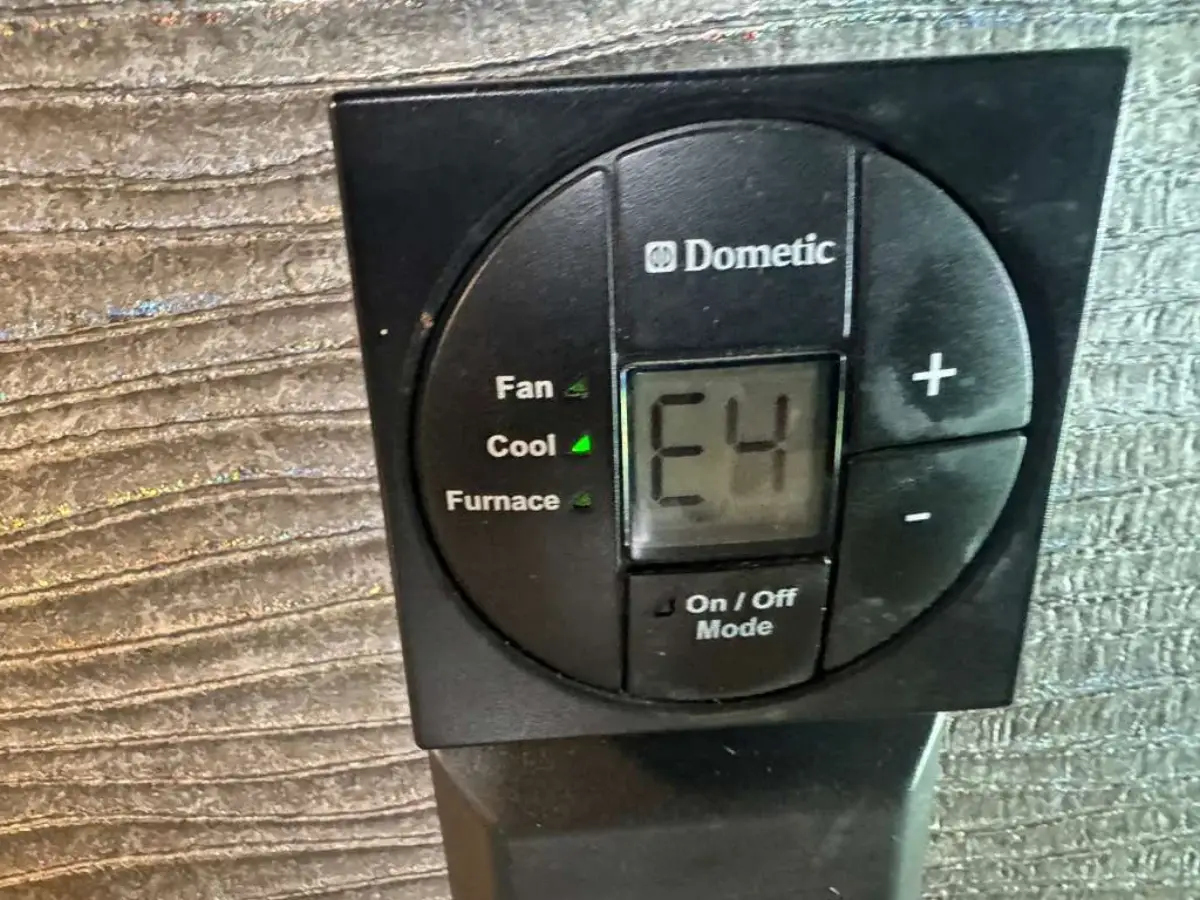
A code is the unit reporting a condition it has detected, not a diagnosis of the part that has failed. That distinction saves a lot of money. Codes on rooftop units commonly point at communication between the thermostat and the control board, at a sensor reading outside its expected range, or at a lockout the unit has imposed on itself.
Write the code down exactly as displayed, including the letter, and note whether it appears immediately on startup or after the unit has been running. That difference frequently separates a wiring or board fault from a thermal one, and it is the first thing our office asks.
Do not clear the code repeatedly to keep the unit limping along. A lockout usually exists to protect the compressor, and overriding it is how a capacitor fault turns into a compressor replacement.
Why does the unit cool for a while and then stop?
Intermittent cooling points somewhere different from a unit that never cools at all. If cold air arrives and then fades after twenty or thirty minutes, the compressor is starting successfully and then dropping out, which is a thermal or electrical protection event rather than a failure to start.
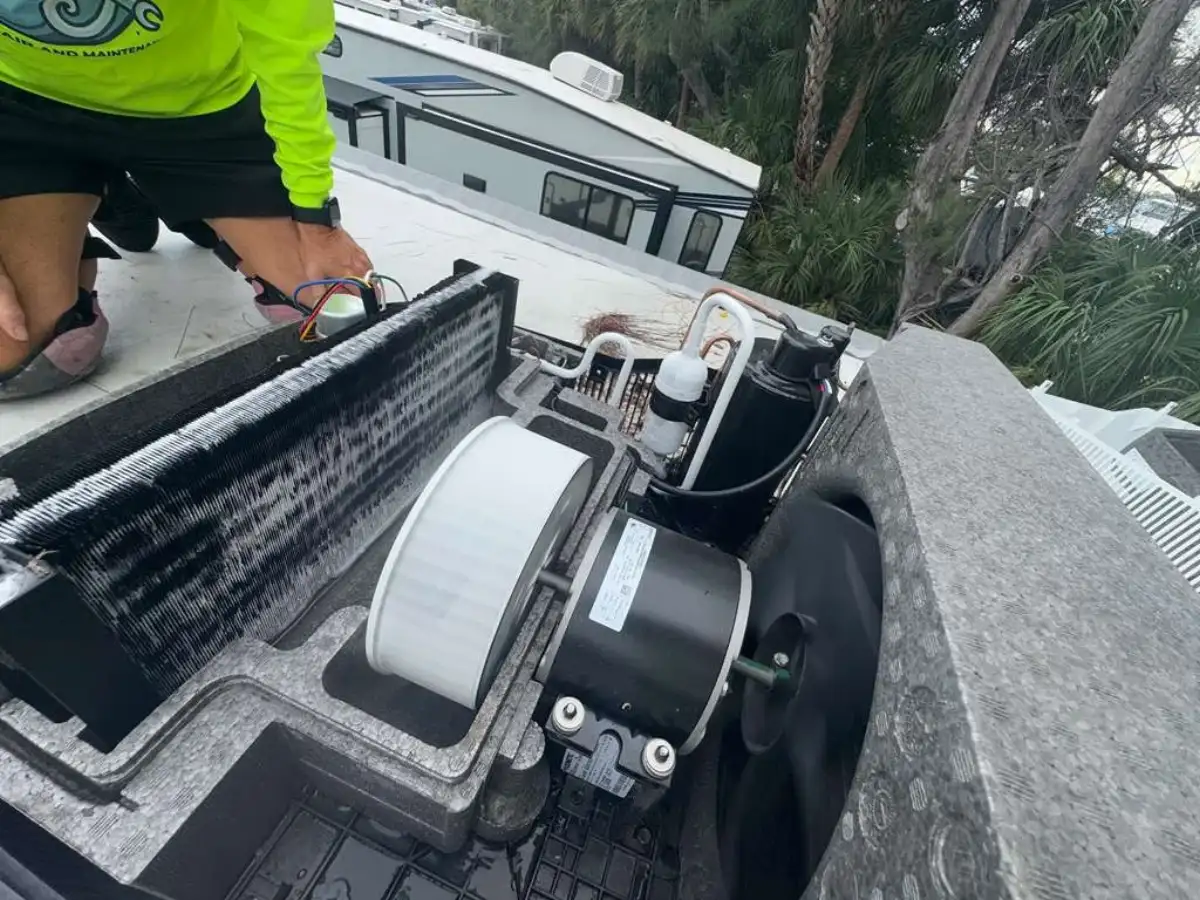
The usual candidates are a coil icing up gradually, a condenser coil so clogged with debris that the unit cannot reject heat and trips on high pressure, or supply voltage sagging under load at a park pedestal until the compressor protects itself.
Timing is the clue worth recording. A unit that fails after a consistent interval is usually thermal. One that fails at unpredictable moments, particularly in the late afternoon when a whole park is drawing hard, is more often electrical. Our guide to an RV air conditioner losing to Florida heat covers the voltage side in detail.
What should you check before calling a technician?
Four checks, all of them safe from inside the coach, and together they resolve a real share of calls before anyone is dispatched.
- Pull the return filter and look at it. If it is gray or matted, clean or replace it and run the unit for thirty minutes.
- Look at the coil behind the return cover for ice. If there is ice, run the fan alone until it clears.
- Do the full ten minute power-off reset, at the breaker rather than the thermostat.
- Note the exact fault code, and whether the unit fails immediately or after a set time.
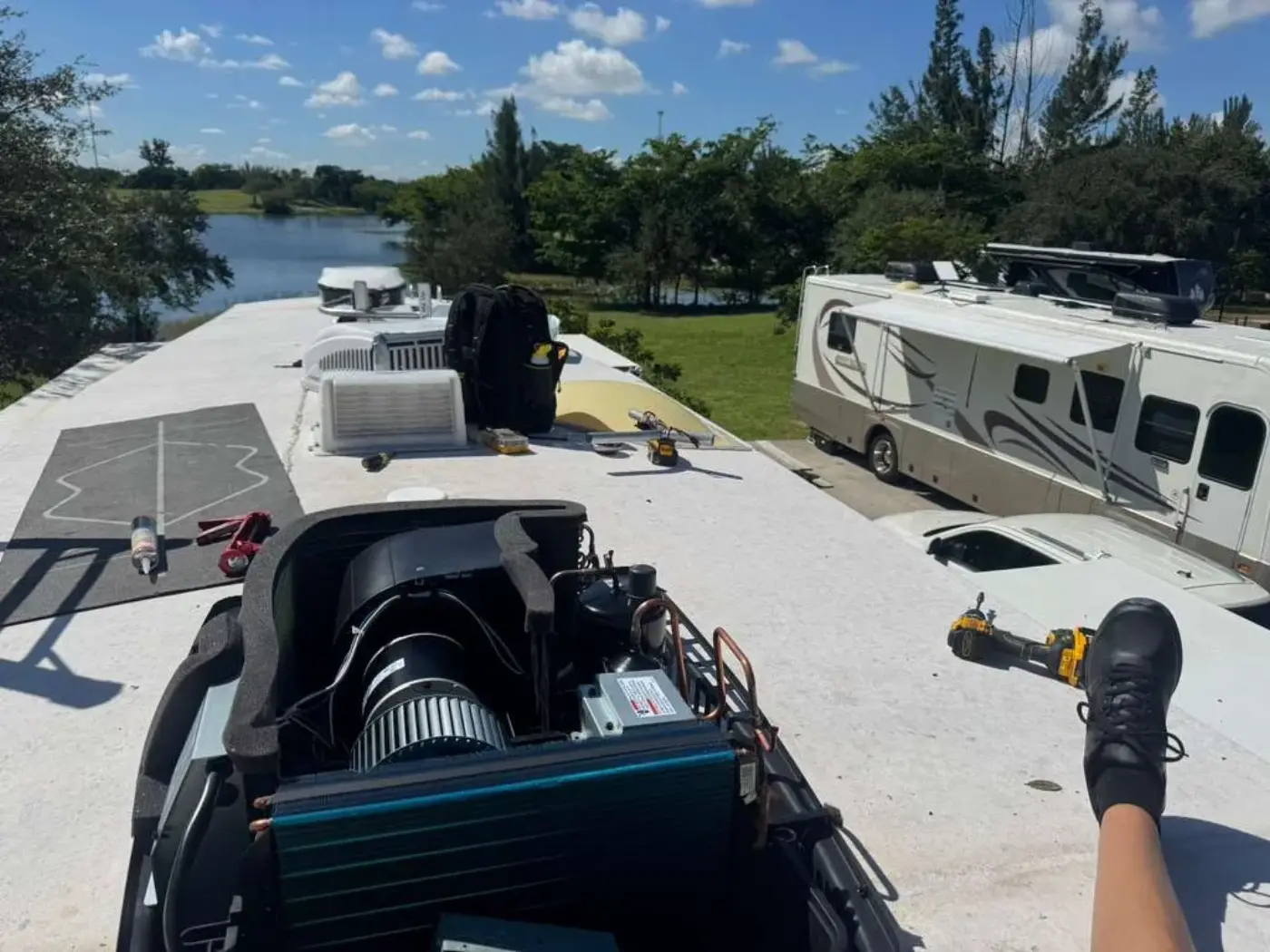
Where to stop is just as clear. Anything needing the rooftop shroud off belongs to a technician, and not because the work is exotic. RV roofs are walkable only in specific places, capacitors hold a dangerous charge after power is removed, and the shroud exposes live 120 volt terminals.
Having those four answers ready when you call routinely turns a diagnosis into a same-visit repair.
What a visit costs
A service call is $299 and covers the trip out to your RV and the first hour on site. Work past that first hour is quoted to you once our technician has found the fault, before we carry on. In Orlando, Lakeland, Kissimmee, Apopka and nearby the service call is $399 and time past the first hour runs $200 per hour. Written estimates are free and you approve one before any work starts. Call 888-759-1438.
Sources and further reading
Every figure above that came from a manufacturer or a standards body is linked here so you can check it yourself.
- Dometic Penguin II rooftop air conditioner manual (PDF) - Manufacturer documentation for one of the most common rooftop units fitted to coaches in Florida, including startup delay behavior.
- Dometic ducted rooftop air conditioner installation manual (PDF) - Covers ducted systems and the air distribution box, which is where cold air is lost on coaches that cool at the unit but not at the vents.
- Airxcel - Coleman-Mach RV air conditioning - Manufacturer reference for the other rooftop brand commonly fitted to coaches sold in Florida.
- OSHA - electrical hazards - Why stored charge in a capacitor and live 120 volt terminals are treated as qualified-person work rather than homeowner work.
- Dometic documents database - Model and serial lookup, which is the information that makes a parts quote accurate rather than approximate.
Related pages on this site
- RV air conditioning and heating repair - what a mobile air conditioning visit covers
- RV AC not cooling in Florida heat - the different fault where the unit cools but loses to the afternoon
- Dometic Penguin AC repair - the specific unit on a large share of Florida coaches
- RV electrical safety - why capacitor and 120 volt work is handed over
- RV repair in Fort Myers - mobile air conditioning service in southwest Florida
Questions about an RV air conditioner that runs without cooling
How long should I wait before restarting an RV air conditioner?
A full ten minutes with power removed at the breaker, not just the thermostat switched off. Rooftop units hold an internal delay so the compressor never restarts against a pressurized system, and restarting sooner simply repeats the failed start you began with.
Can I replace an RV air conditioner capacitor myself?
It is not work we would recommend. A capacitor stores a charge that remains dangerous after the power is off, the terminals sit alongside live 120 volt connections, and reaching them means being on an RV roof that is only walkable in specific places. The part is inexpensive; the access is the risk.
Does ice on the coil mean the unit is low on refrigerant?
Not usually. On RV rooftop units a frozen coil is far more often an airflow problem, most commonly a clogged return filter or a blocked return path. Airflow should always be ruled out first, because it is free to check and it is the more likely answer.
Is it worth replacing the compressor instead of the whole unit?
In practice, no. RV rooftop air conditioners are sealed assemblies not designed for compressor replacement in the field, so a confirmed compressor failure means a replacement unit. This is exactly why a capacitor should be tested before anyone quotes you a new air conditioner.
Why does my air conditioner work at the campground but not at home?
Almost always supply voltage. Park pedestals, long extension cords and household outlets deliver different voltage under load, and a compressor that starts fine on a solid supply may fail to start on a weak one. The unit is often healthy and the power feeding it is not.
My unit hums but nothing happens. What is that?
That hum is usually the compressor attempting to start and failing, which is the classic signature of a weak or failed start capacitor. It is one of the cheaper faults on a rooftop unit, and it is worth testing before accepting any quote for a replacement air conditioner.