Why Your RV AC Isn't Cooling in Florida Heat
How to tell a broken air conditioner from one that is simply losing to a Florida afternoon - and the four faults behind most no-cool calls.
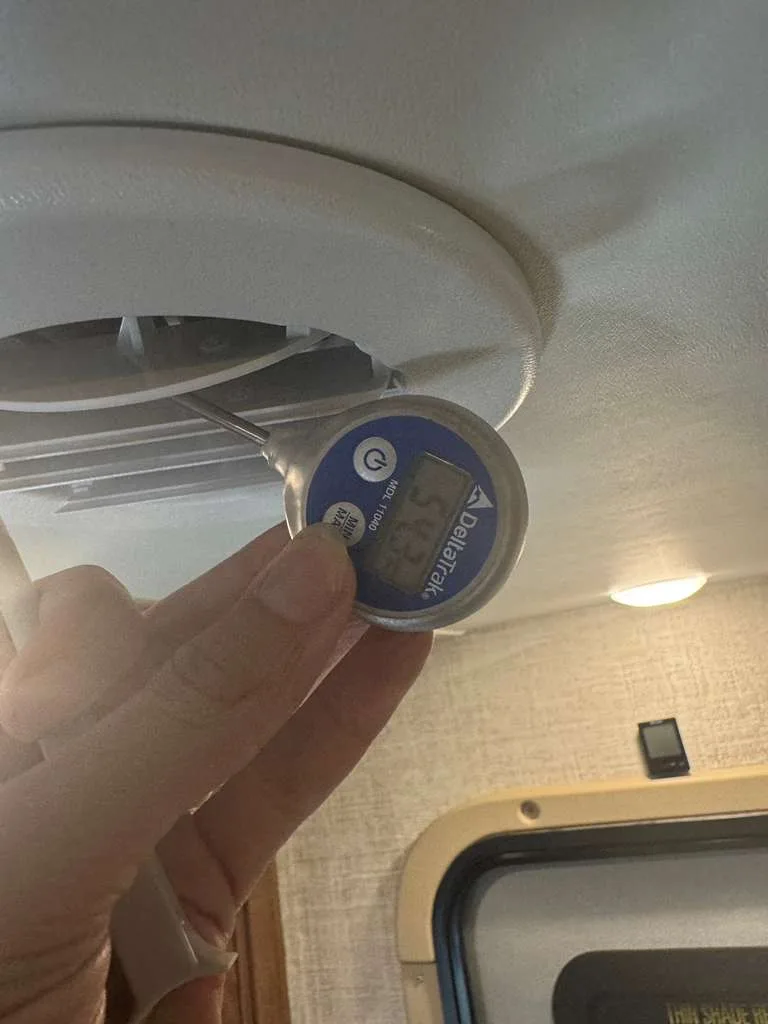
Measure the temperature split before you buy any part. Hold a thermometer at the return grille, then at the closest supply register: a rooftop unit that is doing its job pulls roughly 16 to 22 degrees F out of the air between those two points. If the split is there, the unit is working and the problem is heat load, ducting or voltage.
Apex RV Repair is mobile across Florida - we come to your RV. Call 888-759-1438.
"The AC is running but it's not cooling" is the single most common summer call in Florida, and it describes two completely different situations. In one the air conditioner is broken. In the other the air conditioner is fine and is simply being asked to do something no rooftop unit can do at 3pm in August with the sun on the roof.
Telling those apart takes one measurement and about ninety seconds. Doing it first will save you from the two expensive mistakes we see most often: replacing a working unit, and paying someone to "add refrigerant" to a system that has no way to accept any.
How cold should the air from an RV air conditioner actually be?
Not a fixed number. What matters is the difference between the air going into the unit and the air coming out of it, which technicians call the temperature split or delta-T.
Take two readings with the same thermometer. First at the return air grille, where the unit is pulling cabin air in. Then at the supply register nearest the air conditioner. A rooftop unit that is refrigerating properly will generally show somewhere around a 16 to 22 degree F drop between those two points once it has been running for ten to fifteen minutes.
Two details decide whether the reading means anything. Measure at the register closest to the unit, not the one at the far end of the coach, because duct losses will make a healthy unit look sick. And give it those ten minutes - a compressor that just started has not pulled the coil down yet.
What does a healthy temperature split actually look like?
- Split is 16 to 22 degrees F and the coach is still hot. The air conditioner is working. Your problem is heat load, airflow or ducting, covered further down.
- Split is 8 to 14 degrees F. Something is restricting the system. Dirty filter, fouled coils, a failing fan motor or a weak capacitor are the usual suspects, in that order of likelihood.
- Split is under 8 degrees F, or the air is barely cool. The refrigeration side is not doing its job. This is capacitor, compressor or lost charge territory and it needs a meter, not a guess.
- No air movement at all. This is not a cooling fault. Look at the fan motor, the control board and the thermostat before anyone touches the refrigeration side.
Write the two numbers down with the date and the outside temperature. One reading tells you how the unit is doing today; a short history tells you whether it is getting worse.
Why does my RV air conditioner cool at night but give up in the afternoon?
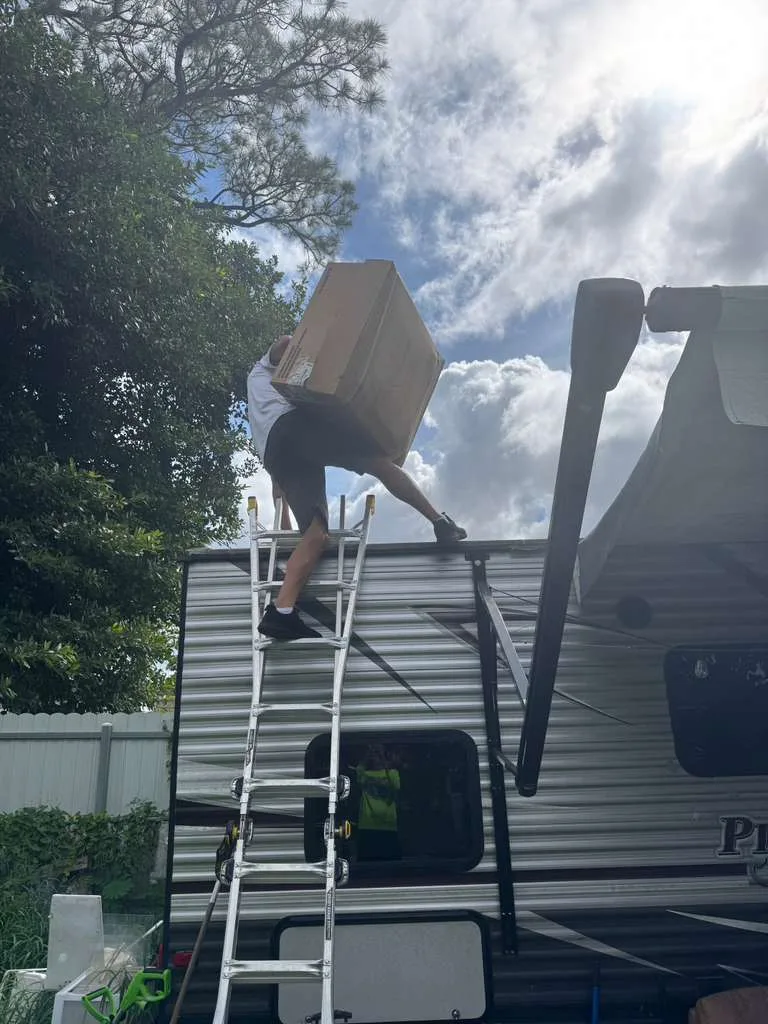
Because a rooftop air conditioner has a fixed capacity and a Florida afternoon does not. The unit is not weakening through the day - the load is climbing past what it can remove.
Three things stack up at once. The outside air the condenser has to reject heat into is at its hottest. The roof the unit is bolted to has been absorbing sun for hours and is far hotter than the air temperature. And the same shaded campground that is comfortable at 8am is in full sun by mid-afternoon, so the walls and windows are pouring heat in faster than the unit removes it.
So take a voltage reading at the same time as the temperature split. Two numbers from the same afternoon tell you whether you are looking at a hot roof or a tired pedestal, and they point at different repairs.
Is low voltage the reason the air conditioner fades in the afternoon?
There is a fourth cause that has nothing to do with heat and is worth ruling out, because it damages equipment: voltage. Late afternoon is when every rig in the park has its air conditioning on, and campground pedestals sag under that load. A compressor fed low voltage draws higher current, runs hotter and can trip on its own thermal overload - which looks exactly like an air conditioner that "stops cooling in the afternoon." Your unit's data plate lists its minimum operating voltage.
If the split is healthy and the coach still will not come down, the honest answer is that the unit is undersized for the conditions rather than faulty. Reflective window covers, a vent-fan running to pull heat out of the upper cabin, parking to put the largest windows in shade, and pre-cooling before the peak all move more temperature than any part you can buy.
Can my RV air conditioner be low on refrigerant?
This is the most important thing on this page, so it gets said plainly: a residential HVAC recharge does not exist for an RV rooftop unit. The common Dometic and Coleman-Mach rooftop air conditioners are sealed systems. They are brazed closed at the factory with no service ports, so there is nothing to connect gauges to and no way to add refrigerant without cutting into the circuit.
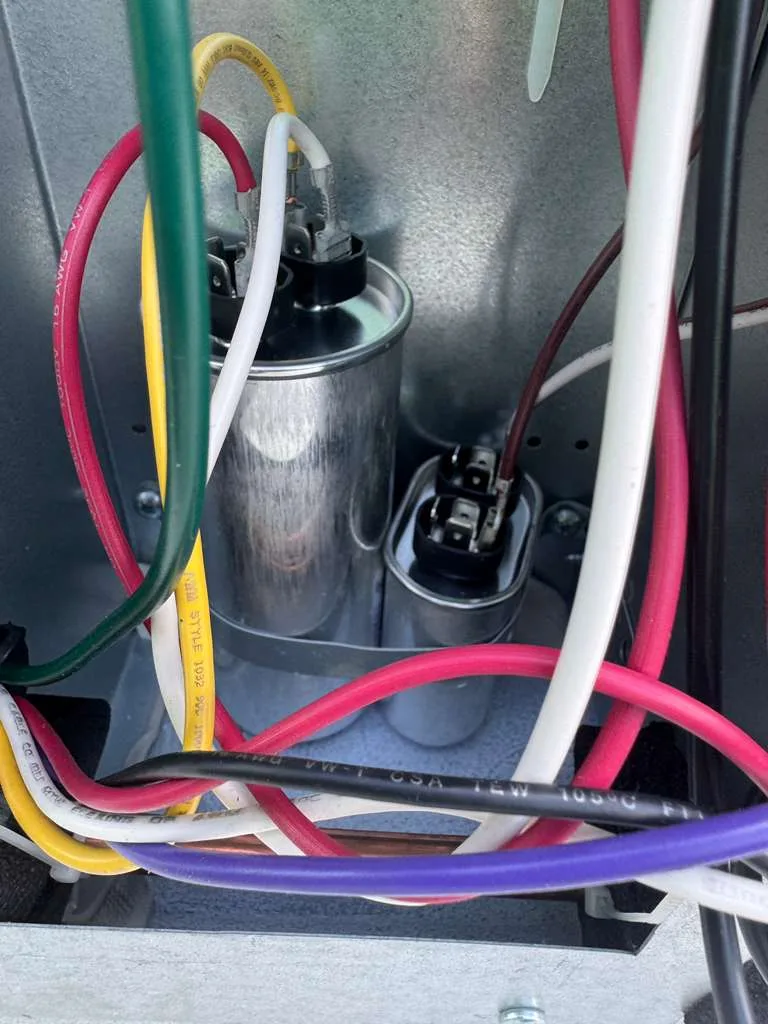
That single fact turns diagnosis into a clean yes-or-no. Everything upstream of the sealed circuit - capacitor, fan motor, control board, thermostat, freeze sensor, wiring, the shroud that protects all of it - is a repairable part and usually a one-visit job on the roof. The sealed circuit itself is not repairable in the field. If the charge is gone, the unit is replaced.
It is also why a second opinion is worth getting on any quote that mentions refrigerant.
What does a sealed circuit mean for what you can be charged?
If someone quotes you a recharge, stop
A quote to "top up the freon" on a sealed rooftop unit is either a misdiagnosis or a charge for work that cannot be performed. Ask which service port they intend to use. There isn't one. Get a second opinion before you pay.
The upside of a sealed system is that you are never paying for a slow leak chase. The downside is that a genuinely lost charge means a whole-unit replacement, which is why it is worth proving the cheap failures are not the cause before condemning it.
Ask which service port a contractor intends to connect to before agreeing to any refrigerant work. On a sealed rooftop unit there is no answer to that question, which makes this the one claim on an RV air conditioning invoice that a customer can check without any technical knowledge at all.
What actually breaks on an RV rooftop air conditioner?
In rough order of how often it turns out to be the answer:
| Part | What you see | Why it happens in Florida |
|---|---|---|
| Run capacitor | Compressor hums and stops, or fan runs while compressor never starts. Split is poor or absent. | Heat is what kills capacitors. A capacitor that has drifted well below its rated microfarads will start the unit on a mild morning and fail it in the afternoon, which is why the fault looks intermittent. |
| Condenser and evaporator coils | Split narrows gradually over a season or two. Unit runs constantly. | Pollen, road film and salt-laden air pack the fins. A coil that cannot reject heat cannot cool the cabin no matter how healthy the compressor is. |
| Return air filter | Weak airflow at every register, split narrows, coil may ice up. | Cheapest possible fix and the most commonly skipped. The filter sits at the air distribution box on the ceiling assembly, not on the roof. |
| Fan motor | Airflow weak or absent, or a bearing whine that gets worse with run time. | Continuous duty in high heat. A dying motor starves the coil of airflow and mimics a refrigeration fault. |
| Control board or thermostat | Unit ignores the thermostat, short-cycles, or the fan runs with no compressor. | Voltage spikes and humidity. Worth ruling out before any roof work, because it is often reachable from inside. |
| Weathered shroud | Cracked or chalky plastic cover, water in the control box. | UV. A cracked shroud is frequently the upstream cause of the electrical failure underneath it, so replacing only the failed part leaves the water path open. |
That last row is the one people skip. A capacitor that failed because rain has been getting into the control box through a UV-cracked shroud will fail again, and the second failure will cost more than fixing the cause would have.
Why is my ducted RV AC cold at the unit but warm at the vents?
This one fools people into replacing a perfectly good air conditioner, and it is a sheet metal and gasket problem rather than a refrigeration one.
In a ducted coach, the ceiling assembly under the unit separates two air paths: the return, pulling warm cabin air up into the evaporator, and the supply, pushing cold air out into the ceiling ducts. Those two paths are held apart by a divider and a gasket that seals the assembly against the roof opening. If that seal is compressed unevenly, torn or missing - which happens after a unit is removed and refitted, and after enough road vibration - the cold supply air takes the short route straight back into the return instead of traveling down the duct.
The give-away is a coach that cools unevenly rather than weakly, and a unit that never seems to cycle off.
How does a leaking air distribution box starve the far end of the coach?
The unit then does exactly what it is designed to do, endlessly cooling the same small pocket of air, while the far end of the coach gets almost nothing. The tell is a large split measured right at the unit and a poor one at the registers, especially the distant ones.
Dometic's own installation literature specifies the duct dimensions and the way the air distribution box seals to the roof opening for exactly this reason. It is a real spec, not a matter of judgment, and getting it wrong costs you cooling capacity you have already paid for.
That is why the fix here is sheet metal and foil tape rather than a new unit, and why it is worth checking before anyone quotes a replacement. Ducted coaches hide this well, because the air conditioner itself sounds and feels like it is working properly the entire time.
Will one 13,500 BTU unit cool my RV in Florida?
It depends far more on the coach than on the number. A well-insulated 24-foot trailer parked in shade is a different problem from a 34-foot fifth wheel with three slides and a wall of south-facing glass, and both might have the same single unit on the roof.
Before adding capacity, work through the things that change the load, because they are cheaper and several of them are free:
- Confirm the existing unit is actually making its split. Adding a second air conditioner to compensate for a weak first one is an expensive way to avoid a capacitor.
- Clean the coils and replace the return filter. A restored unit often ends the conversation.
- Check the ceiling assembly seal described above, especially if the unit has ever been off the roof.
- Cover the windows that face the afternoon sun. Glass is where most of the heat arrives.
- Run a roof vent fan on exhaust. Pulling the hottest air out of the top of the cabin lets the air conditioner work on a smaller temperature difference.
- Then, if the load is genuinely beyond one unit, look at a second unit or a higher-capacity replacement - and check that your electrical supply and breaker can carry it before ordering anything.
Owners who camp on 30-amp service should know that two rooftop units will not run simultaneously on a single 30-amp pedestal without load management, so the upgrade conversation is an electrical one as much as an HVAC one. See our RV electrical repair page for what that involves.
Does a soft start make the air conditioner colder?
No, and it is worth being clear about because soft starts are sold heavily to people whose actual complaint is cooling.
A soft start reduces the inrush current at the instant the compressor kicks in. That is genuinely useful if you want to start an air conditioner on a small generator, on a 20-amp household outlet, or on an inverter, and it takes stress off the starting components. What it does not do is change the unit's cooling capacity by a single BTU once it is running.
None of that makes the cabin any colder. A soft start changes what the compressor draws in the instant it kicks in, not what it delivers for the rest of the cycle, which is why it is the wrong purchase for a cooling complaint and the right one for a generator that trips.
What is a hard-starting compressor usually telling you?
There is also a diagnostic trap worth knowing. These devices run a learning routine over the first several starts, so the very first start after installation can behave oddly and read like a failed install when nothing is wrong. Judge it on the third to fifth start, not the first.
And the awkward truth: a compressor that has become hard to start is often signaling a run capacitor that has drifted out of spec. Fitting a soft start can mask that symptom for a while. It is worth measuring the capacitor first, because that is a small part, and finding out later that you spent the money to hide a cheap fault is a bad afternoon.
Both points matter before you spend, because the device is frequently sold as a fix for exactly the symptom it does not address.
When is this a DIY job and when should you call someone?
Plenty of this list is homeowner work. Reading the split, changing the return filter, checking pedestal voltage, covering windows, running a vent fan - none of that needs a technician and all of it narrows the diagnosis before anyone comes out.
Where we would tell you to stop: anything on the roof. Not because the work is exotic, but because RV roofs are walkable only in specific places, a foot through a soft spot turns a capacitor job into a structural repair, and the shroud comes off to expose live 120-volt terminals and a capacitor that can hold a charge after the power is off. That combination - height, a fragile surface and stored electrical energy - is why this is the one part of the job worth handing over.
It is worth having someone look at the roof membrane and the unit's roof gasket while the shroud is off, since that access is already paid for. Our RV roof repair page explains what that inspection covers.
What a visit costs
A service call is $299 and covers the trip out to your RV and the first hour on site. Work past that first hour is quoted to you once our technician has found the fault, before we carry on. In Orlando, Lakeland, Kissimmee, Apopka and nearby the service call is $399 and time past the first hour runs $200 per hour. Written estimates are free and you approve one before any work starts. Call 888-759-1438.
Sources and further reading
Every figure above that came from a manufacturer or a standards body is linked here so you can check it yourself.
- Dometic Penguin II rooftop air conditioner manual (PDF) - Dometic's own installation and operating document for one of the most common RV rooftop units, including the ceiling assembly and return air filter arrangement.
- Dometic ducted rooftop air conditioner installation manual (PDF) - Specifies duct sizing and how the air distribution box seals to the roof opening - the spec behind the cold-at-the-unit, warm-at-the-vents fault.
- Airxcel - Coleman-Mach RV air conditioning - Manufacturer page for the other rooftop unit found on most North American coaches.
- Dometic documents database - Look up the manual for your exact model number rather than a similar one - specifications differ between series.
Related pages on this site
- RV AC and heating repair - what a mobile air conditioning visit covers
- RV electrical repair - shore power, pedestal voltage and load management
- RV roof repair - the membrane and gasket work that goes with rooftop unit access
- Book a service call - mobile across Florida
RV air conditioner questions Florida owners ask
How long should an RV air conditioner run before the coach cools down?
In Florida summer conditions, expect a rooftop unit to run more or less continuously through the afternoon rather than cycling. That is normal and not a fault. What matters is whether the cabin temperature is slowly falling or holding steady against the heat. If it is climbing while the unit runs with a good temperature split, the load has exceeded the capacity and no repair changes that.
Why does my RV air conditioner freeze up?
Icing on the evaporator coil is nearly always an airflow problem, not a cold problem. A clogged return filter, a fouled coil or a weak fan motor stops enough air passing over the coil, the coil drops below freezing and condensation turns to ice, which then blocks airflow completely. Turn the compressor off and run the fan alone to melt it, then find the airflow restriction before running it again.
Can I add refrigerant to my RV rooftop air conditioner?
No. Common RV rooftop units are sealed systems brazed closed at the factory with no service ports, so there is no way to connect gauges or add refrigerant. If a unit has genuinely lost its charge it is replaced rather than recharged. A quote to recharge one should be questioned.
Is a 15,000 BTU unit worth it over a 13,500 in Florida?
It can be, but only after the existing unit has been proven healthy and the airflow and duct sealing checked. Capacity upgrades also raise your electrical demand, so the pedestal amperage you camp on and the coach wiring need to be part of the decision rather than an afterthought.
Why does my air conditioner trip the breaker on hot afternoons?
Most often low voltage at the pedestal. Under the park's peak load the supply sags, the compressor compensates by drawing more current, and either its own thermal overload or the breaker opens. Check voltage at the outlet under load before assuming the air conditioner is faulty, and compare it to the minimum operating voltage on the unit's data plate.
Do you work on the air conditioner at my campground or storage lot?
Yes. This is mobile work - we come to wherever the RV is parked across Florida, including campgrounds, storage yards and driveways. Call 888-759-1438 and we will tell you on the phone what the visit covers before anyone is dispatched.
Should I clean the coils myself?
The return filter, yes - it is designed to be pulled out from inside the coach. The coils themselves live under the roof shroud alongside live terminals and a capacitor that stores charge, and the fins bend if you lean on them wrong. That part is worth handing over, particularly since a technician can check the roof gasket and membrane in the same access.
My air conditioner is old but still cools. Should I replace it preventively?
Not if it is making a proper temperature split and the shroud is intact. Replace on symptoms, not on age. What is worth doing preventively is dealing with a cracked or chalky shroud, because that is what lets water into the electrical box and turns a working unit into a failed one.