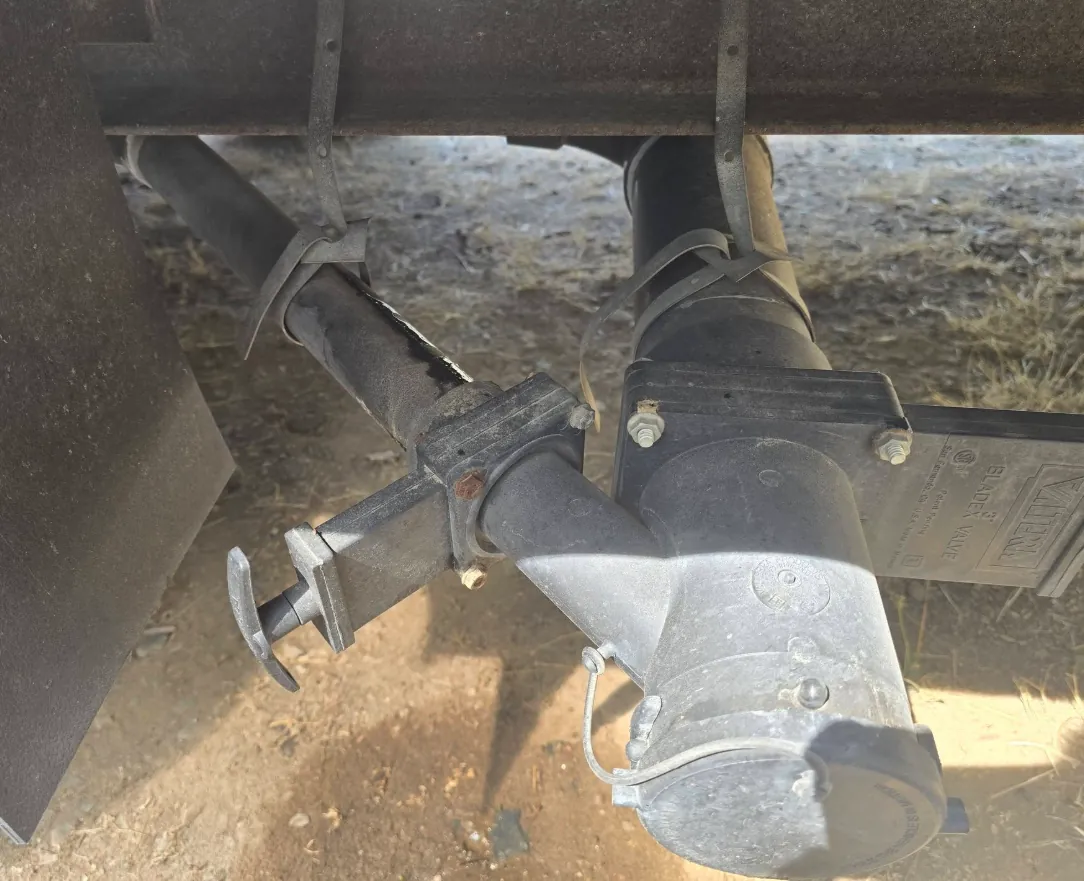
RV Gray Tank Valve Replacement and Stuck Dump Valve Repair
Gray tank valve stuck shut, or weeping so the cap drips every time? Mobile gray dump valve and cable replacement across Florida. Call 888-759-1438.
Ignore a weeping gray tank valve and every cap removal becomes a face full of stale dishwater. Ignore a seized one and you are hauling a full tank you cannot empty until something upstream gives. A gray dump valve fails in two unrelated ways: it will not open, which is a seized blade or a stretched cable, or it will not seal, which is worn seals. Those are two different repairs.
What a Gray Tank Dump Valve Actually Is
A gray tank dump valve is a gate valve. A flat plastic blade slides in and out of a slot between two rubber seals held inside a bolted flange body. When the blade is parked closed, those two stepped seals squeeze it from both sides, and that pinch is the only thing holding the water back. The body bolts up with four flange bolts, sandwiched between the pipe coming off the tank and the pipe running out to the sewer termination, with a sealing face on each side. Valterra's Bladex bodies are the common aftermarket standard in 1-1/2 inch, 2 inch and 3 inch sizes, and the 3 inch body ships with its seals, nuts and bolts included. Gray valves are frequently the smaller sizes, since the gray line carries no solids. The handle is either a short rod you pull directly or a stainless cable running from the blade stem to a handle mounted somewhere reachable.
Will Not Open Versus Will Not Seal: Two Failures, Two Repairs
Treat these as separate faults, because the parts and the labor barely overlap. A valve that will not open is mechanical, at the blade or at the linkage. Either the blade is glued into its slot by cooled grease and soap scum, or the stainless inner wire of the cable has stretched, kinked or parted, so the handle travels without moving anything behind it. Pull the handle and read the resistance: full stroke with no load means the cable has let go, while a handle that will not budge at all points at a seized blade. A valve that will not seal is a different animal entirely. The blade closes fine, but the seals no longer grip its faces, so gray water weeps past and collects against the bayonet cap. The tell is a cap that dribbles every single time you twist it off, days after the last dump, not just after a shower.
What We Check, and In What Order
The first question on the phone is the plainest one: are we talking about the black tank or gray? Gray is galley sink and shower drain water, and its valve usually sits inboard of the black valve on the same termination. From there the order is fixed. Confirm which valve is actually weeping by capping the outlet and watching, then run each handle through its full travel and note whether it loads up or freewheels, then pull the cap and look for a blade edge sitting proud in the opening. If the water at the cap is clear instead of soapy and gray, the source is upstream, in a PEX line or the 12V water pump, and that is a different job. Wet flooring at the toilet base is a flange seal question. Sensor readings and tank flush faults belong to the black tank, not here.
Why the Seals Give Out Long Before the Blade Does
The blade is a molded plate with nothing to wear against except two rubber seals, so it routinely outlives everything around it. The seals do all the work and absorb all the abuse. Every cycle drags grit, hair and congealed cooking grease across their sealing faces, and the gray line delivers far more of that than the black line ever does. Rubber held compressed against a blade also takes a set, so a valve parked open for a season loses its memory of the closed position and never quite grips again. Year-round Florida use compounds it, because the coach never goes into a winter lay-up and the wear never pauses for a single month. That is why a seal card is such a routine part. Valterra numbers them by size, T1003-9VP for the 3 inch and T1002-9VP for the 2 inch, two seals with hardware on the card.
The Bayonet Cap Is Your Backstop, Not a Second Valve
The bayonet cap is the lugged cap that twists onto the termination outlet, and it is the last thing standing between a weeping valve and the campground pad. Valterra's T1020VP carries its own seal and a retaining strap so it does not walk off at a dump station. Treat it as a backstop and nothing more. A cap holding back a leaking valve is holding a head of water it was never designed to hold, and the moment you twist it off to attach the sewer hose, everything the tank has been storing arrives at once. Hose on first, cap off second, every single time. If the cap has lost its own seal or cracked a lug, replace the cap before condemning the valve, because a dripping termination with a sound valve behind it is often just a tired cap and a two minute fix.
Why Leaving the Gray Valve Open on Full Hookup Backfires
Thetford's own guidance says the gray valve may be left open on a sewer hookup, unlike the black valve, but it adds the part owners skip: grease and solids still build in the tank and it needs periodic rinsing. Two things go wrong once the valve lives open. Grease films over the seals and the blade slot while there is no flow to scour them, and the tank never fills enough to wash its own walls, so residue sets hard right where the blade has to travel. The second problem is the connection itself, now a permanently open path for odor and for anything working its way back up the sewer hose. Close the gray valve, let the tank fill most of the way, then dump it in one rush. That surge is what carries grease out, instead of leaving it to line the tank and glaze the seals.
Getting the Valve Out, What It Costs, and What Waiting Costs More
Access decides this job, not the valve. Where the termination hangs in open air, the four flange bolts back out with a nut driver, the body slides off the two stub pipes, and the replacement goes back with the bolts snugged in a crisscross pattern so the flange does not warp. Where a sealed coroplast underbelly wraps the frame, none of that is reachable until a panel of belly board comes down and gets re-taped afterward. Nobody should quote a fixed figure on a valve they have not seen. Left alone, a weeping valve soaks the underbelly insulation, and a seized one eventually gets forced, cracking the ABS hub and turning a bolt-on swap into a re-plumb.
Operate both valves through their full travel every time you dump, even when only one tank needs it. Valves seize from sitting still, and the exercise costs nothing.
Sources
Every figure on this page comes from a manufacturer document or a standards body, not from another repair site. Here is where each one comes from.
- Valterra Products, RV Aftermarket Catalog (manufacturer catalog PDF, Sewer and Sanitation section)Verified by reading the PDF: the Bladex Waste Valves with Metal Handle listing states the valves have durable die-cast aluminum handles and that the body includes seals, nuts and bolts, and lists T1003VPM as the 3 inch metal handle body, carded. The Bladex Valve Seals listing gives T1003-9VP for 3 inch and T1002-9VP for 2 inch seals with hardware, two per card. The Cable Actuated Waste Valve Kit listing states the cables use a stainless steel inner wire, and gives the replacement cable with valve handle as TC72PB at 72 inches, TC96PB at 96 inches and TC120PB at 120 inches.
- Valterra Bladex Valve Seals, 1-1/2 inch, 2 inch and 3 inchSeals are sold separately as a two-per-card kit with hardware and numbered by valve size, confirming the seals are the wear part and the part numbers T1003-9VP and T1002-9VP.
- Thetford: Can I leave my dump valves open when I have sewer hookups at my camp site?Thetford permits leaving the gray valve open on a sewer hookup while warning that grease and solids still build in the tank and require periodic rinsing.
Related repairs
Other systems we service
Where we work
Service category
What this usually costs
| Item | Price | What it covers |
|---|---|---|
| Service call | $299 | Includes the trip out to your RV and the first hour on site |
| Work past the first hour | Quoted after diagnosis | We tell you what it will take before we carry on |
| Parts | Quoted per job | Special-order parts may need a deposit before we order them |
| Written estimate | No charge | You approve the estimate before any work starts |
The service call covers the trip out to your RV and the first hour on site. Anything beyond that depends on what we find, and we quote it and get your approval before carrying on.
The price ranges on this page come from our own recent jobs across Florida, not from an industry average. What you pay depends on the rig, the parts it needs and what we find on site, so we give you a written estimate before any work begins and you approve it first.
Frequently asked questions
Are we talking about the black tank or the gray?
That is the first thing to settle, because the repairs diverge from there. Gray is sink and shower water, and its valve is often the smaller one, commonly 1-1/2 inch or 2 inch. Black is toilet waste and is nearly always a 3 inch valve sitting outboard on the termination. Cap the outlet, work one handle at a time, and watch which one produces soapy water. If it foams, it is gray.
The handle pulls all the way out but nothing drains. Did the valve come loose?
Usually the cable came loose, not the valve. Cable valves run a stainless inner wire inside a housing, and when that wire stretches or its ferrule lets go, the handle travels its whole stroke with no load behind it. Valterra sells replacement cables with handles by length, such as the 96 inch TC96PB, with 72 inch and 120 inch versions for shorter and longer runs. A seized blade feels like the opposite: dead solid, no travel at all.
Can you just replace the seals instead of the whole valve?
Sometimes, and the seals are sold for exactly that, two on a card with hardware. But those seals live inside the same flange you have to unbolt to change the entire body, so the labor is identical either way. If a valve is already old enough to leak at the seals, a fresh body with new seals is usually the better spend, and it clears the blade wear and the corroded flange bolts in the same visit.
Can you repair a broken threaded fitting at the tank?
Often yes, depending on what actually broke. The valve itself bolts to a flange, but the pipe on either side is typically a glued ABS hub or spigot, and a cracked hub means cutting back to clean pipe and bonding in a new fitting rather than a straight bolt-on swap. A cracked boss on the tank shell is a different repair again. Either one needs eyes on it before anyone puts a number on it.
How long does a gray tank valve replacement take?
An exposed valve with reachable bolts is roughly a 45 minute job once the tank is empty. That same valve behind a sealed coroplast underbelly typically runs two to three hours, because the belly panel has to come down and then be re-taped properly. Emptying the tank first, if it will drain at all, saves time and keeps the work clean for everyone involved.