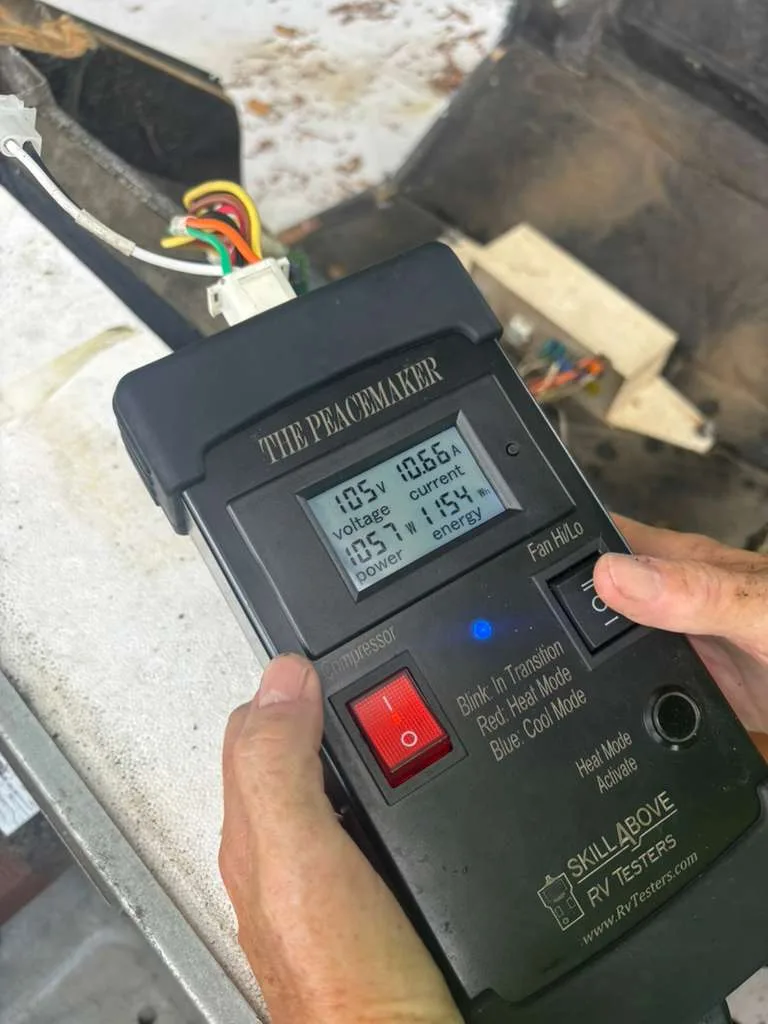
The RV Pre-Purchase Inspection Checklist That Actually Finds Problems
The order to inspect in, the tests that find hidden water, and how to read a DOT date code before you hand over money.
Inspect in the order of what can end the deal, not in the order things catch your eye. Water damage first, then structure, then the systems that cost the most to fix, then cosmetics last. Almost every used-RV regret is structural, and almost every buyer starts with the interior because that is what is easy to look at.
Apex RV Repair is mobile across Florida - we come to your RV. Call 888-759-1438.
Buying a used RV is a structural purchase disguised as a lifestyle one. The upholstery, the layout and how clean it is are the things you notice, and none of them are what determines whether this was a good buy.
This checklist is ordered by consequence. If the first section turns up something serious, you can stop - and stopping early is the entire point of inspecting.
What should I check before anything else?
Water. It is the failure most likely to make a coach not worth buying, the hardest to see, and the one the seller may honestly not know about.
- Smell it before you open a window. Get in and stand still. Musty or earthy means something organic is decomposing out of sight. If the coach has been aired out or has an air freshener working, ask why.
- Walk the whole floor slowly, including under the bed, in the closets, in front of the shower and at every slide opening. You are feeling for a change in how the floor responds, not for an obvious hole.
- Press every wall with a flat palm - low, middle and high. Anything that gives, feels spongy or sounds different has separated from what should be behind it.
- Sight along the exterior walls at a shallow angle. Waves, ripples and bulges are close to invisible face-on and obvious in raking light. That is delamination.
- Look at every ceiling seam and corner for staining, and at the trim around vents and the air conditioner.
- Open every cabinet and drawer and check whether they close properly. Doors that catch mean the structure has moved.
- Get on the roof if it is safe and rated for it, and examine every sealed termination for cracking, lifting and separation.
If you find several of these together, that is enough information to walk away. If you find one, that is the point to bring in a moisture meter - which is what turns a suspicion into a measured boundary. Our water damage article covers what those signals mean in detail.
The switch-plate test
Take a cover plate off a light switch or outlet and look at the cut edge of the panel. Visible wood plies mean a porous lauan-type panel that has to come out if it has been wet. A homogeneous gray or white composite is non-porous and can often be cleaned in place. Same stain, completely different repair, and you can check it in ten seconds with a screwdriver.
How do I check the structure and chassis?
Get underneath with a light, or have someone do it. Most of what matters is visible from below.
- Frame and welds. Look for cracks, especially near suspension mounts and at the point where a fifth wheel pin box or a hitch attaches. Look for repairs - a fresh weld or new paint in one small area is a question worth asking.
- Rust. Surface rust on a Florida coach is normal. Flaking, scaling or perforation is not, and coastal storage is where that happens fastest.
- The underbelly. Tears, sagging or areas that have been re-taped often mean somebody has been in there. Ask what for.
- Suspension. Leaf springs, shackles, and equalizers on a trailer. Cracked or flattened springs and worn shackle bushings are common and are not cheap to ignore.
- Slide openings. Look at whether the room sits square in the opening and whether the gap is even all the way around. An uneven gap is a squareness warning.
- Signs of an impact. Look along the sides for a panel that does not line up, and at the roof edges and corners for evidence of a low-clearance meeting.
Structural findings are the ones that end deals, which is why they belong near the top rather than after you have talked yourself into the coach.
How do I read the DOT date code on the tires?

Worth knowing because tires age on the calendar rather than on mileage, and a stored RV in Florida sun ages them faster than the miles suggest.
Every tire carries a DOT identification number molded into the sidewall, and the last four digits are the manufacture date - the first two are the week of the year, the last two the year. So a code ending 3223 means the thirty-second week of 2023. The format and its requirements are set out in the federal tire identification regulations.
Check every tire including the spare, because they are frequently not the same age. Then look at the sidewalls for fine cracking, which is what ultraviolet exposure does over time.
To be straight: we do not sell, fit or repair tires, so this is not us setting up a sale. It is information you should have before you hand over money, because aged tires on a coach you are buying are a real cost that belongs in the negotiation.
How do I test the appliances properly?
The rule is to run everything, in both of the modes it can run in, and to leave enough time to see it actually work rather than just light up.
| System | How to test | What tells you there is a problem |
|---|---|---|
| Refrigerator | Run on LP and on 120V, both, and give each an hour. | An absorption fridge that cools on one and not the other has a fault in that side. Cooling on neither, after an hour, is the expensive answer. |
| Air conditioner | Run it and measure the temperature difference between the return grille and the nearest supply register. | A weak split means a restriction or a refrigeration fault. These are sealed units, so a lost charge means replacement, not a recharge. |
| Furnace | Run a full cycle and listen to the ignition sequence. | Repeated ignition attempts, a delayed light-off, or a blower running with no heat. |
| Water heater | Run on LP and on electric. | Same logic as the fridge - one mode working and not the other localizes the fault. |
| Water system | Fill and pressurize, then check every fitting and run the hold test with the pump off. | A system that will not hold pressure has a leak, and a leak in an unknown location is a serious finding on a coach you are considering. |
| Generator | Start it and run it under load, ideally the air conditioner. | Hard starting, surging, or an inability to carry the load. Ask for the hours on the meter. |
| Slides and leveling | Run every slide fully in and out, and a complete leveling cycle. | Slow travel, stalling, running crooked, or a cycle that aborts. |
| Electrical | Plug into shore power and test outlets. Test for hot skin at the steps and door frame. | Any tingle when touching metal parts is a stop-immediately finding, not a negotiating point. |
Systems tested cold from a coach that has been sitting are also worth a second look - things that work for five minutes and fail at thirty are common on a coach that has not been used.
What paperwork should I check?
- Title, in the seller's name. A private sale where the title is in someone else's name, or is missing, is a reason to stop rather than a paperwork detail to sort out later.
- VIN matching between the title, the coach and any registration documents.
- Any lien, and how it will be released at sale. This is the one that most often catches private buyers.
- Service records. Their absence is not a deal-breaker on an RV, but records of roof resealing and appliance work are genuinely valuable.
- Warranty status on anything recent, and whether it transfers - many RV warranties do not transfer to a second owner.
- Recall history by VIN, which is worth checking directly rather than taking the seller's word for it.
For Florida-specific title and registration requirements, the state's motor vehicle department publishes the current rules, and that is the authority rather than whatever a forum post says.
Is a professional pre-purchase inspection worth it?
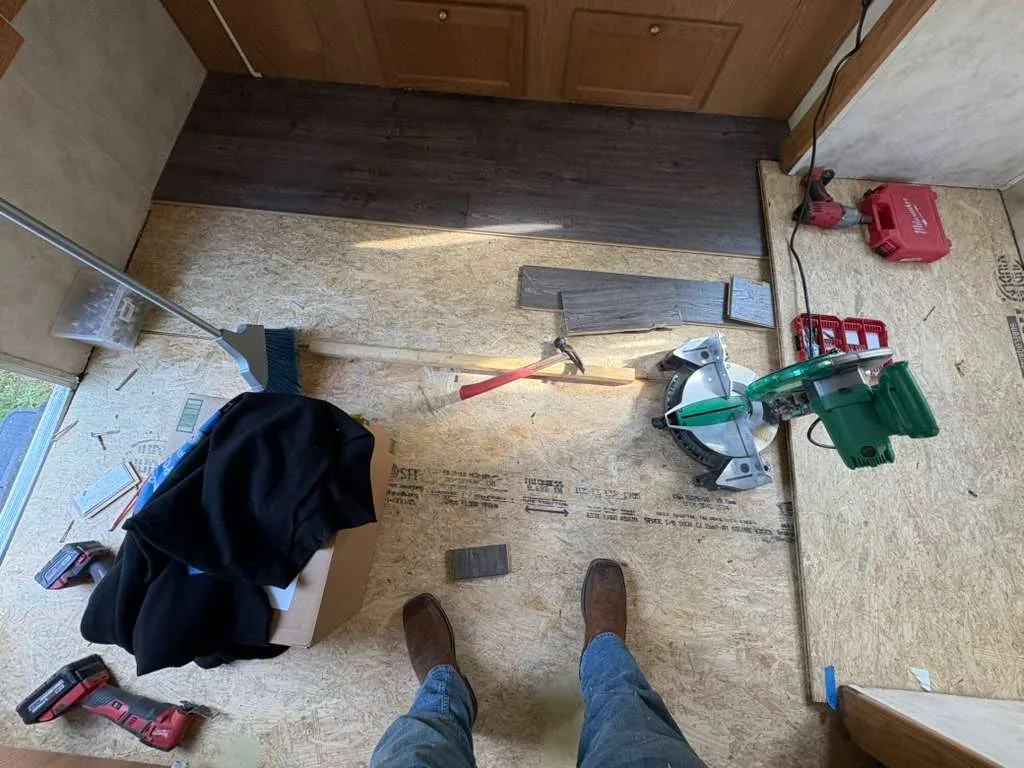
For a used coach at any real price, the arithmetic is not close. The inspection costs a small fraction of what a single significant water repair costs, and its most valuable outcome is often telling you not to buy.
What an independent inspection adds beyond a careful buyer walk-through:
- A moisture meter, which reads through finished surfaces and finds what pressing with a palm cannot.
- Testing appliances properly and long enough, including in both operating modes.
- Knowing what normal looks like on that model - which failures are typical and which are a warning.
- A written record you can take into a negotiation, which is a very different conversation from an opinion.
- Independence. An inspector who has no interest in whether the sale happens is worth more than one recommended by the seller.
One point worth making plainly: choose an inspector who is not connected to the seller. That is the whole value of the exercise.
What is different about buying a used RV in Florida?
Environment history matters more here than almost anywhere, and it is not visible in the mileage.
- Sun exposure. A coach that lived outdoors in Florida has aged seals, roof membrane, awning fabric and tire sidewalls faster than the same coach stored under cover. Ask how it was stored and look at the seals to check the answer.
- Salt. A coastal coach carries corrosion on the frame, fasteners, jack rods and electrical connections. Look underneath and at the jack chrome specifically.
- Humidity and storage. A coach that sat closed up through Florida summers has had ideal mold conditions. That is where the smell test earns its place.
- Storm history. Water intrusion from a hurricane may have been repaired well, badly, or not at all. Look for repairs, and ask directly.
- Snowbird use patterns. Many Florida coaches are used a few months a year and sit the rest. That means low mileage and high sitting time, which is a different wear profile - generators and seals suffer, running gear does not.
Low miles on a Florida RV are not the reassurance they would be on a car. Sitting is its own kind of wear, and this state accelerates it.
What a visit costs
A service call is $299 and covers the trip out to your RV and the first hour on site. Work past that first hour is quoted to you once our technician has found the fault, before we carry on. In Orlando, Lakeland, Kissimmee, Apopka and nearby the service call is $399 and time past the first hour runs $200 per hour. Written estimates are free and you approve one before any work starts. Call 888-759-1438.
Sources and further reading
Every figure above that came from a manufacturer or a standards body is linked here so you can check it yourself.
- 49 CFR Part 574 - Tire Identification and Recordkeeping - The federal regulation that defines the DOT tire identification number, including the date-of-manufacture digits.
- Florida Highway Safety and Motor Vehicles - insurance requirements - State authority on the coverage and registration side of buying a vehicle in Florida.
- Lippert - Master Owner's Manual, Slide-Outs - The squareness tolerance behind the even-gap check on a slide opening.
- Dicor - roof sealant installation instructions - What a properly maintained roof termination should look like, for comparison during a roof inspection.
Related pages on this site
- RV inspections - pre-purchase inspections and moisture surveys
- Spotting RV water damage - the failure most likely to end a deal
- RV roof repair - what a failed roof termination costs to put right
- Book an inspection - mobile across Florida
Pre-purchase inspection questions Florida buyers ask
How much should a used RV inspection cost?
It varies with the size of the coach and how far the inspector travels, and the useful comparison is not to other inspections but to what one missed problem costs. A structural water repair is an order of magnitude more than an inspection. Ask what is included, whether a moisture survey is part of it, and whether you get a written report.
Can I inspect an RV myself?
You can do a great deal of it, and the checklist above is designed to be usable by a buyer. What you cannot easily replicate is a moisture meter reading through finished surfaces and the pattern recognition of someone who has seen the same model fail the same way. For an inexpensive coach a careful self-inspection may be proportionate. For a significant purchase it usually is not.
What is the most expensive thing to find wrong with a used RV?
Structural water damage, by a wide margin, because it is rarely confined to where you can see it and the repair scope cannot be established without opening the coach. Everything else - appliances, slides, generators, even a roof - is a defined job with a knowable price. Water damage is the one where the answer is genuinely unknown until the work starts.
Should I buy from a private seller or a dealer in Florida?
Both are workable and the trade-offs are different. A private sale is usually cheaper and puts the title and lien work on you to verify. A dealer handles paperwork and may offer some coverage, at a higher price. Neither changes what you should inspect - a dealer walk-around is not an inspection, and a dealer's inspection is not an independent one.
How do I know if a slide-out has a problem before buying?
Run every slide fully in and out at least twice while you watch from outside. Look for even travel, listen for a change in sound, and check that the room sits square in the opening with an even gap all round. A slide that binds, runs crooked or hesitates at one corner is worth taking seriously, because it can be reporting a floor problem rather than a mechanism problem.
Does a clean interior mean the RV was well maintained?
No, and this is where buyers most often go wrong. Interior condition reflects how the coach was used and cleaned. Maintenance is roof sealant, seals, appliance service and structure - none of which are visible from the sofa. A spotless coach with failing roof terminations is a much worse buy than a scruffy one that was resealed every year.
Do you do pre-purchase inspections in Florida?
Yes, including moisture surveys, appliance testing in both operating modes, and a written report you can use in the negotiation. We do it wherever the coach is - a dealer lot, a storage yard or a private driveway. Call 888-759-1438. If we find something that means you should not buy it, that is what the report will say.
What if the seller will not let me test everything?
Treat that as an answer. There is no legitimate reason to refuse a buyer running the appliances, the slides and the water system on a coach being sold as working. If access to the roof is refused for safety reasons that is fair, but the rest of it is not an unreasonable request and reluctance is information.