RV Leveling Systems: Why Auto-Level Stalls and What Sinking Jacks Mean
Hydraulic or electric, why the cycle will not complete, and the difference between jacks that leak down and ground that sinks.
If the coach settles overnight, find out whether it is the jacks or the ground before anyone opens a hydraulic system. Put a mark on each jack rod where it meets the cylinder. If the rods have moved back into the cylinders by morning, that is internal bypass in the system.
Apex RV Repair is mobile across Florida - we come to your RV. Call 888-759-1438.
Leveling is one of the few RV systems that is genuinely structural. A coach sitting badly out of level puts a twist through the frame, and that twist is what makes doors stop latching, slides bind and cabinet doors swing open on their own.
It is also a system where the order of operations matters more than the equipment, and where a simple mark with a pencil settles the most commonly misdiagnosed fault.
Which leveling system do I have, and does it matter?
It matters for troubleshooting, because the failure modes have almost nothing in common.
| System | How to identify it | Typical faults |
|---|---|---|
| Hydraulic automatic | A pump and reservoir in a bay, hoses running to cylinders at each jack. Often shares its pump with hydraulic slide-outs. | Fluid level, solenoid valves, cylinder seals, pressure switches, or a controller that will not complete its cycle. |
| Electric automatic | Electric motors and screw jacks at each corner, no hoses or reservoir. | Motor and gearbox wear, corroded connections, and controller faults. Sensitive to battery condition. |
| Manual scissor or stabilizer jacks | Cranked by hand or with a drill, usually on trailers. | Mostly mechanical wear, and being used for the wrong purpose - see below. |
| Blocks and levelers under the wheels | No mechanism at all. | None, and this is worth remembering: on a trailer this is often the correct primary method with the jacks only stabilizing. |
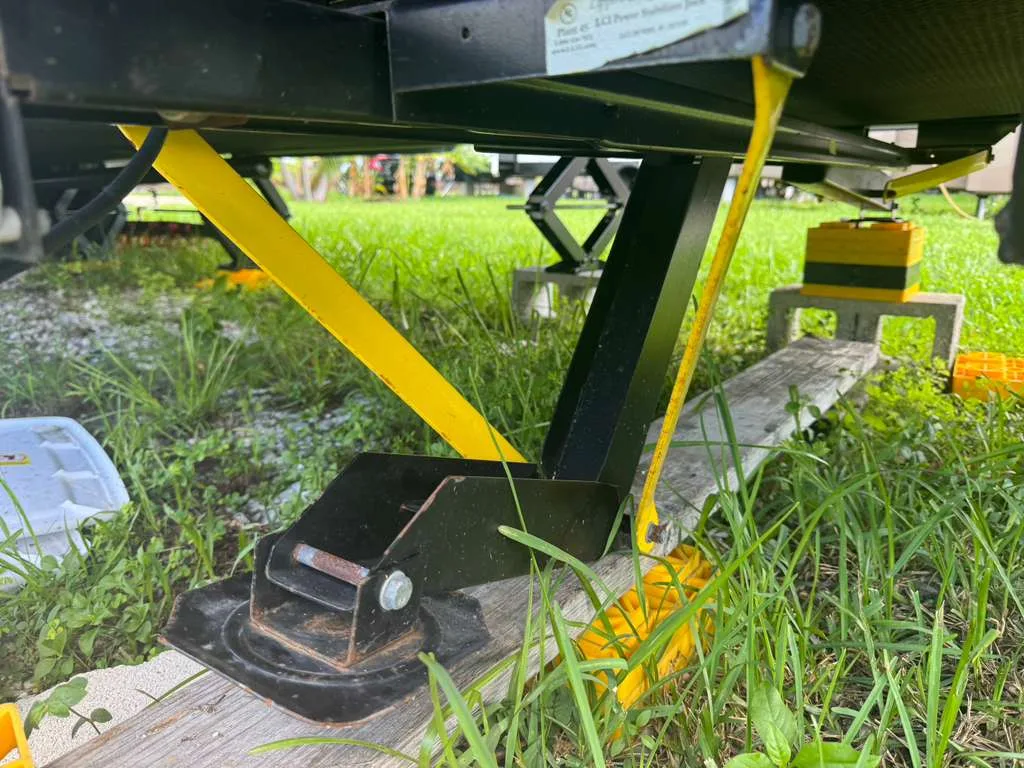
One distinction is worth being explicit about because it causes real damage: stabilizer jacks are not leveling jacks. Scissor jacks fitted to many trailers are designed to stop the coach rocking, not to lift and hold it. Using them to lift a corner into level overloads them and can distort the frame they are bolted to. Level with blocks under the tires first, then set the stabilizers.
In what order should I level, and does it happen before unhitching?
Side to side first, then front to back, and on a towable that means before you unhitch.
- Park where you intend to stay and check side to side level.
- Correct side to side by driving up onto blocks or leveling ramps under the tires on the low side. This is the step people skip, and it is the one that cannot be fixed later without moving the coach again.
- Chock the wheels once you are happy.
- Only then unhitch, and use the tongue jack or the automatic system to set front to back level.
- Set stabilizers last, with firm contact rather than lifting.
The order is not a preference. An automatic system corrects front to back within a limited range, and asking it to fix a side-to-side problem it was never designed to reach is what produces the straining, the alarm and the crooked coach.
Why does leveling a coach out of order damage more than comfort?
Doing it in the wrong order is what produces the classic outcome of an automatic system straining, an alarm, and a coach still sitting crooked. Automatic systems have a limited range of travel and they cannot correct a large side to side error - they are levelers, not cranes.
There is also a real reason to care beyond comfort. A coach held out of level puts a diagonal twist through the frame, and that twist is transmitted straight into the slide openings. A slide-out is held to a tight squareness tolerance, so an out-of-level coach can make a healthy slide bind, which then gets diagnosed as a slide fault. Our slide-out article covers why that tolerance is so small.
That is the part owners underestimate. A twist held through a season shows up in doors that stop latching and slides that stop sealing, and neither of those reads as a leveling problem by the time it appears.
Why won't my auto-level system finish its cycle?
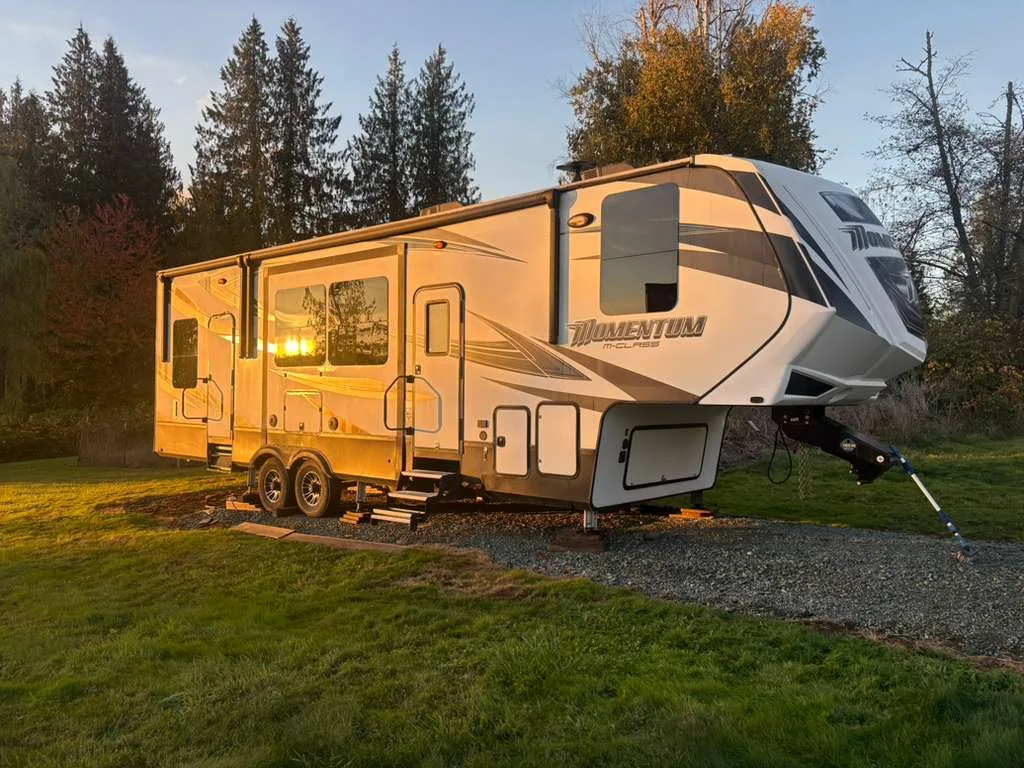
An automatic controller will abort rather than keep pushing, which is correct behavior and is usually reporting something real.
- Not enough range. The ground is too far out of level for the jacks to correct. Reposition or use blocks under the tires and start again.
- Low battery voltage. Both hydraulic pumps and electric jack motors pull hard, and a bank that sags under load will cause a cycle to stall or abort partway. Check it under load rather than at rest.
- Low hydraulic fluid. Check the reservoir with the jacks fully retracted, which is what the manufacturer specifies - checking with jacks extended gives a low reading and tempts people to overfill, which then overflows when the jacks come back up.
- A jack that is not moving. One stuck or slow jack makes the controller unable to reach its target. Watch a cycle and see whether all four are actually moving.
- Sensor or calibration. These systems level to a stored reference. If the coach has had suspension work, or the controller has lost its zero, it will chase a target that is not level.
- A solenoid or pressure switch fault on hydraulic systems, which is where the diagnosis moves from owner checks to a technician.
Repeatedly re-running a failed cycle is the thing to avoid. If the system aborted, it aborted for a reason, and forcing it is how a hydraulic system gets hot and a pressure switch gets worn.
Why do my jacks sink or settle overnight?
There are two completely different causes and one pencil mark tells you which.
Before you go to bed, mark each jack rod where it emerges from the cylinder body. In the morning, look at the marks.
- The rod has retracted into the cylinder. The coach came down because the system let it down. That is internal bypass - fluid crossing inside a cylinder or past a valve - and it is a hydraulic repair.
- The rod has not moved but the coach is lower. The jacks are exactly where you left them and the ground has given way underneath. This is extremely common in Florida on sand, on damp grass, and on hot asphalt in summer, where a small steel foot will press in over a few hours.
That second case is not a fault and no repair fixes it. The fix is surface area: put a large, rigid pad under each jack so the load is spread. It also protects the site and stops a jack foot punching through pavers or asphalt.
Never work under a coach held up by its leveling jacks
Leveling jacks are not designed as safety supports and are not rated to hold a coach up while someone is beneath it - and if the fault you are investigating is a jack that leaks down, you are relying on the exact component you already suspect. Use rated jack stands or cribbing for anything that puts you underneath.
Can I use my leveling jacks to change a tire?

No, and it is worth being blunt about this one because manufacturers say so in their own documentation.
Leveling jacks are designed to lift and level a coach on their footprint, not to hold a corner in the air while a wheel is off and someone is working next to it. Removing a wheel changes the load path and the stability of the whole setup, and a jack that settles even slightly while a wheel is off is a bad situation.
Use the correct lifting equipment and rated stands, positioned at the manufacturer's designated points. And since tires are not something we take on as a service, this is a job we would send you to a tire specialist for rather than take on ourselves - what we can tell you is what your tires are showing, not fit them.
What maintenance do leveling jacks need in Florida?
Less than people think mechanically, and more than people think in terms of corrosion - the coastal environment here is the deciding factor.
- Wipe the exposed rods clean before retracting. Grit and salt drawn back into the cylinder is what destroys seals.
- Keep the rods lubricated per the manufacturer's guidance. Lippert shortens the recommended lubrication interval considerably for coaches in salt air compared to normal conditions, which is directly relevant to most of coastal Florida.
- Inspect the chrome on the rods. This is the important one - Lippert's own seal service guidance says to discard a jack leg rather than reseal it if the rod is dinged, scored or corroded, because a damaged rod destroys a new seal almost immediately.
- Check the fluid level with the jacks fully retracted, on the schedule in your manual.
- Exercise the system periodically during storage so seals do not take a set and the pump does not sit dry.
- Look for weeping at the cylinder ends. A film of fluid on a rod is an early seal warning worth acting on.
That third item changes the economics of a repair, which is why it is worth knowing before you get a quote. On a coastal coach the condition of the chrome, not the price of a seal kit, is what decides whether a jack is resealed or replaced.
When should this go to a technician?
Checking fluid, marking rods, using proper pads, cleaning and lubricating, and watching a cycle to see which jack is misbehaving are all owner tasks and they usually identify the problem.
Where to stop: opening a hydraulic system, replacing cylinders or solenoids, and anything that involves being under the coach. Hydraulic systems hold pressure after the pump stops, and a system that is already misbehaving is not the one to learn on.
Controller calibration is the other one worth handing over, because a system calibrated to the wrong reference will faithfully level the coach to something that is not level, and that error then propagates into the slides and the doors. See our leveling service page for what a mobile visit covers.
Photograph the control panel error code before you clear it, because clearing it is often the first thing an owner does and the last useful evidence.
What a visit costs
A service call is $299 and covers the trip out to your RV and the first hour on site. Work past that first hour is quoted to you once our technician has found the fault, before we carry on. In Orlando, Lakeland, Kissimmee, Apopka and nearby the service call is $399 and time past the first hour runs $200 per hour. Written estimates are free and you approve one before any work starts. Call 888-759-1438.
Sources and further reading
Every figure above that came from a manufacturer or a standards body is linked here so you can check it yourself.
- Lippert - Master Owner's Manual, Leveling and Stabilization - Manufacturer guidance covering leveling and stabilization products, including maintenance and lubrication intervals.
- Lippert - Level Up motorized leveling - Owner's manuals and troubleshooting guides for the automatic system fitted to many coaches.
- Lippert - Power Gear hydraulic leveling - Documentation for the hydraulic leveling product family, including fluid and service procedures.
- Lippert - master owner's manuals index - Find the manual matching your exact system rather than a similar one - error codes differ between them.
Related pages on this site
- RV leveling system repair - hydraulic and electric leveling diagnosis and service
- RV slide-out repair - the system most affected by a coach sitting out of level
- Why your slide out will not move - the squareness tolerance behind a binding slide
- Book a service call - mobile across Florida
RV leveling questions Florida owners ask
How level does an RV actually need to be?
Level enough that doors latch, slides run freely and you are comfortable. Absorption refrigerators are the one component with a genuine sensitivity - they rely on gravity to circulate their solution and running them significantly out of level can damage them permanently. Check your fridge documentation, because that limit is usually tighter than what feels level to you.
Why does my hydraulic pump run but the jacks do not move?
Usually fluid level or a valve, not the pump. A pump running with nothing happening means it is not building or not directing pressure - low fluid, air in the system, or a solenoid that is not opening. Check the reservoir with the jacks fully retracted before assuming a pump failure.
Should I put boards under my leveling jacks?
Yes, on any surface softer than solid concrete, and in Florida that includes hot asphalt in summer. The goal is spreading the load over a larger footprint. Use a rigid pad wide enough to matter - a thin scrap of plywood flexes and does very little. It also protects the surface you are parked on, which some parks require.
Can I level my RV with just the front jack and blocks?
On a towable, that is often exactly the right method: correct side to side with blocks under the tires, then set front to back with the tongue jack, then bring stabilizers down to firm contact. The mistake is trying to lift a corner with a stabilizer jack, which is not what it was built to do.
My leveling controller shows an error code. What now?
Look it up in the manual for your specific system before acting, because the codes are system-specific and the same number means different things across manufacturers. Most codes report something real - excessive slope, a jack that did not reach position, or low voltage - and clearing the code without addressing the cause simply repeats the cycle.
Do you repair hydraulic leveling systems on site?
Yes. Diagnosis, fluid service, solenoids, pressure switches, cylinder and seal work and controller issues are all mobile jobs done where the RV is parked, anywhere in Florida. Call 888-759-1438 and tell us the system type and any error code - that usually narrows it before we arrive.
Is it bad to leave the jacks down for months in storage?
It leaves the rods exposed to weather and salt for the whole period, which is the main thing that shortens seal life. It also loads the tires and suspension differently over a long period. If the coach is stored for months, the manufacturer's storage guidance for your system is worth following rather than guessing, and exercising the system periodically is worth the trip.
My coach is level but a slide-out has started to bind. Are those related?
They can be. A coach sitting out of level, or one that has been leveled to a controller reference that has drifted, puts a twist through the frame that shows up at the slide openings first. It is worth confirming the coach is genuinely level with an independent check before treating a new binding slide as a slide fault.