Is Mobile RV Repair Worth It?
What a mobile technician is genuinely better at, the jobs that belong in a building instead, and how to tell which one your problem is before you book anything.
For anything diagnosed and repaired with tools and parts, mobile is usually both faster and cheaper once you count what moving the coach really costs. For anything needing a lift, a paint booth, a frame jig or a controlled space, a shop wins and no mobile technician should pretend otherwise.
Apex RV Repair is mobile across Florida - we come to your RV. Call 888-759-1438.
The honest answer is that it depends on the job, and the useful version of this page is the part that tells you when the answer is no.
What follows is the test we use ourselves before accepting work, the costs owners routinely leave out of the comparison, and the specific categories where sending you to a facility is the right advice even though it means turning down the job.
What is mobile RV repair actually better at?
Anything where the constraint is knowledge, tools and parts rather than infrastructure. That covers a surprising majority of what goes wrong with a coach.
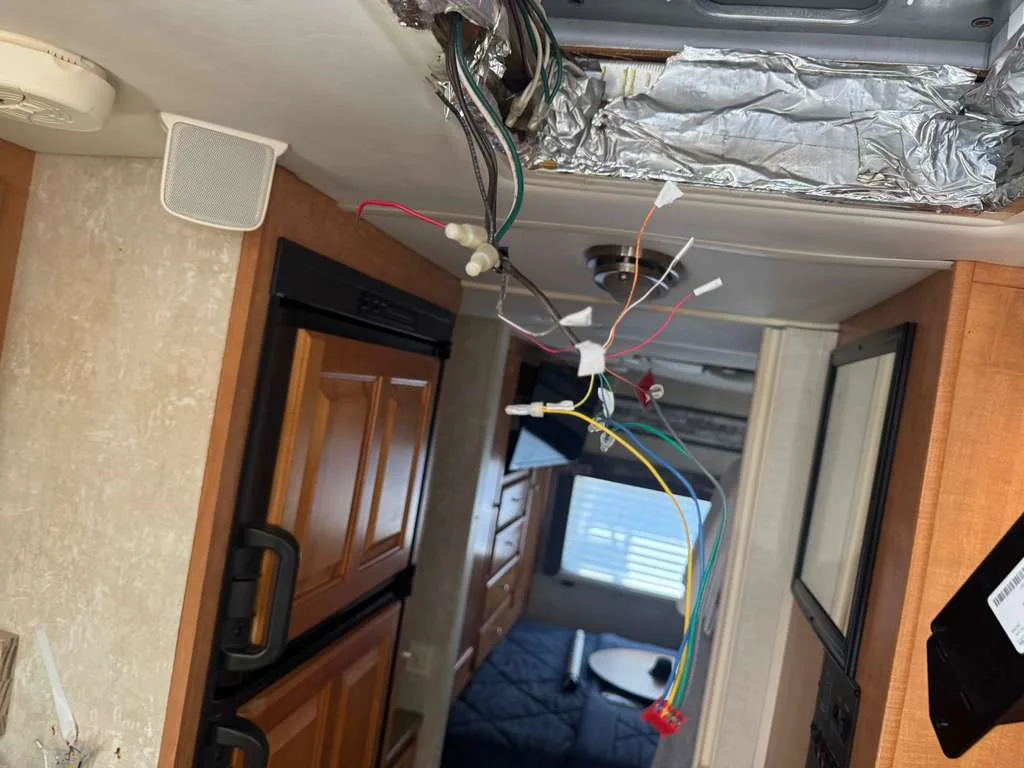
Electrical diagnosis is the clearest example. Finding out why a circuit is dead, why a converter has stopped charging or why a breaker trips under load needs a meter and someone who knows where to put it. The coach does not need to move an inch for any of that, and moving it would tell you nothing new.
The same holds for appliances, rooftop air conditioning, plumbing, sealant work and most slide-out and leveling faults. These are component-level jobs on a machine that is perfectly capable of sitting still while they happen.
Mobile is also better at intermittent faults, because the coach stays in the environment where the fault actually occurs rather than being tested somewhere else.
What does moving the coach really cost?
This is where most comparisons go wrong, because the hourly rate is compared and everything around it is ignored.
- Breaking camp: disconnecting utilities, packing, retracting slides and jacks, which is awkward when one of those is the fault.
- Fuel and the drive there, then the drive back once it is finished.
- Somewhere to sleep while the coach sits in a queue, which for a full-timer is not a small line.
- Site fees you keep paying at the park you left, or the cost of giving up the site entirely.
- The days themselves, since shops schedule in days and a coach dropped Tuesday may not be looked at until Friday.
Add those honestly and a mobile visit that looks dearer per hour usually finishes cheaper overall, and finishes the same week rather than the same month.
When is a shop genuinely the better answer?
When the repair needs a building rather than a technician. That is the test, and it is a genuinely clean one.
Anything requiring the coach lifted off its wheels, a paint booth, a frame jig, or a controlled environment for large scale structural work belongs in a facility with that equipment. So does major collision damage, chassis and drivetrain work, and full body panel replacement.
Large scale water damage sits right on the line. A single soft spot and a failed seal are mobile work. A floor rotted through several bays with mold behind the wall panels is a strip-out, and a strip-out in a Florida August wants a shed rather than a campsite.
Manufacturer warranty work is its own category. Where a manufacturer requires an authorized dealer to perform the repair, going elsewhere can cost you the coverage regardless of who does the better job.
How do I know which one my problem is?
Ask what the repair needs that is not a person, a tool or a part. If the answer is nothing, it is mobile work.
Height and lifting are the usual disqualifiers. So is any process that produces fumes, dust or noise a campground cannot host, or work that leaves the coach unusable overnight while you are living in it.
A reasonable technician will tell you this on the phone rather than after driving out, and it is fair to ask directly whether the job can be completed at your site. An honest no on the phone is worth more than a service call that ends in a referral.
If you genuinely cannot tell, a mobile diagnostic visit is usually the cheapest way to find out, because it produces a written finding you can take to whoever ends up doing the work.
Does mobile repair cost more per hour?
Sometimes, and where it does there is a real reason rather than a premium for convenience. A mobile rate carries a stocked service vehicle and the travel time between jobs, both of which a fixed shop does not pay for in the same way.
What that stock buys is first-visit completion. A van carrying capacitors, sealants, fittings, common motors and control boards fixes a fault the day it is diagnosed. A cheaper hourly rate from someone who has to leave and come back is not cheaper by the time the second visit is counted.
The other side of the comparison is that shop hours are not the whole shop bill either. Storage, shop supply charges and the days a coach sits waiting are real costs that do not appear on the hourly line.
Our page on what mobile RV repair costs in Florida sets out how the service call and parts actually fit together.
Can a mobile technician work at a campground or storage lot?
Usually, and it is worth checking before booking rather than after. Most Florida parks allow contractor work on a site, and many are used to it, but the rules vary and some restrict it to certain hours or require notice at the office.
Storage lots are more variable. Some allow work freely, some require the owner present, and a few prohibit contractors entirely. A quick call to the office answers it and prevents a wasted visit for everyone.
There are practical requirements too. A technician needs room to work around the coach, safe access to the roof if the job is up there, and in some cases power. A coach wedged between two others with no clearance limits what can be done regardless of permission.
Where a park does not permit it, meeting at a nearby lot is often the simplest answer.
Is mobile repair a good idea for a coach you are about to buy?
It is arguably the best use of a mobile technician there is, because the whole point of a pre-purchase inspection is to see the coach where it sits rather than after it is yours.
An inspection at the seller's location tests the coach in its actual state: whether the slides work, whether the roof has been maintained, whether the appliances run on both power sources, and whether there is moisture in places a walkthrough will never reveal.
It is also the one repair-adjacent spend that reliably pays for itself. Finding soft decking or a failed cooling unit before money changes hands either removes the coach from your list or moves the price, and both outcomes are worth more than the inspection cost.
Our RV pre-purchase inspection checklist covers what a thorough one actually includes.
What should you ask before booking a mobile technician?
Five questions, and the answers tell you most of what you need to know about who you are dealing with.
- Can this job actually be completed at my site, or will it end in a referral?
- What does the service call include, and what is quoted separately?
- Do you carry the likely parts, or will this need a second visit?
- Will I get the quote in writing before work goes past the included time?
- Do you work on my brand and system, and have you seen this fault before?
A technician who answers the first one honestly, including saying no, is the one worth booking. The willingness to turn down work that belongs in a shop is the clearest signal you will get about everything else.
What a visit costs
A service call is $299 and covers the trip out to your RV and the first hour on site. Work past that first hour is quoted to you once our technician has found the fault, before we carry on. In Orlando, Lakeland, Kissimmee, Apopka and nearby the service call is $399 and time past the first hour runs $200 per hour. Written estimates are free and you approve one before any work starts. Call 888-759-1438.
Sources and further reading
Every figure above that came from a manufacturer or a standards body is linked here so you can check it yourself.
- Lippert - master owner's manuals index - Identify the systems fitted to your coach, which decides whether a fault is component-level or structural.
- Dometic documents database - Model lookup for appliances, which is what lets a technician carry the right part to a first visit.
- US EPA - mold cleanup guidance - Why large scale mold remediation needs a controlled space rather than a campsite.
- OSHA - electrical hazards - The safety framework behind which electrical work is qualified-person work wherever it happens.
Related pages on this site
- All Apex RV Repair services - what a mobile technician can do at your site
- What mobile RV repair costs in Florida - how the service call, time and parts fit together
- RV pre-purchase inspection checklist - the highest-value mobile visit there is
- Full-time RV living in Florida - why moving the coach costs a full-timer more
- RV repair in Lakeland - coverage through the central Florida corridor
Questions owners ask before booking mobile RV service
Can a mobile technician do warranty work?
It depends on the manufacturer and the specific coverage. Some warranties require an authorized dealer to perform the repair, and having it done elsewhere can void that coverage. Check the terms before booking, because the cost of getting it wrong is far larger than the repair.
Do I need to be there for a mobile RV repair?
Often yes, at least at the start and the end, since you need to give access, approve the quote once the fault is found, and settle up. Some sites and storage lots also require the owner present as a condition of allowing contractor work at all.
How far will a mobile technician travel?
Coverage is set by the service area rather than by distance from any one address, and Apex works across Florida with a different rate through the busiest central corridor. The office confirms both coverage and price for your location when you book.
What if the technician cannot fix it on site?
You still pay for the visit, because the diagnosis is the work that was done. What you receive for it is a written finding identifying the fault, which is what a shop, an insurer or a buyer will want and which saves paying twice to diagnose the same problem.
Is mobile repair slower than a shop?
Almost always faster in elapsed time, which is the measure that matters. Shops schedule in days and work through a queue; a mobile visit is an appointment. The exception is a job needing a special order part, where the wait is the supplier rather than either kind of workshop.
Can two problems be fixed in one visit?
Frequently, and it is worth mentioning everything when you book rather than only the urgent item. Knowing about a second fault lets the technician carry the right parts, and doing both at once means paying for one trip instead of two.