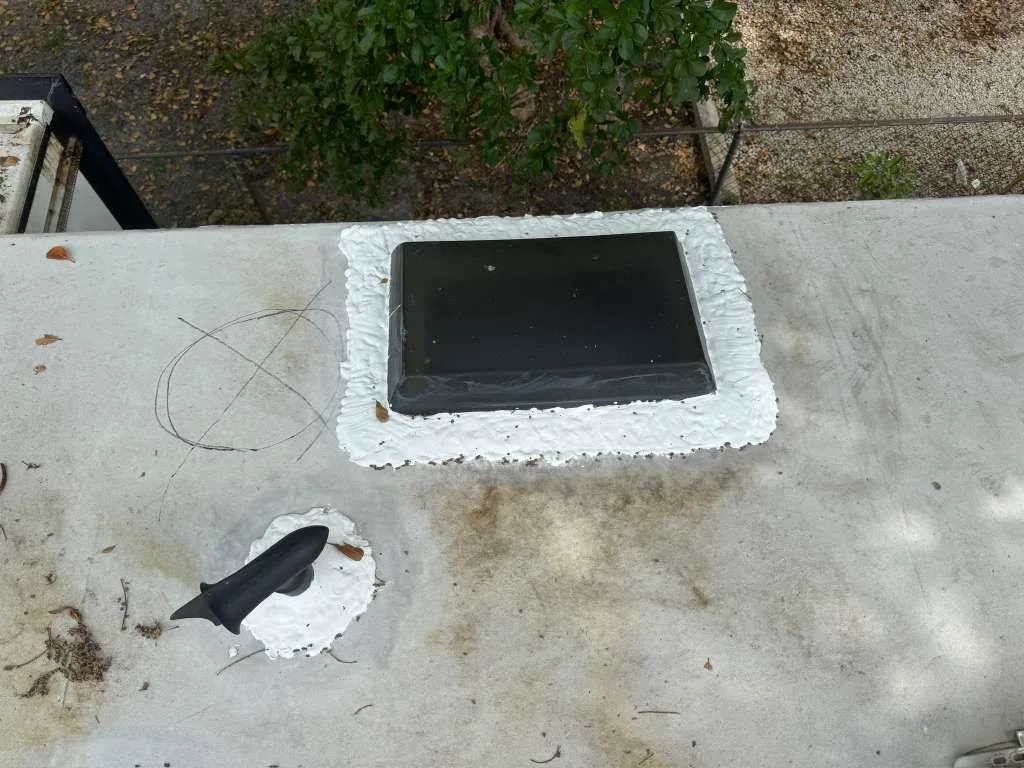
RV Roof Maintenance in Florida: What Actually Needs Doing
Which membrane you have, why sealing first is the wrong order, and how to check a reseal quote with a tape measure.
Survey before you seal. A fresh bead of lap sealant closes the exact termination that would have proved where the water is getting in, so sealing first destroys the evidence and can trap moisture inside the roof structure. Find out where water is entering and how far it has traveled, then seal. Doing it the other way round is the most expensive common mistake in RV roof work.
Apex RV Repair is mobile across Florida - we come to your RV. Call 888-759-1438.
Roof work is where Florida punishes an RV hardest. Sustained ultraviolet exposure, daily thermal cycling that moves every joint, and summer rain that arrives in volume rather than drizzle all attack the same thing: the sealed terminations where the membrane meets everything else.
The membrane itself rarely fails first. What fails is the sealant around a vent, a skylight, an air conditioner or the front and rear caps - and by the time it shows inside, the water has usually been traveling through the structure for a while.
How do I tell if my RV roof is EPDM, TPO or fiberglass?
It matters because the cleaners, sealants and coatings are not interchangeable, and using an EPDM product on a TPO roof or a petroleum-based cleaner on rubber does real damage.
| Material | How it looks and feels | What to know |
|---|---|---|
| EPDM rubber | Matte, slightly textured, usually dark gray or black underneath a white surface layer. Wiping it with a damp white cloth picks up a chalky residue. | That chalking is the membrane sacrificing its surface to UV, and it is normal rather than a fault. It is also why runoff streaks the sidewalls. |
| TPO | Brighter white, smoother, slightly shiny, and does not chalk onto a cloth. | Heat-weldable and generally more puncture-resistant, but it wants TPO-specific products. Many owners assume any white RV roof is rubber. |
| Fiberglass | Hard and rigid, taps solid rather than giving under a knuckle, often with a gelcoat sheen. | Does not chalk, but gelcoat oxidizes and crazes in Florida sun, and the sealed terminations still need exactly the same attention. |
If a wipe test is ambiguous, the coach's documentation or the manufacturer's build sheet will state it. Guessing and buying the wrong sealant is a costly way to find out.
Why does a moisture survey have to come before any resealing?
This is the point most worth taking away from this page, and it runs against instinct.
When a roof leaks, the useful information is the path: where water is entering, and how far through the structure it has already gone. That path is readable at the terminations - a lifted edge, a crack in a bead, a gap where a bead has pulled away from a flange - and readable with a moisture meter through the ceiling panel and walls.
It runs against instinct because the obvious response to a leak is to seal something, and sealing is exactly what destroys the evidence you need first. Every instinct on finding a wet ceiling says to get something waterproof over the roof before the next storm, and doing that is what turns a diagnosable leak into a guess.
What is the correct order for diagnosing and sealing an RV roof?
Running a fresh bead of self-leveling sealant over everything erases exactly that. The termination that was going to tell you where the water entered is now sealed and looks identical to the fifteen that were never leaking. Worse, if moisture is already inside the roof sandwich, you have just closed the last route it had to dry, and rot continues under a roof that now looks freshly maintained.
So the sequence is: survey, identify, open and dry what needs drying, repair the actual cause, then seal. A reseal is the last step of a roof job, not the whole job.
The path is the evidence. Lose it and the next person to look at this roof starts from nothing, on a coach that now looks freshly maintained from above and is still wet inside. That is a worse position than the owner started in.
How often does an RV roof need resealing in Florida?
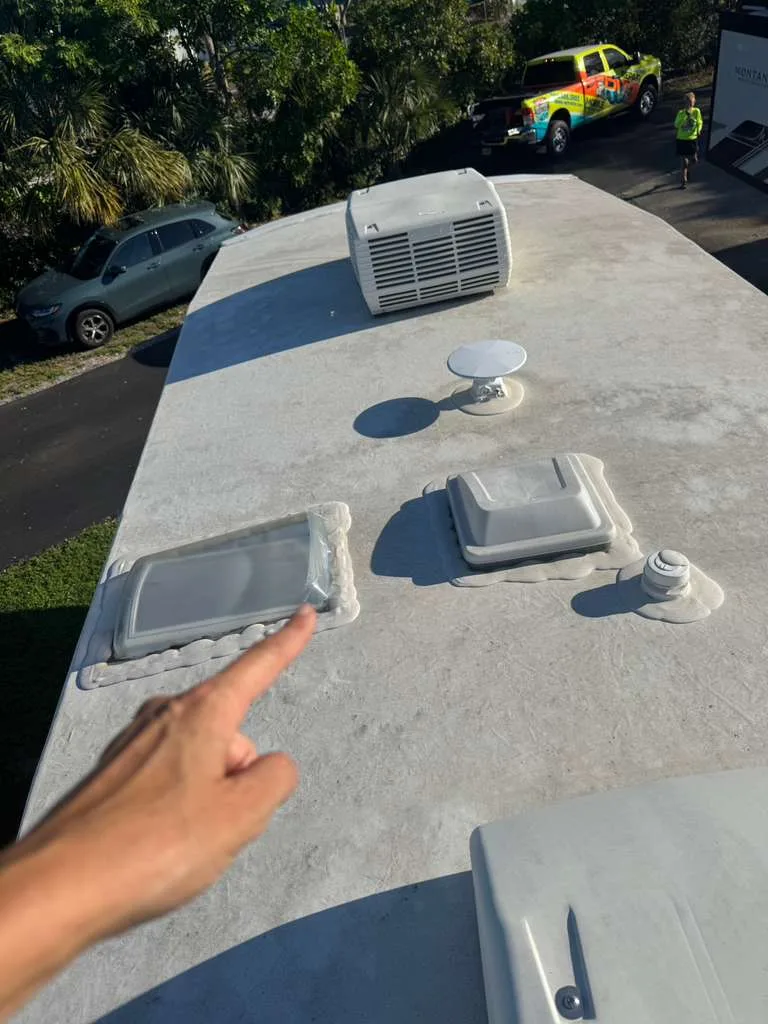
The honest answer is that intervals are a poor way to manage this, because two identical coaches age completely differently depending on how they are stored.
- A coach kept under cover or in a barn sees a fraction of the ultraviolet exposure and moves through a much smaller daily temperature swing. Its sealants last a long time.
- A coach parked in open Florida sun year-round is being cooked and cycled every single day. Its terminations are the ones that fail early.
- Coastal storage adds salt to the picture, which attacks fasteners and metal flanges under the sealant rather than the sealant itself.
A coach kept under cover and one parked in open sun year-round are not on the same clock at all, which is why a fixed interval either wastes money or arrives too late.
Which parts of a Florida RV roof deserve the most attention?
What works better than a calendar is a twice-yearly inspection with your eyes and a fingertip, done before and after the summer storm season. You are looking for beads that have cracked, hardened, lifted at an edge, pulled back from a flange, or gone chalky and brittle. Any of those is a termination that is no longer sealing, regardless of how recently it was done.
Two places deserve extra attention on a Florida coach: the front cap seam, which takes wind-driven rain at highway speed, and everything around the rooftop air conditioner, where a shroud that has become brittle in the sun is often the upstream cause of an electrical fault below it.
Check those two first on any Florida coach. They fail earlier than the rest of the roof and they are the two places where a failure puts water straight into the structure.
Self-leveling or non-sag - which sealant goes where?
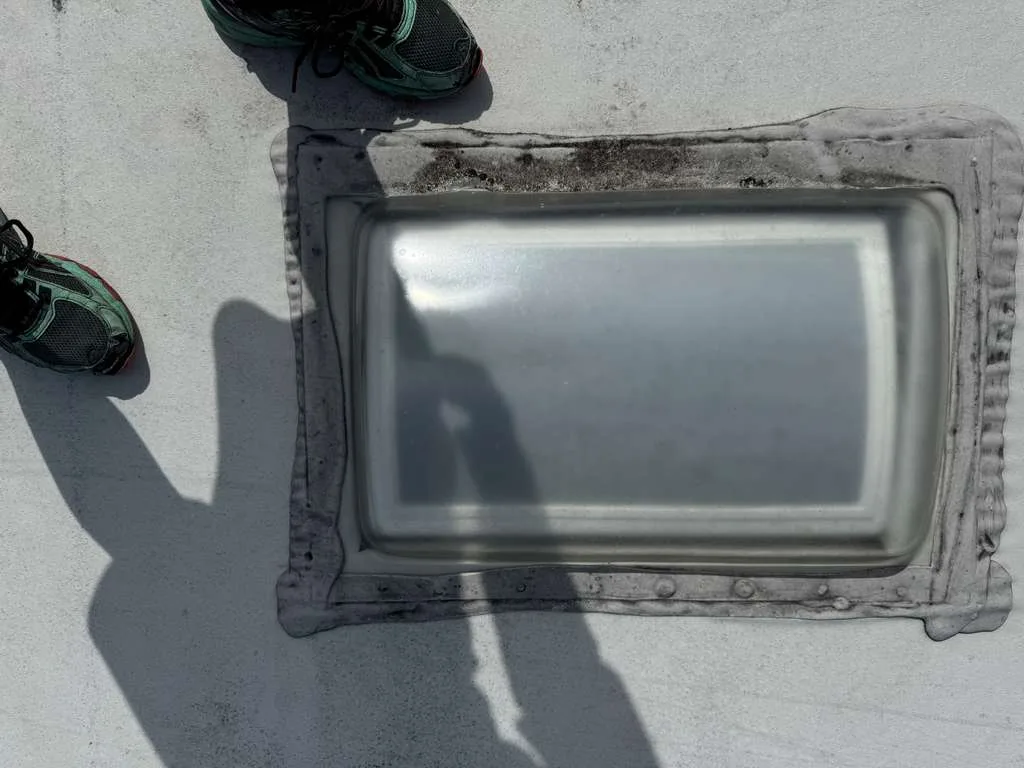
Two products, two jobs, and mixing them up produces a repair that fails within a season.
- Self-leveling sealant is for horizontal surfaces. It flows out and settles into the joint, which is what you want around a vent flange or a skylight on a flat roof. On anything vertical it simply runs.
- Non-sag sealant is for vertical and sloped surfaces - the sides of a front cap, an awning rail, a sidewall termination. It stays where it is placed and does not flow.
Getting this pair the wrong way round is one of the most common owner repairs we are called out to redo, and it usually fails within a single wet season. The two products look similar in the tube and behave completely differently once they are on a roof, which is exactly why the mistake is so easy to make and so expensive to leave.
What preparation does RV roof sealant actually need?
Both want the same preparation, and preparation is where most owner repairs go wrong. Sealant bonds to a clean, dry, sound surface. Applied over a chalky membrane, over old cracked sealant, or onto a surface still damp from a morning shower, it will lift at the edges within months - and it will have hidden the failed joint underneath in the meantime.
Dicor publishes application instructions for its roof products, including surface preparation and which product belongs on which surface. Reading them is ten minutes well spent before starting.
So preparation is not the boring part of the job before the real work. On a roof it is most of the reason the repair lasts, and it is what separates a bead still sound in three years from one that lifts at the first edge.
How do I know if a reseal quote is actually a reseal?
Here is an arithmetic check anyone can do with a tape measure, and it is the most practical consumer-protection tool on this page.
A genuine reseal covers every sealed termination on the roof, so start by measuring what that actually is:
- The perimeter of the roof itself - both long edges plus the front and rear cap seams.
- The perimeter of every roof penetration: each vent, the air conditioner, each skylight, the refrigerator vent, the antenna, the plumbing vents, any solar mount feet.
- Add them together. That is your linear footage of sealed joint.
On a mid-size trailer the total is far larger than people expect, because the penetrations add up fast even though each one is small. Then read the coverage figure printed on the sealant being used and divide. The result is roughly how many tubes the job needs.
What does a proper reseal actually involve on an RV roof?
Now compare that against the quote. A job quoted around a couple of tubes of sealant is a spot repair on specific terminations, which is a perfectly legitimate piece of work - but it is not a reseal, and it should not be priced or described as one. Asking a contractor how many linear feet they measured and how many tubes they have allowed is a fair question, and the answer tells you a great deal.
Ask for the scope in two parts
On any roof with suspected water intrusion, the honest structure of a quote is a fixed price for the work that can be seen plus a stated allowance for decking or framing found once a section is opened. Nobody can price hidden rot from the outside, and a single fixed number for a roof that has not been surveyed is either a guess or an upsell waiting to happen.
Can I walk on my RV roof?
Some are rated to walk on and some are not, and the coach's documentation states which. Even on a walkable roof there is a right way to do it.
The structure underneath is framing on regular centers with thin decking spanning between. Weight belongs over the framing, not in the middle of a bay, and it belongs spread rather than concentrated - which is why kneeling on a board beats standing on a heel.
Spread your weight over the framing rather than the middle of a bay, and work on a dry roof in the cool part of the day. Both matter more on an older coach, where the decking has already lost some of its stiffness and the framing is carrying more of the load than the sheet between it is. If you are not certain the roof is rated to take your weight, that is the point to stop.
How can you tell decking has gone soft before it fails?
Here is the diagnostic worth knowing. Decking that gives under firm palm pressure between the framing members is already compromised, even where the membrane above it looks perfect. Membrane is flexible and will bridge over softened decking for a long time before it shows any sign at all. That is why a roof can look fine from a ladder and still be structurally gone, and why a proper survey involves pressing rather than only looking.
If you are not certain your roof is rated for it, or the coach is older and has any leak history, that is a good reason to have someone else go up. A foot through soft decking turns a sealant job into a structural repair in one step.
A wet membrane is slippery and a hot one is soft enough to mark under a knee, so the same trip that was fine in the morning can damage the roof at two in the afternoon.
What does a soft spot mean, and can it be patched?
A soft spot means water has been in the roof sandwich long enough to degrade the decking. The membrane above it may be entirely intact, because the water usually arrived through a termination somewhere else and traveled.
The membrane above a soft spot is often perfectly intact, which is why owners find these by accident rather than by looking for them. Water reaches the decking through a termination somewhere else and then travels along the framing, so the damage and the entry point are rarely in the same place. That is also why a soft area found early is a manageable repair and the same area found two seasons later is not. The membrane is doing its job right up until the moment somebody presses on the roof and finds it moving underfoot, which is usually how this gets discovered at all.
Why does patching over a soft spot on an RV roof fail?
That travel is why patching over a soft spot fails. The wet area is rarely directly under the entry point, so a patch placed over the symptom leaves the actual entry open and seals moisture in. The repair has to start at the source and remove the affected decking, which means opening the membrane and knowing beforehand how far the damage extends - hence the survey.
The scope is genuinely hard to predict from outside, which is why the two-part quote above exists. What can be said is that a soft area caught early is a section repair, while one left for another season tends to reach the framing and the wall junction, and that is a different job entirely. Our RV roof repair and water damage pages cover both ends of that range.
What actually helps a roof survive Florida?
- Wash it. Removing chalked residue, tree debris and pollen is not cosmetic - organic debris holds water against terminations and is where a leak starts.
- Use a cleaner rated for your membrane. Petroleum-based products attack rubber roofs.
- Inspect terminations twice a year and treat any lifted or cracked bead as urgent rather than cosmetic.
- Keep the air conditioner shroud in good condition. A brittle, cracked shroud is a water path into an electrical box as well as a UV warning about everything else on the roof.
- Clear the roof before retracting slides or awnings, so debris is not dragged into a mechanism or a seal.
- Store under cover if you possibly can. Nothing else on this list comes close to the effect of keeping the sun off the roof.
None of that is expensive. All of it is cheaper than decking.
What a visit costs
A service call is $299 and covers the trip out to your RV and the first hour on site. Work past that first hour is quoted to you once our technician has found the fault, before we carry on. In Orlando, Lakeland, Kissimmee, Apopka and nearby the service call is $399 and time past the first hour runs $200 per hour. Written estimates are free and you approve one before any work starts. Call 888-759-1438.
Sources and further reading
Every figure above that came from a manufacturer or a standards body is linked here so you can check it yourself.
- Dicor - installation instructions for roof products - Manufacturer guidance on surface preparation and which sealant belongs on horizontal versus vertical surfaces.
- Dicor - self-leveling lap sealant - The product data for the sealant used around roof penetrations, including its stated coverage.
- Dicor - non-sag sealant - The vertical-surface counterpart, for cap seams and sidewall terminations.
- Dicor - roof sealant range - Useful for matching a product to your specific membrane rather than assuming all white roofs are the same.
Related pages on this site
- RV roof repair - surveys, termination resealing and section repairs
- RV water damage - what happens once water has reached the structure
- RV AC and heating - the rooftop unit and its shroud, gasket and roof opening
- Book a roof inspection - mobile across Florida
RV roof questions Florida owners ask
Can I put a roof coating over my old RV roof instead of resealing?
A coating can extend the life of a sound membrane, but it is not a substitute for repairing terminations and it must never go over an unresolved leak. Coating a roof with moisture already inside it seals the water in and hides the evidence, which is the same mistake as sealing before surveying, just at a larger scale and a higher price.
How do I find where my RV roof is leaking?
You look for the entry point rather than the wet spot, because water travels along framing before it appears inside. That means inspecting every sealed termination for cracks, lifting and separation, and using a moisture meter through the interior surfaces to map how far the wet area extends. The stain inside is the end of the trail, not the beginning.
Is a chalky white residue on my RV roof a problem?
On an EPDM rubber roof, no - that chalking is the membrane's designed response to ultraviolet exposure and it is why the sidewalls streak. What it does mean is that the surface is no longer a good bonding surface, so it must be cleaned properly before any sealant is applied over it.
How long does an RV roof membrane last in Florida?
Longer than the sealants around it, which is the point. Membranes generally outlive the terminations by years, so a roof's life is usually decided by whether those terminations were maintained rather than by the membrane itself. Storage matters more than age - covered storage roughly changes the conversation.
Do I need to reseal a fiberglass roof?
The membrane does not need sealing, but every penetration through it does, and those terminations fail the same way they do on rubber. Fiberglass owners sometimes skip roof inspections on the assumption that a hard roof does not leak. The vents, air conditioner and skylight are exactly as vulnerable.
Can you do roof work at my campground?
Inspections, moisture surveys, termination resealing and most repairs are mobile work done where the RV is parked, anywhere in Florida. Larger structural repairs where decking has to come out depend on what the survey finds and on the space available. Call 888-759-1438 and we will tell you honestly which one you are looking at.
The ceiling has a stain but the roof looks fine. What now?
That combination is normal and it does not mean the roof is fine. Water enters at a termination, runs along framing, and shows up somewhere else entirely. A visual roof check from a ladder cannot rule it out - it takes a moisture survey to find where the wet area actually is and where it starts.
Should I reseal before hurricane season or after?
Inspect before and after. Before, so that anything already lifting is fixed while the weather is dry enough for a sealant to bond properly. After, because wind-driven rain and debris find the weak terminations, and damage from a storm is far cheaper to catch in the following weeks than the following year.