Mobile RV Repair in St. Augustine, Florida
The oldest city in the country, and the appliance in your coach that works on a principle almost nobody has had explained to them.
The refrigerator in most RVs is not a small version of a domestic fridge. It is an absorption unit with no compressor and effectively no moving parts, cooling by driving a chemical cycle with heat rather than pumping refrigerant. That changes how it fails and how it should be diagnosed: silence is normal rather than a symptom, being level actually matters, and a dead cooling unit and a control fault need completely different responses.
We are mobile - we come to your RV in St. Augustine. Call 888-759-1438.
This is the appliance owners most often misdiagnose, because they are reasoning from the fridge in their kitchen and it works on a different principle entirely.
Ten minutes of understanding here is worth a great deal, because one of the two failure modes is cheap and the other is not.
How does an RV absorption refrigerator actually work?
It uses heat to drive a sealed chemical cycle rather than a compressor to pump refrigerant. A heat source - a propane flame or an electric element - boils an ammonia and water solution in the boiler at the back of the unit, and the resulting vapor travels through a sealed circuit of tubes where it condenses, evaporates and is reabsorbed, taking heat out of the cabinet as it goes. Three practical consequences follow. There is nothing to hear, so a silent fridge is a working fridge and silence tells you nothing. It is slow, because you are waiting on a thermal process rather than a pump, and several hours to reach temperature is normal rather than a fault. And because the cycle relies on liquid flowing by gravity through those tubes, the unit genuinely has to be reasonably level to work properly.
The Anastasia job: a Bounder with a dead cooling unit
A 2018 Fleetwood Bounder Classic at Anastasia State Park, reported as not cooling. The Dometic three-way unit had a failed cooling unit, so we fitted a rebuilt one and tested it on all three modes, and it was cold within four hours. Two things in that are worth drawing out. Testing on all three modes matters because a fridge can cool perfectly on propane and not at all on electric, or the reverse, and that pattern points at the heat source or its controls rather than at the sealed system - so a unit that fails on every mode is telling you the cooling unit itself has gone. And a rebuilt cooling unit is a real option rather than a compromise: on a coach of that age, replacing the sealed unit is a fraction of the cost of a new refrigerator and it is the same repair a dealer would carry out.
How do I tell a cooling unit failure from a control problem?
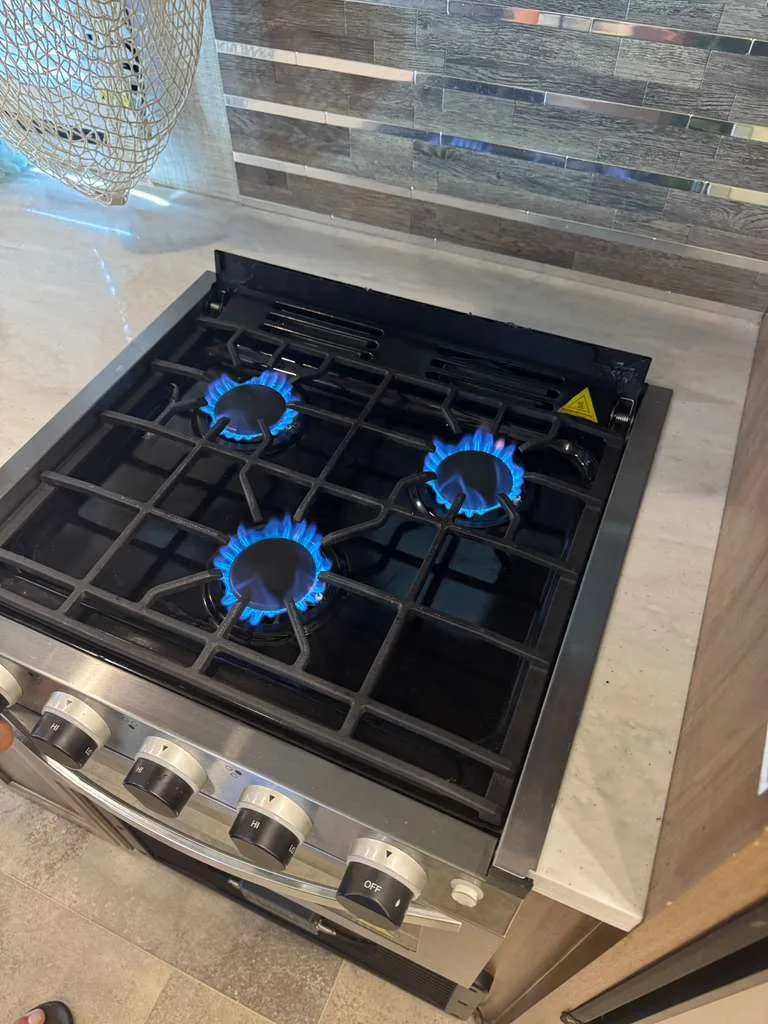
By testing each mode separately, and it is a test any owner can run before calling anyone. Put the fridge on propane and give it several hours, then on electric and give it the same. If it cools on one and not the other, the sealed cooling unit is fine and the problem is in that heat source or its controls - a gas supply issue, a dirty burner, an igniter, a failed element or a control board. Those are ordinary repairs. If it cools on neither, and there is no power or gas fault upstream, the cooling unit itself is the suspect and that is a much larger job. There is one more tell worth knowing: a strong ammonia smell or a yellowish residue at the back of the unit points to a leak in the sealed system, which is a definite cooling unit failure and a reason to stop using it.
Does the coach really have to be level for the fridge?
For extended periods, yes, and this is the maintenance point most owners have never been told. The cycle depends on liquid running through the tubes by gravity, so a unit left tilted for hours does not circulate properly, and liquid can pool where it should be flowing. Over time that is what damages a cooling unit from the inside - not a single afternoon on a slope, but repeated long periods parked out of level. Traveling is not the concern, because the coach is moving and the fluid sloshes around. Being parked overnight on a noticeable tilt is. The practical rule is to level for the site rather than for comfort: if the coffee cup slides, the fridge is unhappy too. On soft or sloping ground get the side-to-side correct with blocks under the tires first.
What maintenance does one of these actually need?
Airflow and burner cleanliness, and both are outside the fridge rather than inside it. The unit sheds its heat through a vented compartment on the outside wall, and that path has to stay clear - which in practice means the exterior vents, the space behind the fridge and the roof vent above it, all of which are magnets for wasp nests, spider webs and debris. A blocked vent is one of the most common causes of poor cooling and it costs nothing to fix. The propane burner needs cleaning periodically as well, because a burner producing a lazy yellow flame instead of a crisp blue one is not delivering the heat the cycle needs. Beyond that: check the door seal, do not overfill the cabinet so air cannot circulate, and let it reach temperature before loading it.
Where do people camp around St. Augustine?
Right in the city and just outside it, which is unusual and part of the appeal. Anastasia State Park sits on the island across from downtown and is oceanfront camping within reach of the historic district. Faver-Dykes State Park is south on Pellicer Creek and is a much quieter, smaller proposition. St. Augustine KOA Holiday is the commercial option inland. Florida State Parks publish that their full-facility campsites include water, electricity and a dump station as part of the campground, which covers both state parks. Book Anastasia early - Florida residents can reserve eleven months out and non-residents ten, and a site that close to the oldest city in the country is not a secret. Note that this is far enough north for winter freeze protection to be a genuine consideration on a stored coach.
Camping around St. Augustine
St. Johns County has an oceanfront state park in the city, a quieter one south on the creek and a commercial site inland.
What a visit costs in St. Augustine
The service call is $299 and covers the trip out to your RV and the first hour on site. Work past that first hour is quoted to you once our technician has found the fault, before we carry on. Written estimates are free and you approve one before any work starts. Call 888-759-1438.
Sources for the St. Augustine detail
- Norcold - RV refrigerator manuals - manuals for RV absorption refrigerators, covering operation and the failure modes above
- Anastasia State Park - the state's page for the oceanfront park across from downtown
- Faver-Dykes State Park - the quieter park south on Pellicer Creek
- Florida State Parks - RV camping - confirms full-facility campsites include water, electricity and a dump station
What St. Johns County owners book most
- RV appliance service - refrigerators, cooling units and control boards
- RV LP gas service - the propane side of a three-way fridge
- RV leveling systems - why being level matters to the fridge
- Winterization and storage prep - far enough north for freeze protection to count
St. Augustine and St. Johns County RV questions
My RV fridge makes no noise at all. Is it broken?
No - silence is normal. An absorption refrigerator has no compressor and effectively no moving parts, so there is nothing to hear. It cools by using heat to drive a sealed chemical cycle. Judge it by cabinet temperature after several hours, not by sound.
How long should it take to get cold?
Several hours, and that is not a fault. You are waiting on a thermal process rather than a pump, so plan on starting it well before you load it and before you travel. A fridge judged to have failed after ninety minutes is usually a fridge that was not given time.
How do I tell if it is the cooling unit or something cheaper?
Test each mode separately. Run it on propane for several hours, then on electric for the same. Cooling on one but not the other means the sealed unit is fine and the fault is in that heat source or its controls. Failing on both, with no power or gas problem upstream, points at the cooling unit itself.
There is a sharp smell and yellow residue behind the fridge. What is that?
That is the classic sign of an ammonia leak from the sealed cooling unit. It means the cooling unit has failed and it is a reason to stop using the appliance and ventilate the space rather than to keep testing it. Have it looked at rather than working around it.
Is a rebuilt cooling unit a reasonable repair?
Yes, and on an older coach it is usually the sensible one. It is a fraction of the cost of a new refrigerator and it is the same repair a dealer would carry out. Ask what warranty comes with the rebuilt unit, since that varies and it is the thing worth comparing.
Does being off level really damage the fridge?
Over time, yes. The cycle depends on liquid flowing by gravity, so long periods parked on a tilt stop it circulating properly and can damage the unit internally. Traveling is fine because the fluid moves around. Parking overnight on a noticeable slope is what to avoid.
My fridge cools poorly in hot weather. Is it failing?
Check the airflow first. The unit sheds heat through the exterior vents, the space behind it and the roof vent, and those are magnets for wasp nests, webs and debris. A blocked vent is one of the most common causes of poor cooling and clearing it costs nothing.
Do you work at Anastasia and the parks around the city?
Yes, plus the KOA and residential addresses across St. Johns County. Give us the site number when you book and check whether the park wants contractors to sign in at the entrance station. Travel is inside the service call, so a park site and a driveway cost the same to reach.